
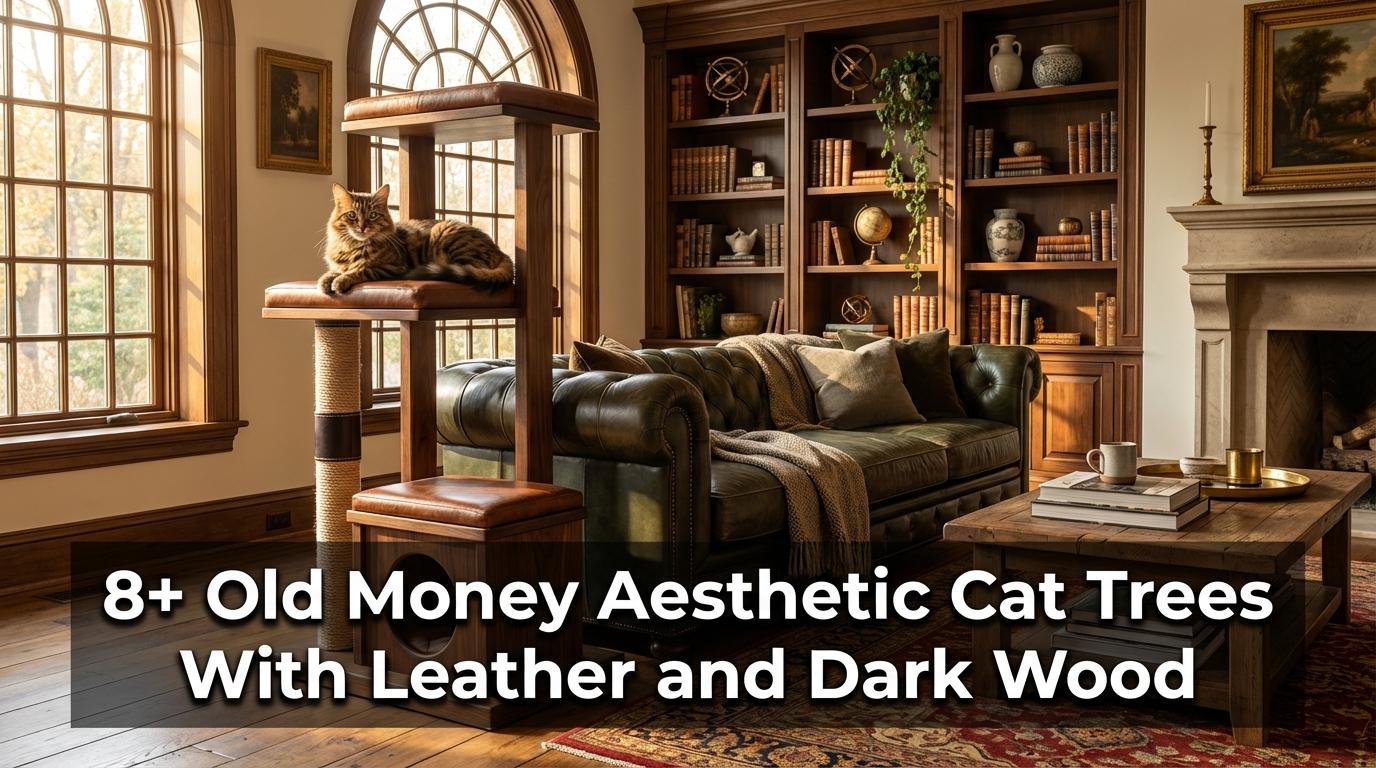
Old money aesthetic cat trees built with dark wood tones and leather details are the fastest way to make your cat’s furniture look like it was always part of your home — not bolted on as an afterthought. We’re talking deep walnut stains, brass hardware, tufted cushions, and the kind of rich textures you’d expect in a private library or a well-appointed smoking lounge. And the best part? Most of the materials — dark wood stain, leather cord, brass cabinet pulls — run between $8 and $25 on Amazon, which means the look is wildly more accessible than it appears.
Below, you’ll find 8+ ideas that blend genuine old money design principles with functional cat furniture your pets will actually use. Each one includes a step-by-step breakdown covering materials, construction tips, and the specific finishing details that sell the whole aesthetic. Some are full builds from scratch, others are clever modifications to existing pieces, and a few are the kind of styling tricks that make a $40 cat tree look like it cost ten times that.
Whether you’re starting with raw lumber or transforming something you already own, every idea here earns its place in a room designed for adults who happen to share their space with cats. Let’s get into it.
1. The Library Ladder Cat Tree That Looks Like It Belongs in a Manor House
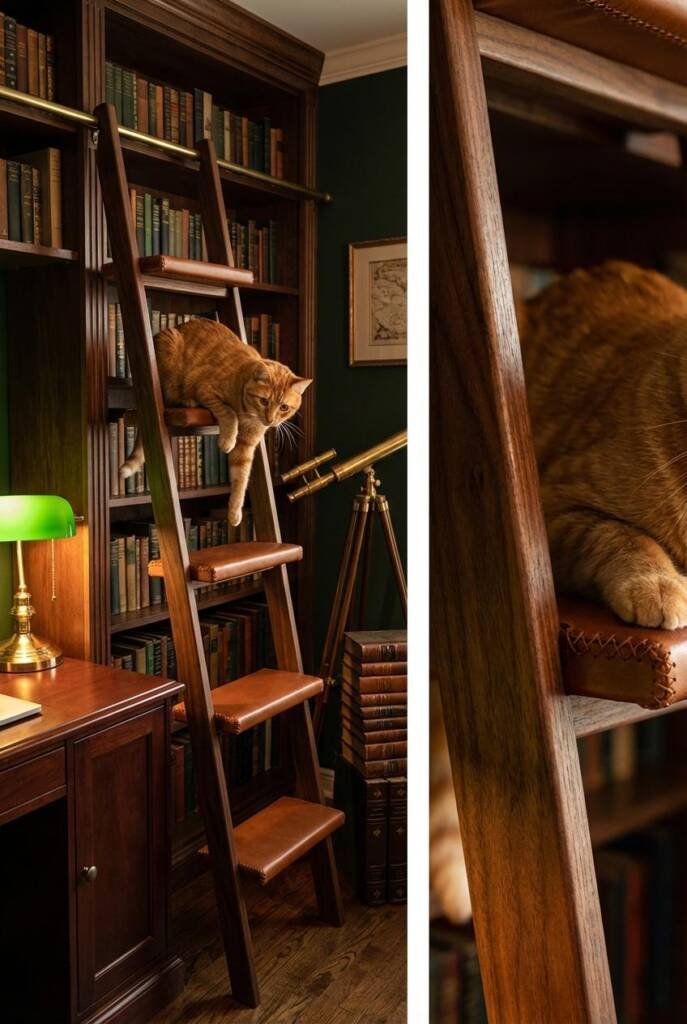
Your cat deserves a climbing wall that looks like it came with the estate.
A ladder-style cat tree in dark walnut finish is the closest thing to old money furniture your cat will ever climb. The design borrows directly from the rolling library ladders you see in manor house studies — tall, narrow, leaning against a wall with evenly spaced rungs and platforms. When those perches are wrapped in rich brown or cognac leather (or a convincing faux), the whole piece reads as intentional decor rather than pet equipment. Placed next to a tall bookshelf or in a reading nook, it looks like it’s always been there.
Cats love vertical climbing paths, and a ladder format gives them exactly that — a clear upward route with resting spots at each level. The narrow footprint means it works even in apartments where a bulky cat tree would dominate the room. Look for a leaning wall-mounted cat ladder with 4-5 platforms in a dark wood or espresso finish — a quick Amazon search turns up options for $60–$120 depending on size and material. From there, you can add your own leather or faux-leather cushion covers to the platforms for that estate-library polish.
How to Choose a Library-Inspired Ladder Cat Tree That Actually Looks Expensive
- Pick the right frame: Choose a wall-leaning cat ladder in dark walnut, espresso, or mahogany finish, at least 60 inches tall so it gives your cat real vertical range. You can find these on Amazon for around $70–$110.
- Wrap the perches in leather: Grab a set of faux-leather fabric remnants on Amazon for ~$15 and cut pieces to fit each platform, securing them with upholstery tacks or adhesive for a clean, tailored look.
- Anchor it properly: Use L-brackets (available on Amazon for roughly $8) to secure the top of the ladder to your wall — this prevents tipping and lets your cat launch off the top perch without drama.
- Style the surrounding wall: Hang a vintage-style framed print or a brass wall sconce next to the ladder so it blends into a curated gallery moment rather than standing alone as ‘the cat thing.’
- Budget move: You can build this entire look for under $100 on Amazon — a dark wood cat ladder for ~$75, faux-leather fabric for $15, and mounting brackets for $8.
2. Dark-Stained Barrister Cat Tower With Brass Rail Details
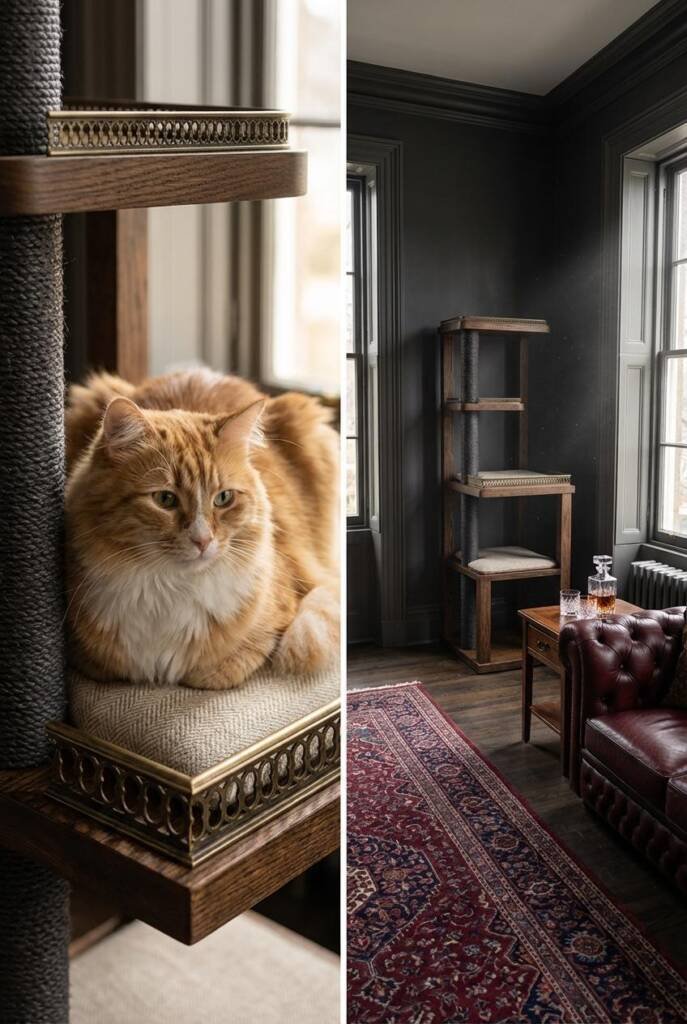
Your attorney’s bookcase just got a feline promotion.
Think of those stately barrister bookcases in a law office — stacked cubbies with brass rails across each shelf — then reimagine it as a cat tower. That’s the energy here. A dark-stained oak frame with open cubbies (no glass panels, obviously) gives your cat multiple perching and napping levels, while slim brass rails along each tier keep the old money aesthetic unmistakable. The whole piece reads like heirloom furniture, not pet furniture.
Cats love cubbies because they mimic enclosed dens, so the barrister layout is actually ideal — each compartment becomes a private hideaway or a lookout post. Start with a tall, narrow bookcase in a dark finish (you can find solid wood ones on Amazon for around $120–$180) and add brass gallery rails to each shelf. A set of four brass shelf rails runs roughly $25–$35 on Amazon, and they install with simple screws. Line the shelves with removable carpet tiles or sisal mats so your cat gets traction without ruining the wood.
How to Find a Barrister-Style Cat Tower With Real Brass Hardware
- Choose the Right Frame: Look for a tall, narrow bookcase (roughly 60–72 inches high, 24 inches wide) in a dark walnut or espresso finish. Solid wood options are available on Amazon for $120–$180.
- Install Brass Gallery Rails: Attach a brass gallery rail across the front of each shelf, leaving a 6-inch opening on one side for your cat to enter. A set of four rails runs about $25–$35 on Amazon.
- Add Traction to Each Level: Cut self-adhesive carpet tiles or sisal mats to fit each shelf — grab a pack of peel-and-stick carpet squares on Amazon for around $20.
- Anchor It Securely: Use a furniture anti-tip strap kit (under $10 on Amazon) to bolt the tower to the wall — non-negotiable with a tall, narrow piece like this.
- Budget move: You can build the full barrister cat tower for under $175 total by sourcing everything from Amazon — the bookcase, brass rails, carpet tiles, and anti-tip hardware.
3. The Tufted Chesterfield Cat Perch Your Guests Won’t Believe Is for Cats
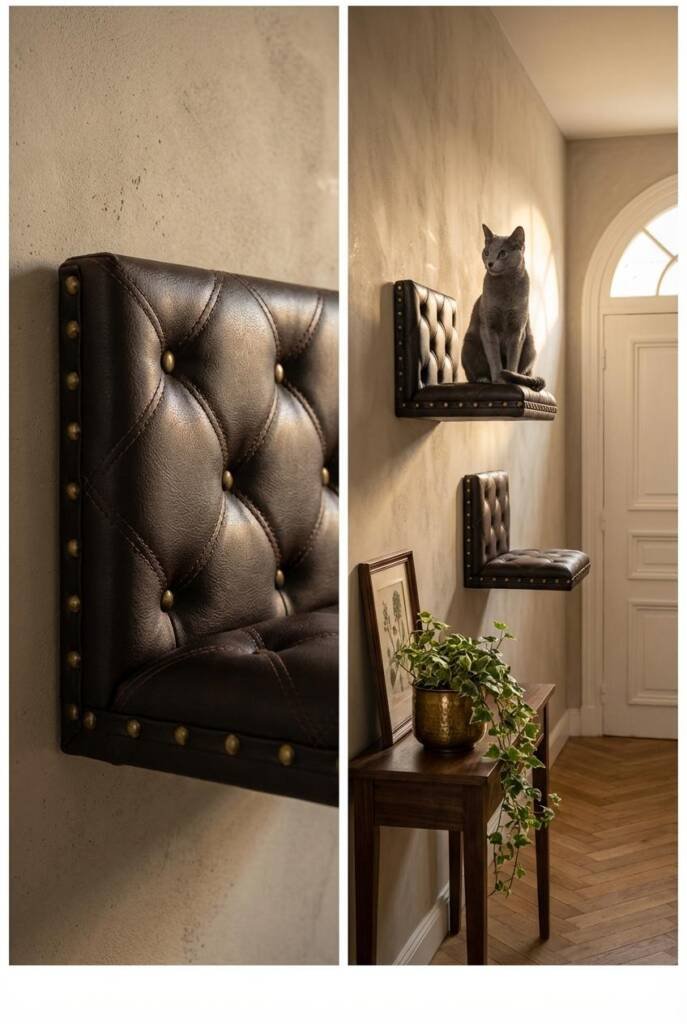
Your cat deserves a gentleman’s club perch, and your wall has the square footage to spare.
Picture a slice of a chesterfield sofa — diamond-tufted, nailhead-trimmed, upholstered in rich espresso faux leather — mounted to your wall at cat height. That’s this perch. It reads like a fragment of antique furniture that somehow floated off the floor, and guests will genuinely do a double-take before they realize your cat is the one lounging on it. The old money aesthetic hits different when it’s functional for your pet and decorative for your living room simultaneously.
Cats love elevated perches because height equals security, and a sturdy wall-mounted shelf gives them exactly that without eating up floor space. Start with a solid wood wall-mounted cat shelf — you can find these on Amazon for around $35–$50 — then upholster the platform yourself with tufted faux leather. A roll of espresso faux leather upholstery fabric runs roughly $15–$20 on Amazon, and a box of antique brass upholstery nailhead trim costs about $8. The diamond tufting is easier than it looks: you’re pulling fabric through pre-marked points and securing buttons from underneath. The result is a perch that belongs in a private library, not a pet store.
How to Install a Tufted Leather Wall-Mounted Cat Perch That Screams Old Money
- Mount a sturdy shelf: Install a wall-mounted cat shelf rated for at least 20 lbs, anchoring into studs with 3-inch lag bolts. Solid wood shelves in walnut or espresso finish start at ~$40 on Amazon.
- Cut and pad the platform: Cut a piece of 1-inch high-density upholstery foam to match your shelf dimensions — a quick Amazon search turns up sheets for $12–$18 — and adhere it with spray adhesive.
- Tufted faux leather wrap: Lay espresso faux leather over the foam, mark a diamond grid at 3-inch intervals, pull fabric through each point with a button and secure underneath with a staple gun. Trim excess fabric flush with the shelf edges.
- Add nailhead trim: Press a strip of antique brass decorative nailhead trim along all four edges to hide staples and complete the chesterfield look.
- Budget move: The full build runs under $75 with everything sourced from Amazon — shelf (~$40), faux leather and foam (~$25), and nailhead trim (~$8).
4. A Gentleman’s Club Cat Condo Hidden Inside a Bar Cabinet
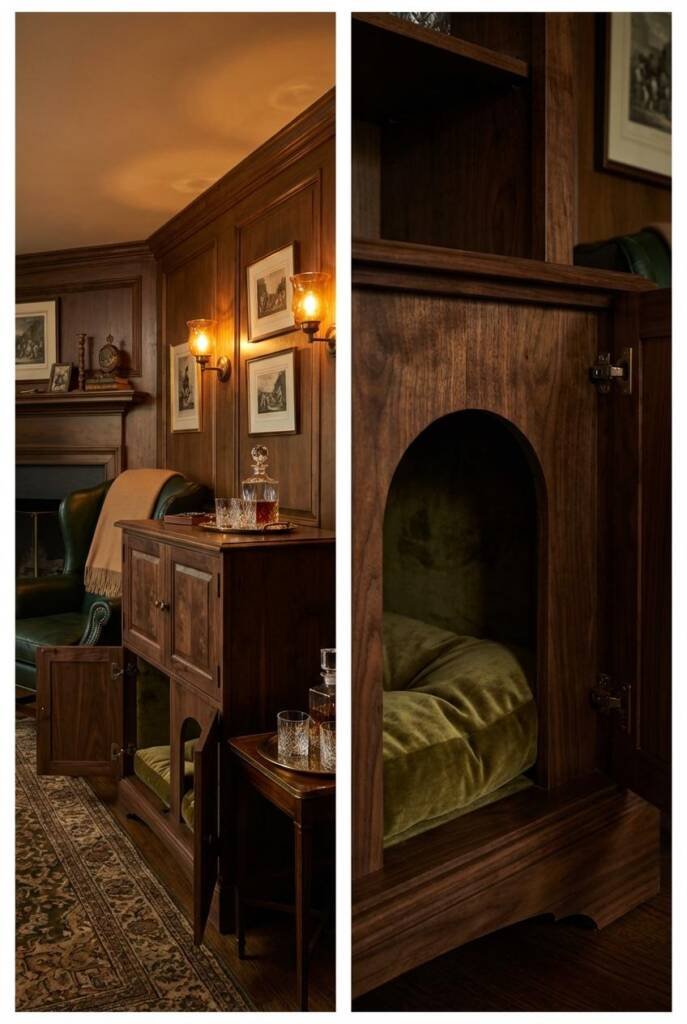
Your cat doesn’t need a cocktail, but they absolutely deserve the cabinet.
A dark wood bar cabinet with paneled doors is already dripping with gentleman’s club energy — the kind of piece that looks like it belongs in a leather-and-mahogany study. Now imagine opening those doors to reveal not cocktail glasses, but a plush cat hideaway lined in velvet-look fabric. Closed, it’s a stunning piece of old money furniture. Open, your cat is curled up inside like the pampered aristocrat they clearly believe they are.
Cats are hardwired to seek enclosed, dark spaces — it makes them feel safe and reduces stress. A bar cabinet with solid doors gives them exactly that, while keeping the cat condo furniture completely invisible when guests come over. Line the interior with a self-warming pet mat (you can find these on Amazon for ~$15) and add a small cushion, and your cat won’t want to leave. The shelf inside doubles as a second level if your cat likes to perch up high within their den.
How to Convert a Dark Wood Bar Cabinet Into a Secret Old Money Cat Condo
- Find Your Cabinet: Look for a vintage-style bar cabinet in dark walnut or mahogany finish, at least 24″ wide and 18″ deep so your cat has room to turn around. Reproduction styles run about $120–$180 on Amazon.
- Remove and Refit the Interior: Pull out any glass racks or wine holders. Sand down sharp edges and line the bottom and back panel with a peel-and-stick felt liner — grab a roll on Amazon for around $10.
- Add the Comfort Layer: Place a self-warming cat mat on the bottom shelf and a washable cushion insert on the top shelf. Both together cost roughly $30 on Amazon.
- Install Ventilation if Needed: If the cabinet doors seal tightly, drill three 1.5″ holes in the back panel or leave one door slightly ajar with a small magnetic door stop (~$5 on Amazon).
- Budget move: You can pull this entire conversion together for under $60 in materials from Amazon if you already own the cabinet — or under $220 total including a reproduction bar cabinet for around $150.
5. Dark Walnut Cat Shelves Arranged Like a Gallery Wall Staircase
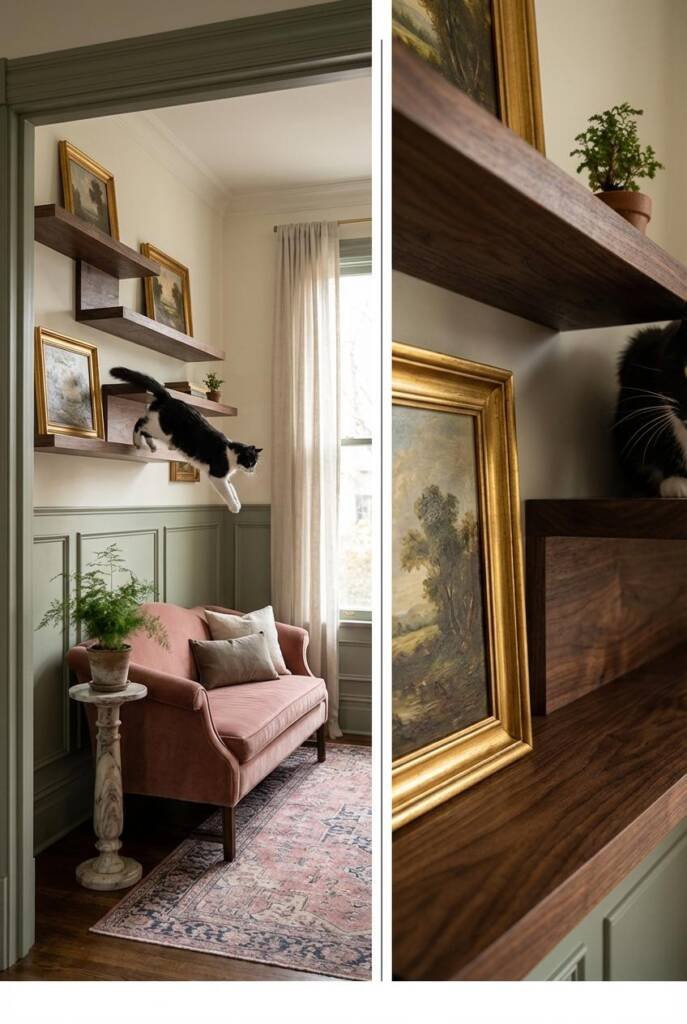
Your cat wants to climb the walls — so give them a wall worth climbing.
Floating cat shelves in a deep walnut finish, staggered diagonally up a wall like a staircase, instantly read as intentional architecture — not pet furniture. Intersperse them with framed oil-style portraits (landscapes, hunting dogs, the cat herself if you’re feeling bold), and the whole arrangement becomes a gallery wall that doubles as a vertical climbing path. This is old money aesthetic meets functional cat tree, and it looks like something out of an English country house.
Cats naturally want to climb and survey from height, so a staircase formation gives them exactly that while keeping your floor space clear. Look for floating cat shelves in a dark walnut or espresso finish with a carpeted or sisal-wrapped top surface — you can find sets of two or three on Amazon for roughly $40–$65. Pair them with gold-framed art prints, which a quick Amazon search turns up for $15–$25 per set, and the wall goes from blank to breathtaking.
How to Create an Old Money Gallery Wall With Built-In Cat Climbing Shelves
- Plan the staircase layout: Map out a diagonal path ascending left to right (or right to left) with shelves spaced about 12–16 inches apart vertically and 14–18 inches horizontally. Use painter’s tape to mock it up before drilling.
- Install the shelves into studs: Mount each floating cat shelf directly into wall studs using the included hardware — if you miss a stud, heavy-duty toggle bolts rated for 50+ lbs (available on Amazon for around $8) are non-negotiable for safety.
- Fill the gaps with framed art: Hang gold or antiqued-bronze framed prints between the shelves to create the gallery wall effect. Oil-style landscape prints in 8×10 or 11×14 sizes work best for scale.
- Add a landing shelf at the top: Finish with a wider shelf (at least 18 inches long) at the highest point so your cat has a comfortable perch to lounge on once they’ve made the climb.
- Budget move: You can build the entire gallery wall cat staircase for under $100 from Amazon — a set of three floating shelves for ~$55 and a framed print set for around $20.
6. Sisal Scratching Posts Wrapped in Dark Leather Cord — The Upgrade Nobody Talks About
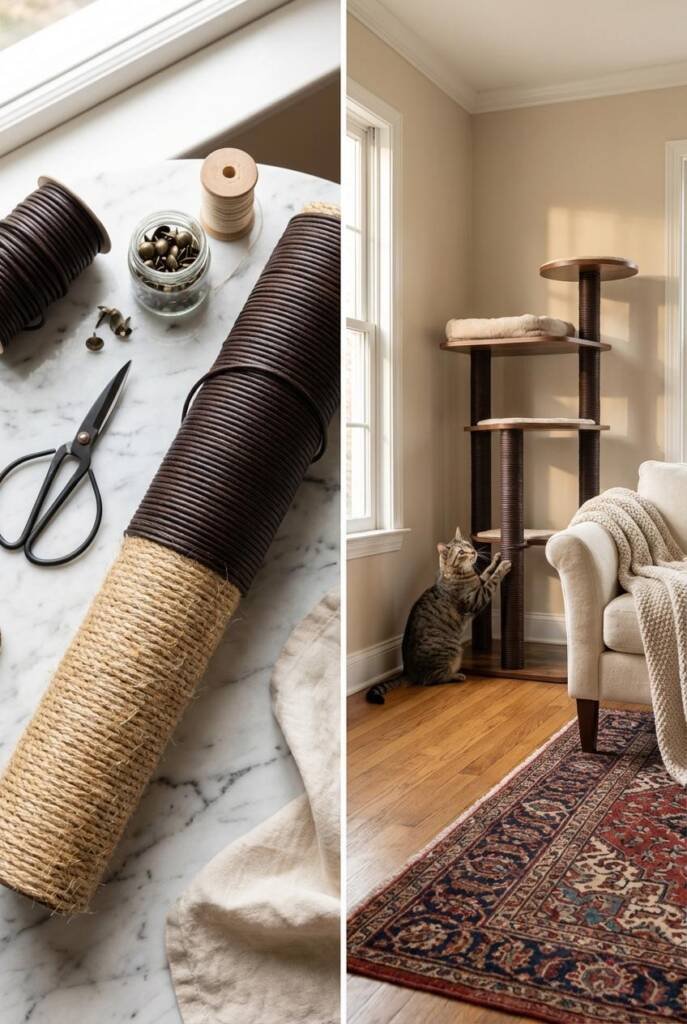
That beige sisal rope is doing your entire room dirty — here’s the 30-minute fix.
Standard sisal rope is the beige sweatpants of cat furniture — functional, forgettable, and screaming “I gave up.” Dark leather-look cord changes everything. Swap those fuzzy tan posts for tightly wrapped dark brown or black faux leather cord, and suddenly your cat tree looks like it belongs in a library with mahogany bookshelves and a globe bar. The texture reads rich, the color anchors the piece, and nobody will guess you did it yourself on a Saturday afternoon.
Cats don’t care about aesthetics, but they do care about grip — and faux leather cord with a woven or braided texture gives them plenty of traction to dig their claws into. You want a braided faux leather rope in the 5–6mm thickness range; a quick Amazon search turns up options for $12–$18 per 50-yard spool. One spool typically covers two standard 18-inch posts. For extra durability, layer a coat of non-toxic clear sealant over the finished wrap so it holds up to enthusiastic scratching sessions.
How to Re-Wrap Your Cat Tree Posts With Dark Leather-Look Cord for a Luxe Finish
- Remove the old sisal: Use a utility knife to cut away existing sisal rope, then clean the post with a damp cloth. Most posts are cardboard tubes or PVC pipes around 3–4 inches in diameter.
- Anchor the new cord: Hot-glue the end of your dark faux leather cord to the base of the post and begin wrapping tightly upward, adding a line of glue every 5–6 wraps to keep tension.
- Finish and seal the top: When you reach the top, tuck the cord end under the last wrap and secure with glue. Apply a non-toxic clear sealant — available on Amazon for around $10 — to protect against claw wear.
- Test before full commitment: Wrap one post first and let your cat test it for 48 hours. If they take to it, do the rest; if not, the braided texture can be roughed up lightly with sandpaper for better grip.
- Budget move: Two spools of faux leather cord and a bottle of sealant from Amazon run under $35 total — a full cat tree transformation for the price of a mediocre lunch.
7. An Heirloom-Style Cat Tree With Turned Spindle Legs and Velvet Cushions
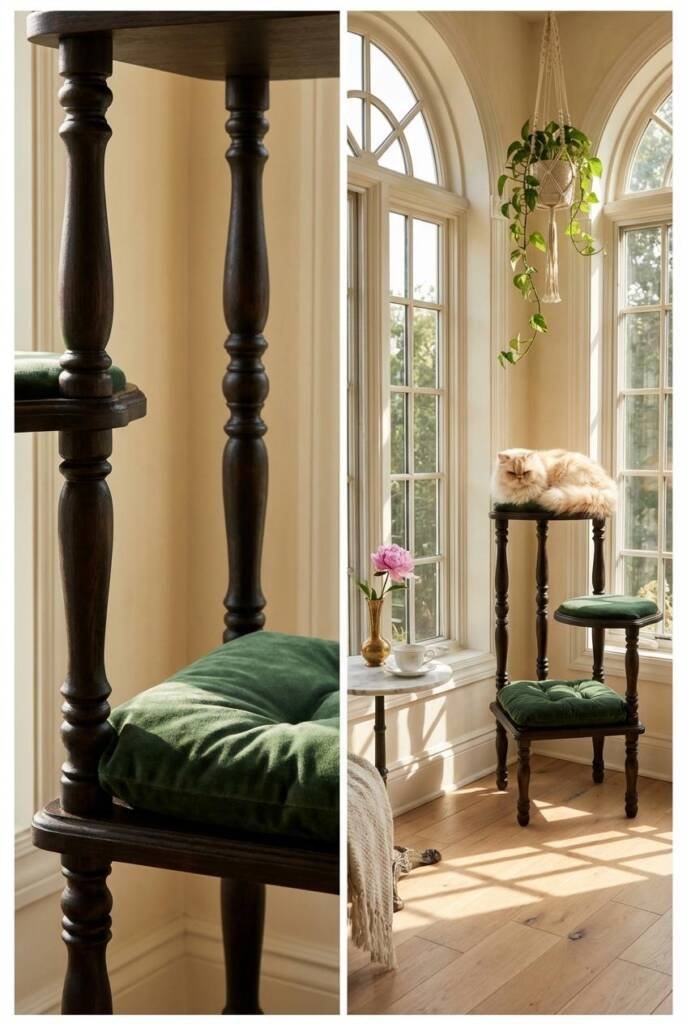
Your guests will compliment the antique plant stand before they realize your cat lives on it.
A cat tree with turned spindle legs and tiered velvet cushions doesn’t read as pet furniture — it reads as a Victorian plant stand that wandered out of a Downton Abbey set. The spindle detailing gives it that handcrafted, heirloom weight that flat-pack cat towers simply can’t replicate, and when you layer in deep jewel-toned velvet (think emerald, burgundy, or midnight navy), the whole piece anchors a room the way real antique furniture does.
Cats love the vertical stacking of cushion tiers because it mimics the elevated perching spots they’d choose naturally, and the velvet gives them a warm, textured surface to knead. Look for a multi-tier wooden cat tower with spindle-style posts. Choose one with removable cushion covers so you can swap or wash them without dismantling the whole structure. If the stock cushions aren’t velvet, that’s an easy fix: a set of round velvet pillow covers in 14–16 inch sizes runs under $15 on Amazon, and they slip right over existing pads.
How to Find a Turned Spindle Cat Tree That Passes for Antique Furniture
- Start with the right frame: Search for a multi-tier wooden cat tree or cat tower with spindle or turned-leg detailing. Darker finishes like walnut or espresso sell the old money look instantly.
- Upgrade to velvet cushions: Replace any stock fabric with round velvet cushion covers (14–16 inches). Grab a set on Amazon for around $12–$15 and pick a jewel tone that contrasts the wood.
- Wrap the posts in natural sisal: If any posts are carpet-covered, re-wrap them with a roll of natural sisal rope — available on Amazon for ~$10 for a 100-foot roll. It blends with the antique aesthetic and doubles as a scratch surface.
- Style the surrounding space: Place the tree next to a real piece of dark wood furniture — a side table or bookcase — so it looks intentional rather than isolated. A small brass picture frame or stacked vintage books nearby seals the vibe.
8. The Smoke-and-Mirrors Trick: Dark Wood Cat Tree Stained to Match Your Existing Furniture
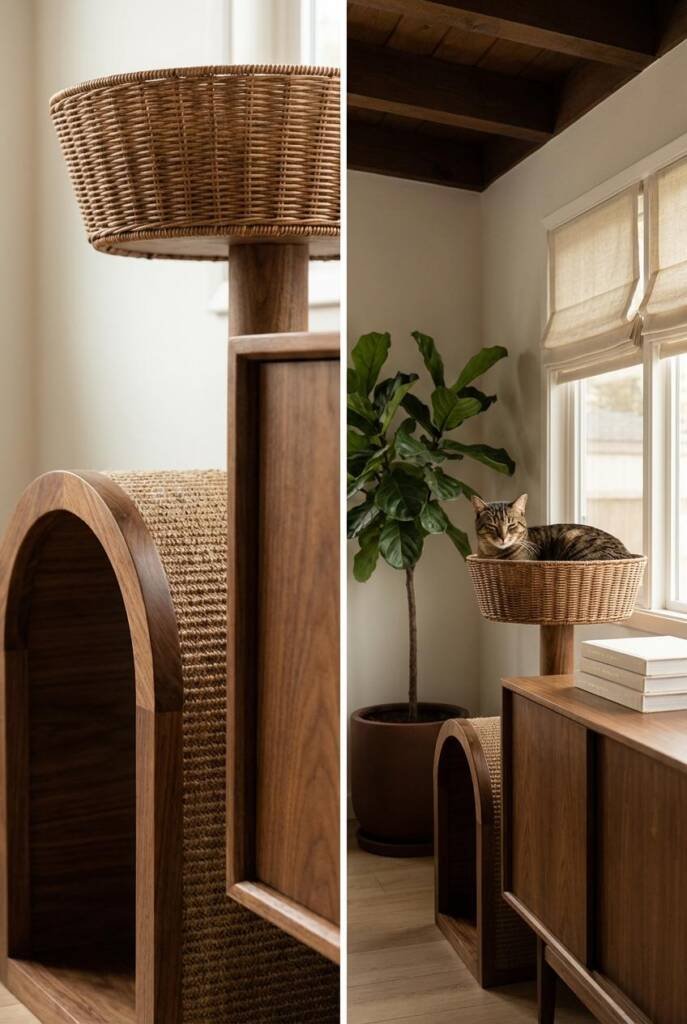
Your cat tree shouldn’t be the thing that breaks the spell — make it vanish into the room instead.
The fastest way to make a cat tree look like it belongs in your old money aesthetic room? Stain it to match the furniture that’s already there. An unfinished wooden cat tree becomes virtually invisible when it shares the same mahogany, espresso, or walnut tone as your bookcase or console table. Instead of a cat tree that screams “pet owner,” you get a piece that looks like it was commissioned alongside the rest of your collection. Guests won’t clock it until your cat leaps onto it mid-conversation.
Cats don’t care about color — they care about height, stability, and texture. An unfinished solid wood cat tree gives you all three, plus a blank canvas. You can find unfinished wooden cat trees on Amazon for roughly $60–$120, and they typically come with platforms at varying heights that cats genuinely love. Pair one with a can of gel stain in your target shade, and you’ve got something that looks custom without the custom price tag. The gel formula sits on top of the wood rather than soaking in unevenly, so even beginners get professional-looking results on the first try.
How to Stain an Unfinished Cat Tree to Match Your Dark Wood Furniture Perfectly
- Identify your target shade: Hold a paint swatch or wood sample from your existing furniture against options at the store, or order a gel stain sample kit — available on Amazon for around $12–$18. Walnut and dark mahogany are the most common old money tones.
- Prep and sand the cat tree: Lightly sand every surface with 220-grit sandpaper to open the grain. Wipe it down with a tack cloth so the stain adheres cleanly.
- Apply gel stain in thin coats: Use a lint-free cloth to apply one thin coat, wait 8–12 hours, then assess. Two coats usually nail the depth of color you’re after. A quart of gel stain runs under $15 on Amazon.
- Seal and cure: Finish with a coat of polyurethane in a satin sheen — grab one on Amazon for about $10 — and let it cure for 48 hours before letting your cat use it. Satin keeps the look muted and expensive.
- Budget move: The full project runs under $100 on Amazon — an unfinished cat tree for ~$70, gel stain for $15, and polyurethane for $10.
9. A Four-Poster Cat Canopy Bed That’s Giving Downton Abbey Energy
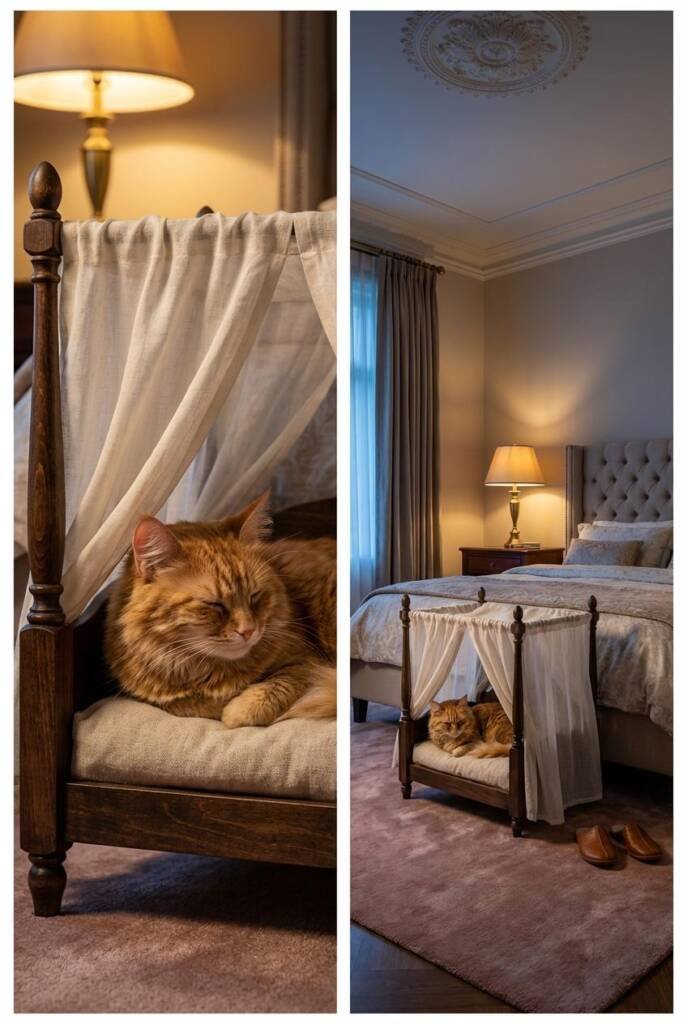
Your cat doesn’t just deserve a bed — they deserve a four-poster with a canopy and full period-drama energy.
A miniature four-poster cat bed in dark stained wood with a draped linen canopy is the most absurdly elegant thing you can do for your cat’s sleeping situation — and it looks incredible in a living room corner or bedroom nook. The verticality of the posts draws the eye up, the draping softens the lines, and the whole thing reads like a piece of heirloom furniture rather than pet gear. It’s Downton Abbey energy, distilled into something your cat will actually use. Cats gravitate toward enclosed, elevated sleeping spots, and a canopy bed delivers both the cozy cave feeling and the slight elevation they prefer.
How to Style a Four-Poster Canopy Cat Bed for Maximum Old Money Impact
- Choose the right bed frame: Look for a four-poster pet bed in espresso or walnut-stained wood, at least 20″ long for most cats. A quick Amazon search turns up solid options for $55–$90.
- Add the canopy draping: Use a yard of natural linen or lightweight muslin (~$8–$12 on Amazon) draped loosely across the top posts and pinned with small upholstery tacks for a soft, lived-in look.
- Upgrade the cushion: Swap the stock pad for a velvet or linen cushion cover in cream, sage, or dusty rose — grab a set on Amazon for under $15.
- Ground it with placement: Position the bed on a small dark-stained side table or a stack of vintage-look hardcover books to give it visual weight and keep it off cold floors.
- Budget move: The entire setup runs under $85 from Amazon — the bed itself for around $60, plus linen fabric and a cushion cover for roughly $20 combined.
Old Money Aesthetic, Cat Trees That Welcome Pets
When you line these ideas up together, a pattern emerges — the old money aesthetic isn’t really about spending more. It’s about choosing darker finishes over blonde wood, brass over chrome, tufted velvet over cheap fleece, and committing to the details that make cat furniture feel intentional rather than temporary. Every project on this list pulls double duty: it gives your cat vertical territory, scratching surfaces, and cozy hideaways while giving you a living space that actually looks cohesive.
If even one of these old money aesthetic cat trees sparked something for you, start with the simplest version — a dark walnut stain and a leather cord sisal wrap can transform a basic cat tree over a single weekend. Stack the upgrades over time, and before long your entire space tells the same story.
Here at Sweet Purrfections, we create content at the intersection of cool home decor and real life with pets. Because we believe your home should look like it belongs in a design magazine AND work for the furry family members who actually run it.
Leave a Reply