
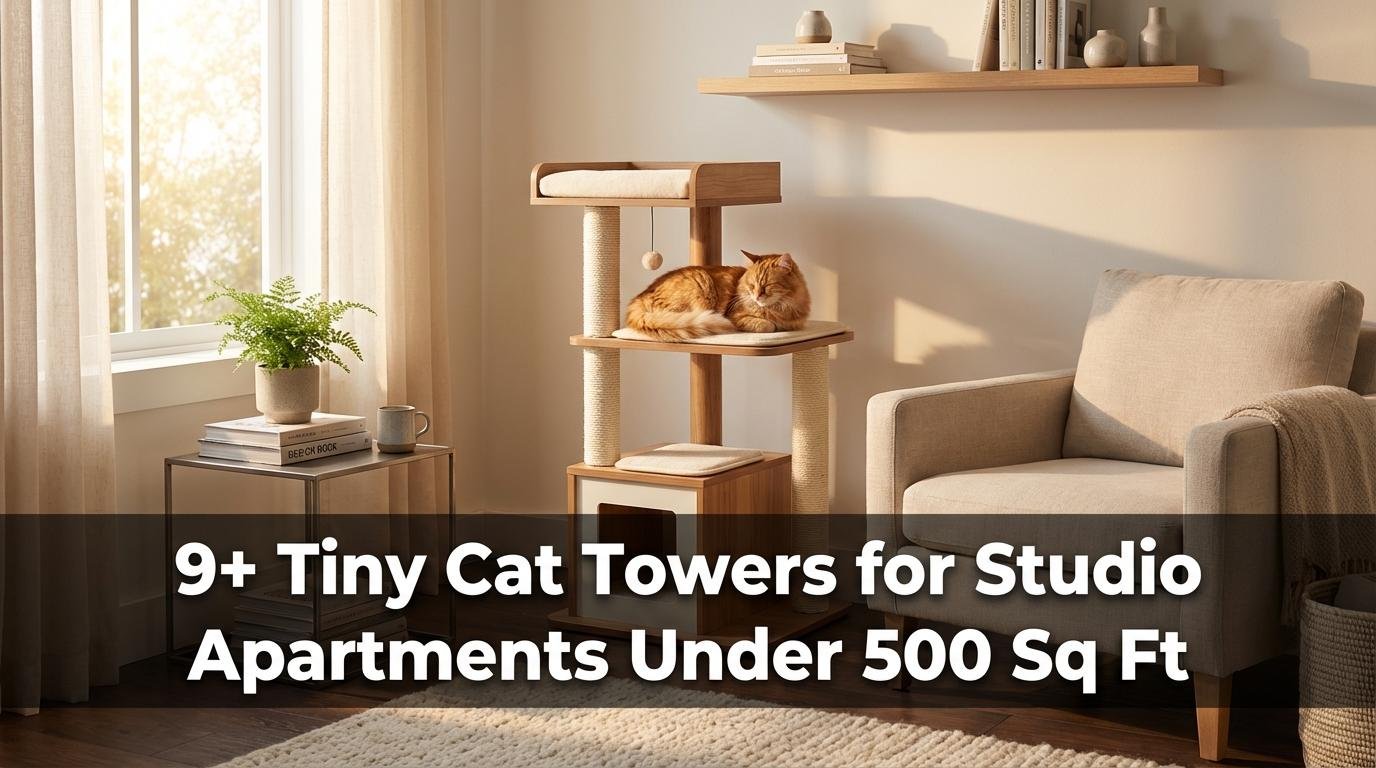
Cat towers for studio apartments don’t have to look like carpeted eyesores shoved into a corner — the ten options ahead prove that small space cat furniture can actually make a sub-500-sq-ft apartment feel bigger, more stylish, and more functional, all for well under $200 in most cases. Whether you need a compact cat tree that doubles as an end table, a wall-mounted cat climber that frees up every inch of floor space, or a modern cat tower disguised as a bookshelf, there’s a pick here that earns its square footage the same way every other piece of furniture in your studio has to: by pulling double duty.
Each idea below comes with a step-by-step DIY breakdown so you can build, hack, or assemble it yourself — no workshop required. We’re talking cat wall shelves that turn dead vertical space into a playground, modular cat trees that adapt when you move to your next lease, and a $79 cube shelf hack that has genuinely taken over cat-owner TikTok. Materials range from woven rattan and natural wood to industrial steel brackets, so your small apartment cat tree actually coordinates with the rest of your decor instead of clashing with it.
Every pick was chosen with real studio living in mind: tight layouts, rental-friendly cat furniture installation where possible, and cats who need enrichment even when their human’s entire life fits in one room. Let’s get into it.
1. The 2-Foot-Wide Tower That Replaced My End Table
Your nightstand is wasting 2 square feet of prime vertical space your cat would kill for.
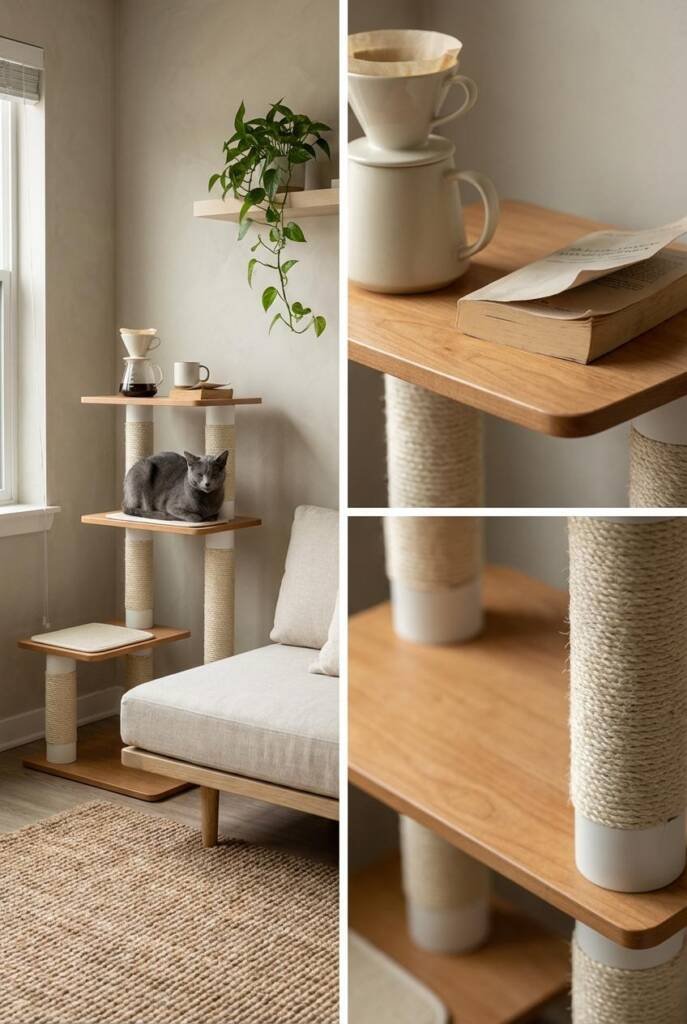
My nightstand was doing exactly one thing — holding a lamp and collecting clutter. The day I swapped it for a slim cat tower with a flat top platform, I got vertical cat real estate and a functioning side table in 24 inches of floor space. It looks intentional, not like I surrendered my apartment to a pet store.
The FUKUMARU Wall-Mounted Cat Shelf Tower (around $65 on Amazon) keeps a footprint under 16 inches wide while giving your cat two perching levels and a cozy box hideout. Cats love height more than square footage, a 4-foot-tall slim tower next to your bed gives them a vantage point over the entire studio, which is exactly what they want.
The trick is choosing a tower with a solid, flat top platform at least 14 inches wide. That’s enough surface for a lamp, your phone, and a small plant — everything your old nightstand held, minus the wasted potential.
How to Use a Slim Cat Tower as a Side Table in a Studio
- Measure your current table footprint: Most nightstands occupy 18–24 inches of width. Measure yours, then shop for a slim cat tower that fits within that same footprint so the swap is seamless.
- Pick a tower with a flat, weight-bearing top: Look for platforms at least 14″ wide with a weight rating above 15 lbs — the FUKUMARU options ($55–$75) specifically list load capacities.
- Anchor it for safety: Use a single L-bracket ($3 at Home Depot) to secure the tower to the wall so your cat’s midnight zoomies don’t send your lamp flying.
- Style the top like actual furniture: Add a small tray for your phone and keys, a clip-on reading lamp instead of a heavy base lamp, and one plant — it’ll read as a design choice, not a compromise.
- Budget move: Skip branded cat furniture and search for slim wooden plant stands with added sisal-wrapped posts — you can DIY the conversion for under $40.
2. This Wall-Mounted Cat Climber Takes Up Zero Floor Space
Your cat wants to climb the walls — so let them.
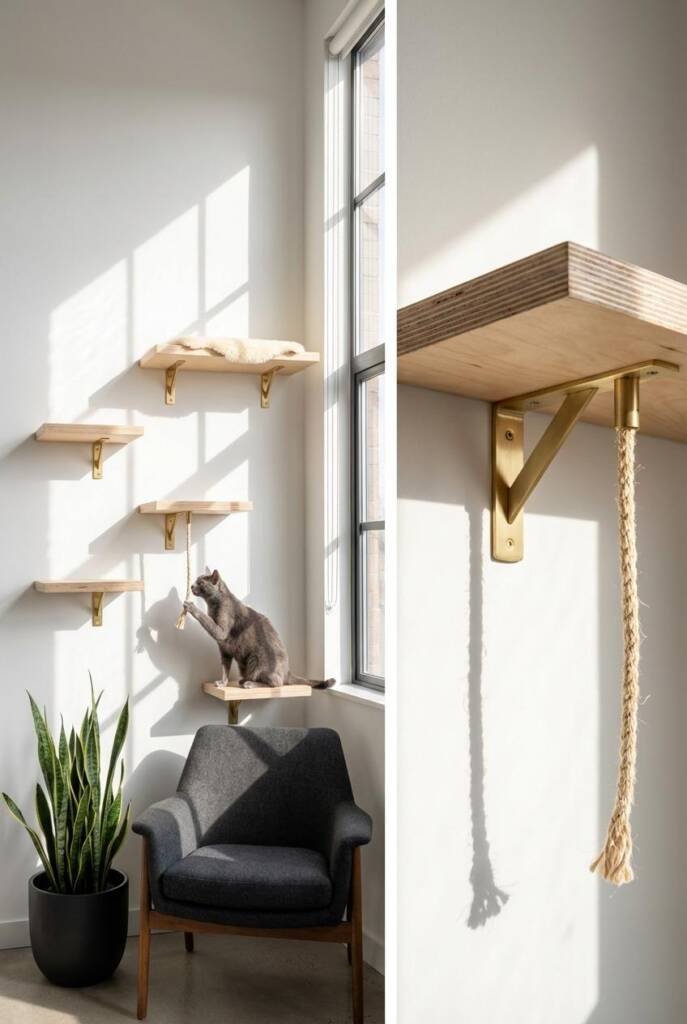
Wall-mounted cat climbers are the cheat code for studio apartments because they literally use zero floor space. Catastrophic Creations makes the best-looking modular systems on the market — think floating shelves, bridges, and hammocks in solid wood and canvas that actually look like intentional décor, not pet furniture. Their pieces mount directly to wall studs and come in finishes like unfinished pine, onyx, and English chestnut, so they blend right into a curated apartment aesthetic.
Cats are natural vertical climbers, and giving them wall-mounted territory satisfies that instinct way better than a stubby floor tower ever could. For studios under 500 sq ft, this wall-mounted cat tower turns dead vertical space into a legitimate cat playground without sacrificing a single inch where your furniture needs to go.
How to Install a Wall-Mounted Cat Climber in a Rental-Friendly Way
- Find your studs first: Use a stud finder to map every stud along your chosen wall. Wall-mounted cat shelves need to anchor into studs — drywall anchors alone won’t safely hold a 15-lb cat in motion.
- Plan your layout with painter’s tape: Mock up shelf and bridge positions using painter’s tape before drilling. Keep shelves 12-16 inches apart vertically so your cat can comfortably hop between levels.
- Use rental-friendly mounting if needed: If your lease prohibits large holes, pick up a set of French cleats — they distribute weight across fewer anchor points and make removal and wall repair much easier on move-out day.
- Add a starter shelf low enough to reach: Mount the lowest shelf about 18-24 inches off the ground so your cat has an obvious entry point without needing a running leap from the couch.
3. The $79 Cube Shelf Hack That Cat Influencers Won’t Stop Posting
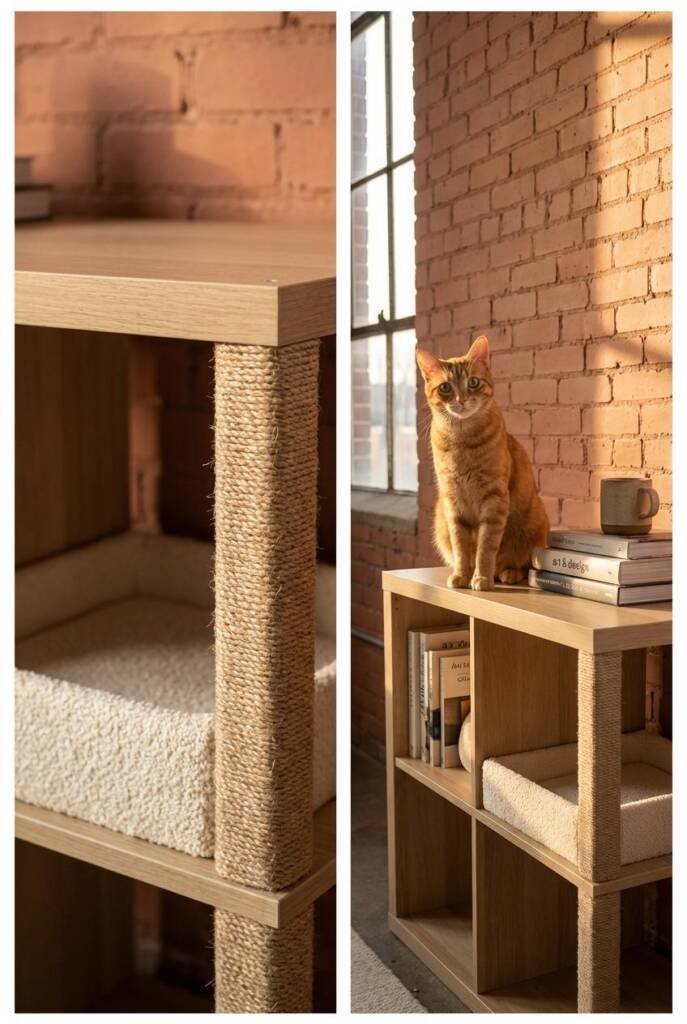
A 2×2 cube storage shelf has quietly become the most popular cat tower base on TikTok and Instagram — and honestly, it makes perfect sense. The Homfa 4-Cube Storage Organizer (around $45 on Amazon) is 30″ tall, sturdy enough for a 15-pound cat, and actually looks like a piece of furniture you chose on purpose. Stand it upright, wrap the exterior edges in sisal rope, and tuck fleece-lined cubby inserts into the compartments. You get a cat tower that doubles as a bookshelf or nightstand, which is exactly the kind of dual-purpose piece a studio apartment demands.
Cats love cube shelves because the openings sit right around 13″ x 13″ — the perfect enclosed space for a cat who wants to feel hidden and secure. Line two cubbies with a soft pet cushion insert ($8–$12 on Amazon) for instant cozy dens, and leave the other two open for books, plants, or storage bins. The beauty of this hack is that every part is replaceable. When the sisal gets shredded, you re-wrap for $12 instead of buying a whole new tower.
For multi-cat households in small spaces, stack a second unit on top using L-brackets — you’ve just created a 5-foot vertical playground for under $100 that takes up barely 2 square feet of floor space.
How to DIY a Cat Tower from a Cube Storage Shelf
- Grab the base: Order the Homfa 4-Cube Storage Organizer ($45) on Amazon and position it vertically so it stands 30″ tall with four open cubbies.
- Wrap in sisal: Use 200 feet of 3/8″ sisal rope ($12–15 on Amazon) and a hot glue gun to wrap the two front vertical edges, creating built-in scratching posts.
- Add cubby inserts: Place soft pet cushion inserts ($8–$12 each) in the top and bottom cubbies for sleeping spots, and use the middle cubbies for your own storage.
- Secure to the wall: Use an anti-tip furniture strap ($8–$10 on Amazon) to anchor the unit to the wall — non-negotiable when cats are launching themselves on and off it.
- Budget move: Skip the cushion inserts and use a folded $4 fleece blanket from Amazon in each cubby to keep your total build under $65.
4. A Ceiling-to-Floor Cat Pole That Looks Like Actual Sculpture
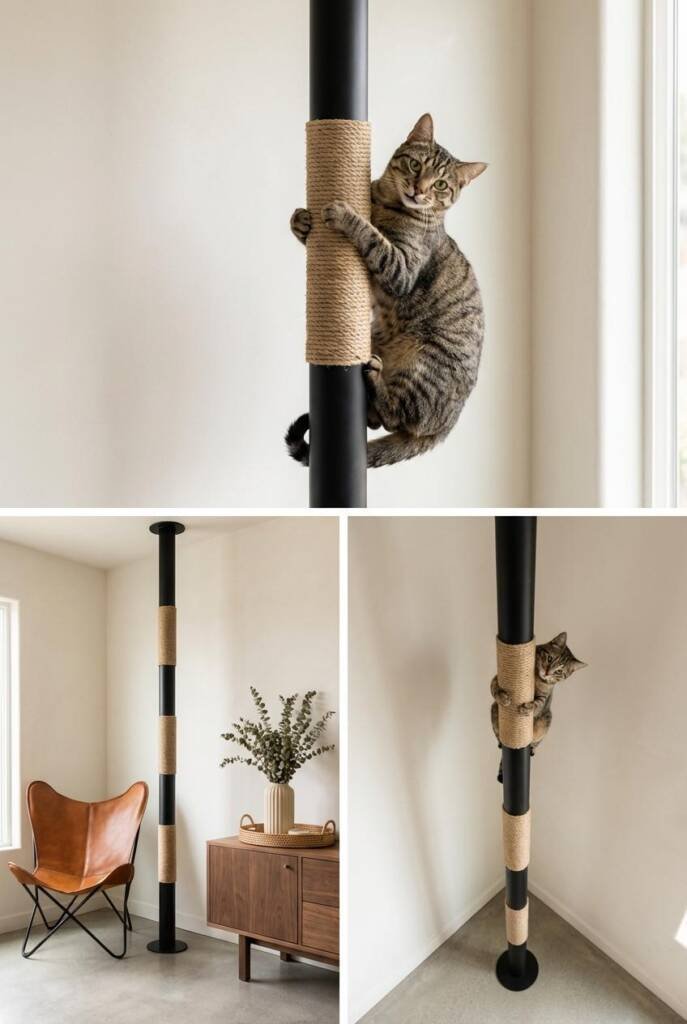
Zero square footage lost, infinite vertical playground gained — this is the studio apartment cheat code.
Most cat towers scream “I have a cat.” A floor-to-ceiling tension pole whispers “I have taste.” The Vesper Cat Furniture Tower (around $150–$180 on Amazon) mounts between your floor and ceiling using spring-loaded tension — no drilling, no wall damage, no lost floor space. Wrapped in natural sisal with clean wood platform finishes, it reads like a Scandinavian sculpture standing quietly in the corner of your studio. Guests will compliment it before they realize it’s for your cat.
Cats are vertical creatures, and a tension pole turns an otherwise useless column of air into a full climbing path. The Vesper comes with adjustable platforms and perches that stack upward, giving your cat multiple resting spots from eye level to near-ceiling height. It fits ceilings from 7.5 to 10 feet and occupies roughly 12 inches of floor diameter — less space than a single dining chair. For studios under 500 square feet, that footprint-to-enrichment ratio is unbeatable.
You can also pair two poles a few feet apart and add a bridge between them, creating an aerial highway that keeps your cat entertained without touching a single piece of furniture.
How to Set Up a Floor-to-Ceiling Cat Pole in a Studio Apartment
- Measure your ceiling height: Use a tape measure to get the exact floor-to-ceiling distance. Most tension poles on Amazon adjust for 7.5–10 ft ceilings, but confirm the specs before ordering.
- Choose your placement: Pick a corner or spot next to a window — cats prefer climbing near perches with a view. Keep it at least 6 inches from walls so platforms can rotate freely.
- Assemble and tension-lock: Stack the pole sections, attach the sisal-wrapped segments and platforms, then twist the spring mechanism until it’s firmly pressed against the ceiling. Give it a solid shake test.
- Lure your cat up with treats: Place treats on the lowest platform first, then progressively higher. Most cats figure out the climbing path within a day or two.
- Budget move: The Yaheetech Floor-to-Ceiling Cat Tree on Amazon runs about $75–$90 and includes multiple platforms — a solid entry point if the Vesper is out of budget.
5. This Bookshelf Cat Tower Had My Guests Fooled for Months
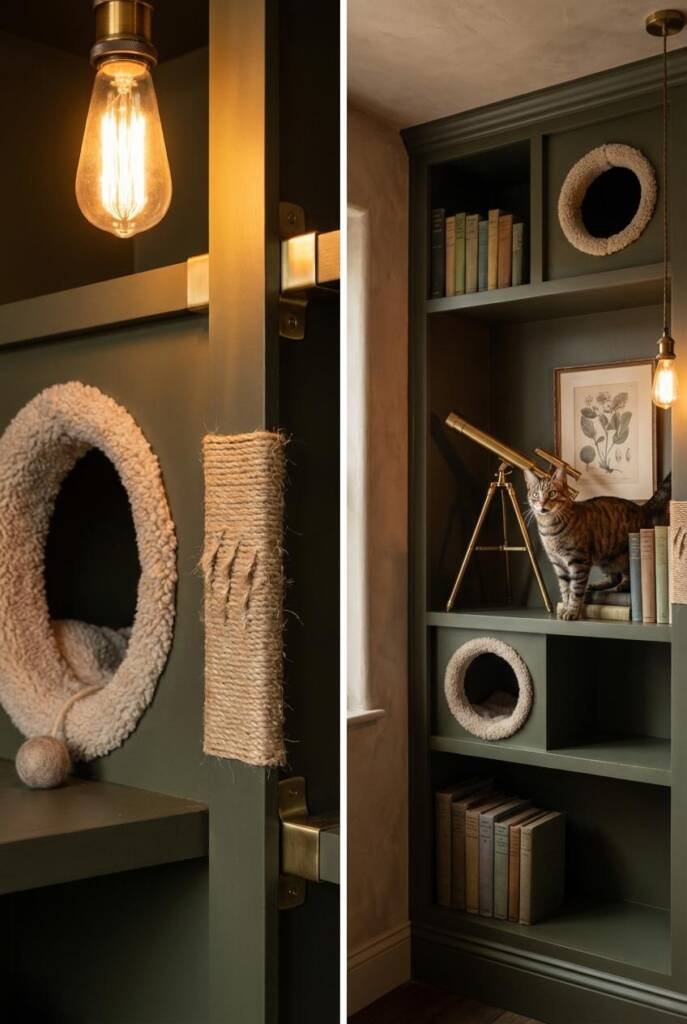
Most cat towers for studio apartments scream “I have a cat” the second someone walks in. This one doesn’t. A bookshelf-style cat tower with clean lines, warm wood veneer, and open cubbies looks like intentional furniture — until your cat emerges from one of the concealed perching nooks like a furry plot twist.
The concept is simple: find a solid wood bookshelf with a mix of open and closed compartments, line the enclosed sections with soft fleece inserts, and wrap one vertical edge in sisal rope. The design alternates open shelves with cozy cat cubbies, giving your cat multiple hiding spots and climbing routes without sacrificing a single square foot to a standalone tower. At the right dimensions — around 60″ tall and 24″ wide — it fits flush against a wall in the tightest studio layout.
How to Style a Bookshelf Cat Tower So Nobody Knows It’s for Cats
- Mix real books with cat cubbies: Fill 2-3 open shelves with books, plants, and objects so the cat-specific cubbies blend seamlessly into the overall arrangement.
- Stick to a color palette: Choose book spines and décor in 2-3 tones that complement the wood finish — creams, greens, and terracotta work beautifully.
- Hide the cat entrance points: Position a trailing pothos or a bookend near cubby openings so they read as decorative shadow boxes, not cat caves.
- Skip the toy clutter: Store cat toys in a nearby drawer or basket — one dangling mouse ruins the whole disguise.
- Budget move: Look for any solid wood bookshelf on Amazon with a mix of open and closed compartments, add fleece-lined inserts to the enclosed sections, and wrap a vertical edge in sisal rope. The disguised effect comes from how you style it, not the price tag.
6. The Corner Cat Tower That Turns Dead Space Into Cat Paradise
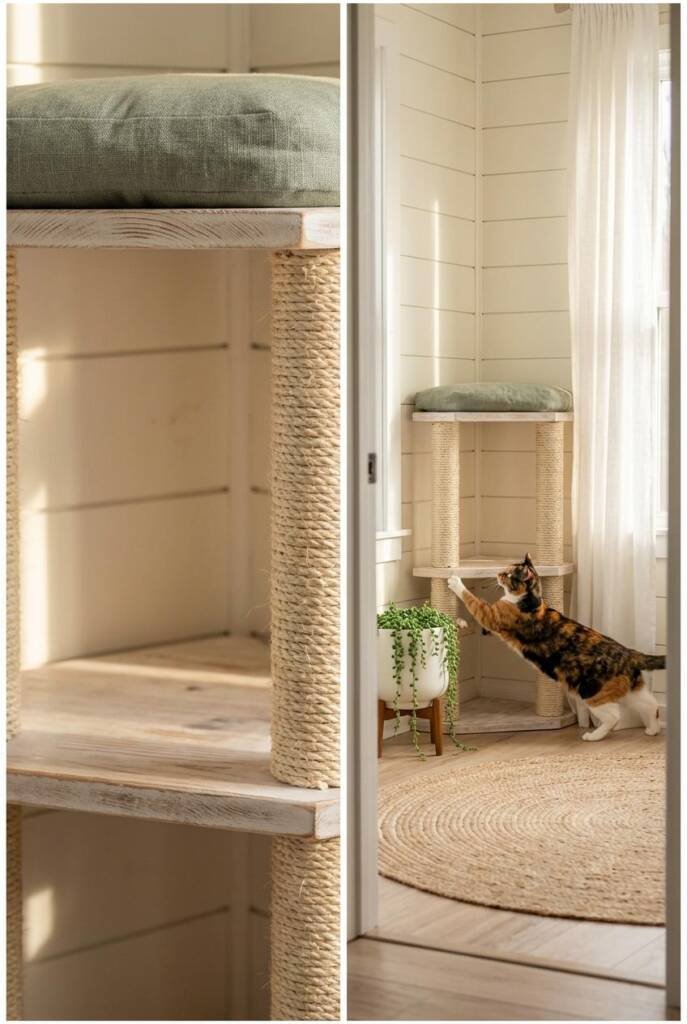
That empty corner behind your reading chair? Your cat already wants it — give it to them vertically.
Every studio apartment has at least one corner doing absolutely nothing. A triangular corner cat tower slots into that 90-degree dead zone and turns it into a vertical playground without stealing a single usable square foot from your floor plan. The wedge shape looks intentional and architectural — more like a modern shelving unit than a pet product — especially in light wood or matte white finishes.
Cats love corners because two walls create a sense of security, so your cat will actually prefer this spot over a tower placed mid-room. It gives your cat genuine vertical territory — perching, climbing, hiding — in a footprint roughly the size of a pizza box.
If you’re renting and can’t drill into walls, a corner tower is your best friend. It’s freestanding, stable thanks to the two-wall contact, and you can move it when you rearrange. No holes, no landlord drama.
How to Maximize a Corner With a Triangular Cat Tower
- Measure your corner: Check that you have at least 20″ along each wall and 5+ feet of vertical clearance — most corner towers need this minimum to fit properly.
- Pick the right height: Go tall. Give your cat a high vantage point without requiring wall anchors, which matters in a rental.
- Stabilize with adhesive pads: Stick furniture grip pads (about $6 on Amazon) under the base to prevent any sliding on hardwood or tile floors.
- Add a wall-side scratcher: Attach a 24″ sisal scratch pad ($12–$15) to one of the adjacent walls at tower height to extend the play zone without adding bulk.
- Budget move: Skip branded corner towers and build a three-tier triangular shelf from a single 2×4 and plywood scraps for under $30 total.
7. Under $50: A Woven Rattan Cat Tower That Screams Coastal Chic
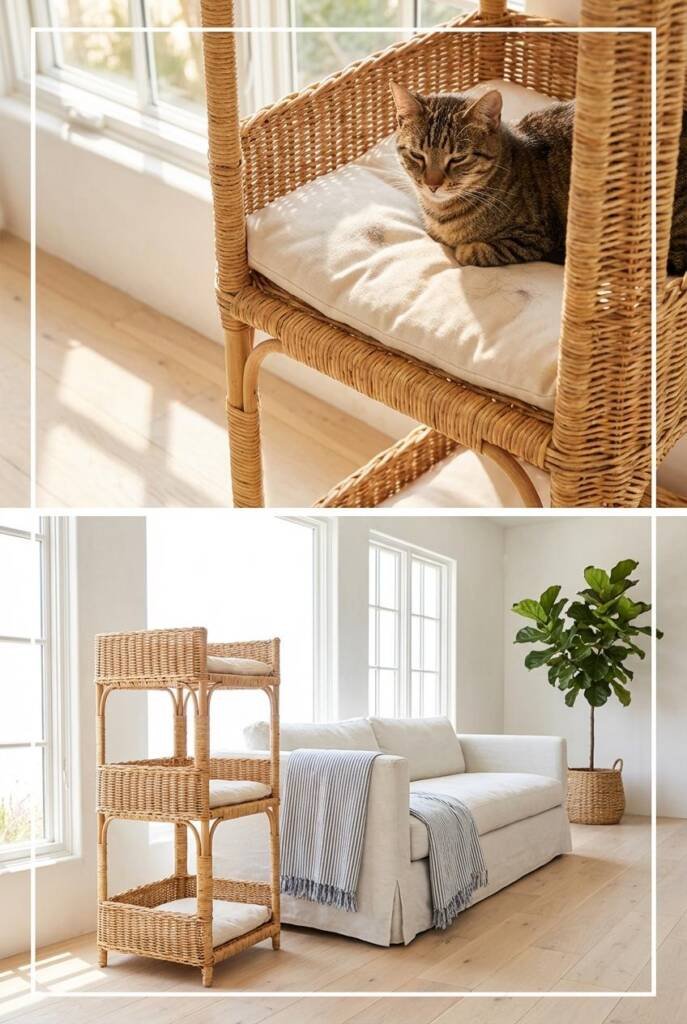
Under fifty bucks and it looks like it came from an Anthropologie catalog — your cat’s new beach house just landed on Amazon.
Rattan and seagrass have that effortless beach-house energy that makes even a 400 sq ft studio feel like a coastal retreat. A woven rattan cat tower pulls double duty as a textural statement piece and a legitimate climbing structure — the kind of thing guests notice and compliment before they realize it’s for your cat. The natural weave pattern pairs beautifully with white walls, linen curtains, and light wood floors, making it one of the most photogenic cat towers for studio apartments.
The open-weave baskets let air circulate, which cats love in warmer months, and the natural seagrass material holds up surprisingly well to claws. At this price point, you’re getting an affordable cat tower that genuinely looks like decor rather than pet furniture.
How to Style a Rattan Cat Tower for a Coastal Studio Look
- Pick your palette: Stick to a white, sand, and soft blue color scheme within a 3-foot radius of the tower. A $12 woven jute rug from IKEA underneath ties it all together.
- Add natural textures nearby: Place a dried pampas grass arrangement or a macramé wall hanging within eyeline of the rattan cat tower to create a cohesive coastal vignette.
- Use a linen throw as a basket liner: Drape a lightweight linen cloth inside the top basket — it softens the look, gives your cat a cozy surface, and washes easily.
- Keep the surroundings minimal: Resist cluttering the area. Leave at least 18 inches of clear space on each side so the tower reads as an intentional design moment, not an afterthought.
- Budget move: Grab a seagrass placemat for $4 at Target and set it under the base to protect your floors and add another layer of coastal texture.
8. This Magnetic Modular Tower Grows (or Shrinks) With Your Lease
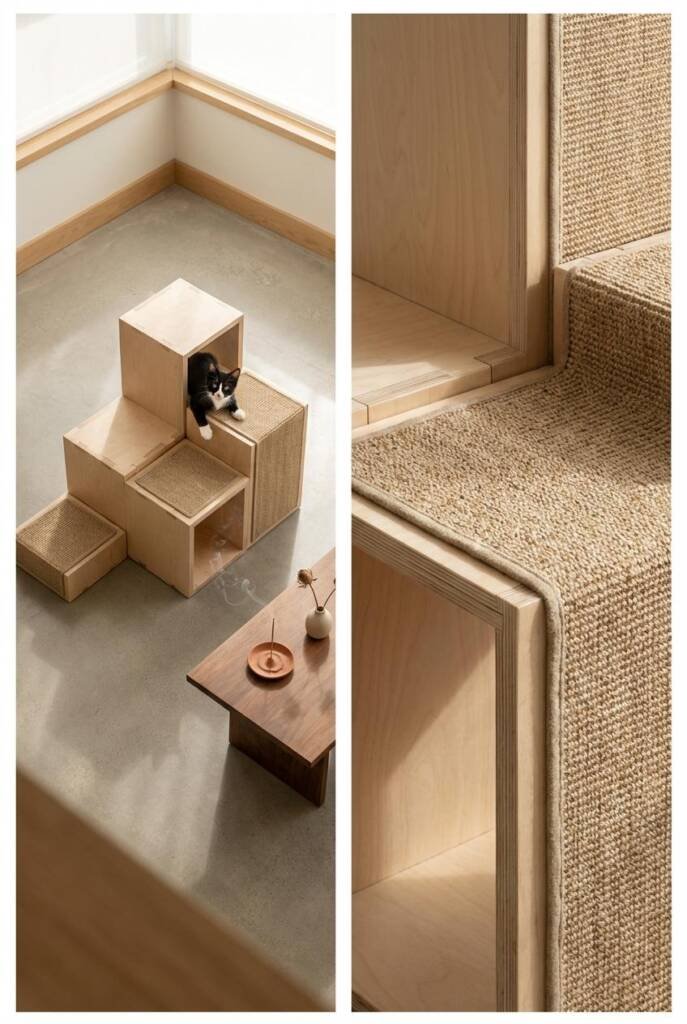
Your apartment will change — your cat tower should keep up.
Most cat towers for studio apartments force you into a single shape that either works in your space or doesn’t. A modular cat tree flips that problem entirely — stackable geometric blocks connect together so you can build a tall tower, a low bench, an L-shape against a corner, or a sprawling horizontal playground depending on what your current apartment allows. The clean, wood-grain aesthetic looks more like a designer shelf than cat furniture.
Cats love weaving through the openings, perching on top, and shredding the replaceable pads instead of your security deposit. The modular concept means nothing gets wasted when you move — you just rearrange.
Here’s the underrated perk: if you downsize from a studio to a micro-studio (it happens), you pull off two blocks and suddenly it fits. If you upgrade, you add units. Your cat tower literally adapts to your lease.
How to Build a Modular Cat Tower You Can Reconfigure Anytime
- Choose your starting configuration: Begin with a 3–4 unit setup — enough to build up to 4 feet tall or spread along a wall without overwhelming a small space.
- Pick a layout for your floorplan: Corner spots work best in studios under 500 sq ft since they use dead space without eating into your living area.
- Stack and secure: Follow the connection system between units — no tools needed. Give it a firm shake test before letting your cat loose on it.
- Swap the scratcher inserts: Replace corrugated cardboard pads every 3–4 months to keep your cat interested and your furniture safe.
- Budget move: Start with just two units and add one at a time as your budget allows — the beauty of modular is you never have to buy the whole system at once.
9. A Window-Perch Tower That Gives Your Cat the Best View in Town
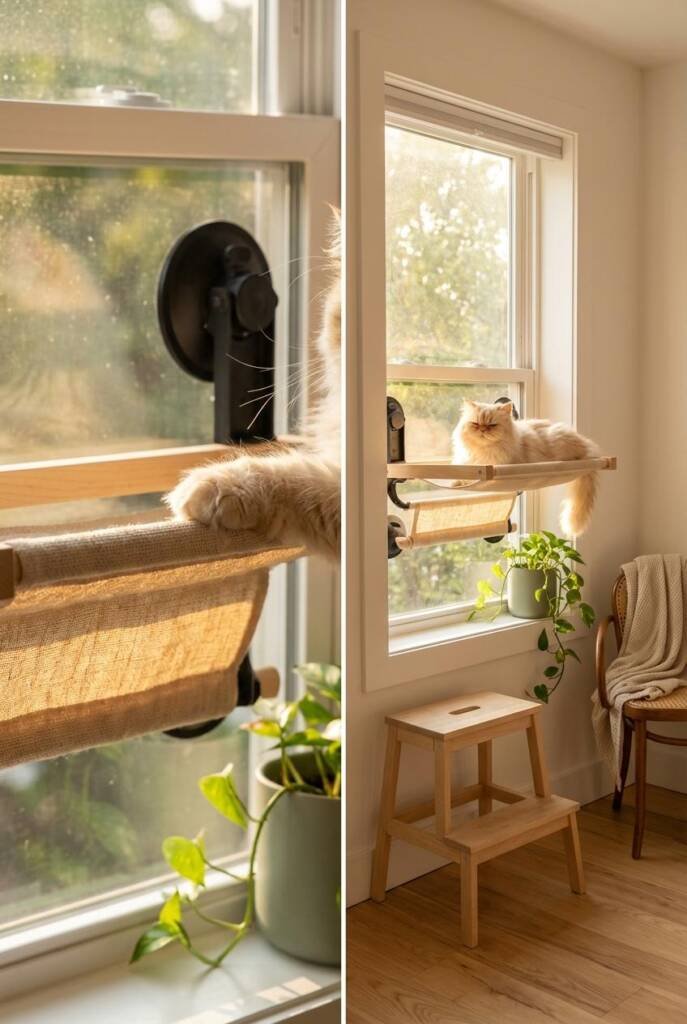
Your cat already stares out that window all day — give them a proper seat for the show.
A window-perch combines the best of two worlds: the vertical space cats crave and the bird-watching entertainment that keeps them glued for hours. The design is simple — a slim tower base (usually 12–18 inches wide) sits on the floor beneath your window, topped by a suction-cup or bracket-mounted perch that attaches directly to the glass or window frame. It looks like an intentional piece of furniture rather than a clunky cat tree shoved into a corner, and it takes up virtually zero usable floor space since it lives in the window’s dead zone.
The FUKUMARU Cat Window Perch (around $40 on Amazon) is one of the best options here — it supports up to 40 lbs with heavy-duty suction cups and a steel cable safety tether. Pair it with a small 2-tier base tower like the Catry Mini Cat Tower ($35) placed directly underneath, and your cat gets a full climbing-to-perching loop using about 1.5 square feet of floor space. Cats who live in studios without outdoor access genuinely benefit from window perches — the visual stimulation of birds, pedestrians, and weather changes reduces anxiety and boredom behaviors like scratching furniture or excessive meowing.
How to Install a Window Cat Perch Tower Without Damaging Walls
- Test your window strength: Press firmly on the glass to check for flex or looseness. Suction-cup perches need tempered or double-pane glass that’s at least 3/16 inch thick.
- Clean and mount the perch: Wipe the glass with rubbing alcohol for maximum suction grip, then press each cup firmly for 30 seconds. Attach the included steel safety cable to the window frame as backup.
- Position the base tower: Place a compact tower like the Catry Mini ($35) directly beneath the perch so your cat can step up naturally rather than leaping from the floor.
- Stress-test before first use: Press down on the perch with 15–20 lbs of force and wait 24 hours before letting your cat on it to confirm the suction cups hold.
- Budget move: Skip the base tower entirely and use a sturdy $12 storage step stool as a launchpad — your cat won’t judge the aesthetics.
10. The Hidden Cat Tower Inside a Mid-Century Plant Stand
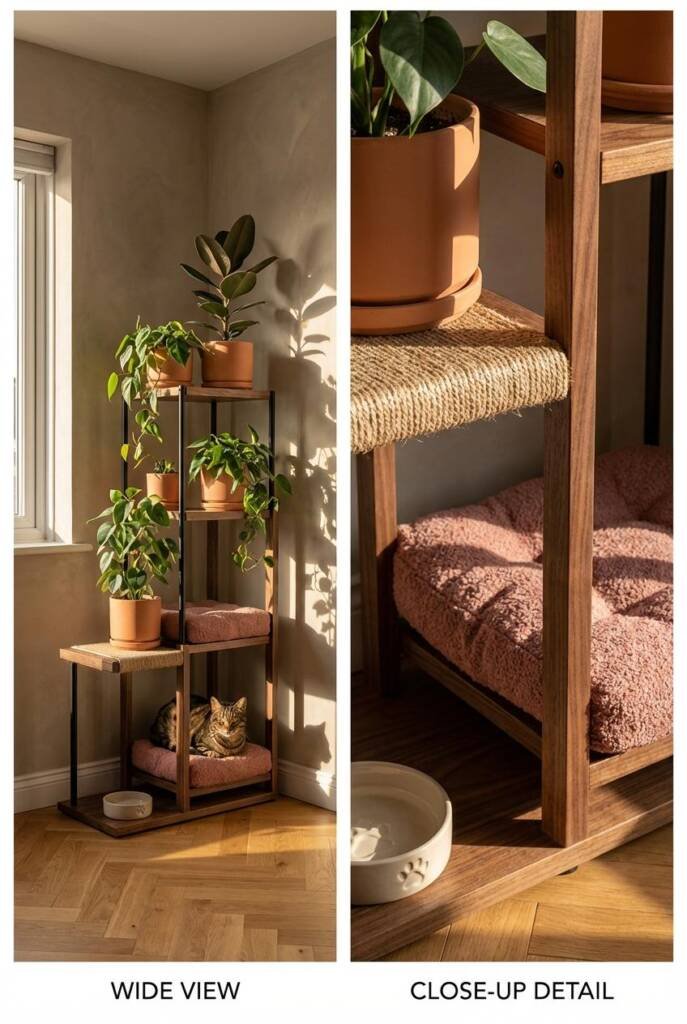
Your cat doesn’t need to know it’s a plant stand, and your landlord doesn’t need to know it’s a cat tower.
A tiered mid-century plant stand — the kind with three or four staggered shelves at different heights — is basically a cat tower that forgot it was supposed to be furniture. Swap a couple of plant shelves for carpet-wrapped platforms, tuck some cat-safe greenery like spider plants or Boston ferns on the remaining tiers, and you’ve got a climbing structure that reads as pure mid-century decor. Guests won’t clock it as a cat tower until your cat launches herself onto the second tier mid-conversation.
Cats love vertical routes with multiple stopping points, and a staggered plant stand delivers exactly that. The Archiology 3-Tier Acacia Wood Plant Stand ($65, Amazon) has solid shelves at 12″, 24″, and 36″ heights — perfect climbing intervals for cats. Each shelf holds up to 30 lbs, so even a hefty Maine Coon won’t test its limits. The narrow footprint (about 14″ wide) means it tucks against a studio wall without eating floor space, and the warm wood tones blend with virtually any palette.
How to Turn a Tiered Plant Stand Into a Disguised Cat Tower
- Choose Your Stand: Pick a tiered plant stand with shelves at staggered heights, at least 10″ deep per shelf.
- Convert Select Shelves: Wrap one or two shelves with sisal rope or adhesive-backed carpet tiles cut to size — leave at least one shelf for actual plants.
- Add Cat-Safe Plants: Fill the remaining tiers with non-toxic greenery like spider plants or calathea to complete the disguise and give the whole piece that lush, intentional look.
- Anchor to the Wall: Use a single L-bracket ($3, any hardware store) to secure the stand to a wall stud — non-negotiable for anything a cat will jump on.
- Budget move: A secondhand mid-century plant stand from Facebook Marketplace typically runs $15–$30, keeping this entire build under $50.
Cat Towers For Studio Apartments That Welcome Pets
Living in a studio with a cat means every object in your home needs to justify the space it takes up — and the right cat tower does that effortlessly when it doubles as an end table, bookshelf, plant stand, or sculptural accent piece. The ten ideas above show that small-space cat furniture isn’t about settling for less; it’s about designing smarter so your cat gets vertical territory and you get an apartment that still feels like yours.
If you’re working with under 500 square feet, start with whichever option matches your layout’s biggest weakness — dead corners, bare walls, or windowsills going to waste — and build from there. The best cat towers for studio apartments are the ones that make guests say “wait, that’s for the cat?” right before your cat leaps onto it to prove the point.
Here at Sweet Purrfections, we create content at the intersection of cool home decor and real life with pets. Because we believe your home should look like it belongs in a design magazine AND work for the furry family members who actually run it.
Leave a Reply