

Cat trees shaped like landmarks take the most boring piece of pet furniture in your home and turn it into an actual conversation starter — and the best part is you can build most of these yourself for under $150 in materials. We’re talking sisal-wrapped minarets, carpet-covered pyramids with hidden caves, and multi-tiered pagodas made from plywood and jute rope. Whether you’re working with a compact apartment corner or a full cat room, these landmark-inspired designs give your cats serious vertical territory while giving your space something that actually looks intentional.
Each of the 9+ ideas below comes with a step-by-step breakdown so you can see exactly how the build comes together — from the base structure and materials list to the finishing touches that make each one look like a real landmark. We’ve covered everything from beginner-friendly projects like the cactus scratching post to more ambitious builds like a full Colosseum with tiered seating for multi-cat households. Every design prioritizes cat-safe materials, stability at height, and surfaces your cats will actually want to scratch, climb, and nap on.
You don’t need to be a woodworker or drop a fortune to pull these off. A sheet of birch plywood (you can grab a half-sheet on Amazon for around $30), some sisal rope, and a handful of basic tools will get you surprisingly far. Let’s get into it.
1. The Eiffel Tower Cat Tree That Makes Your Living Room Feel Like Paris
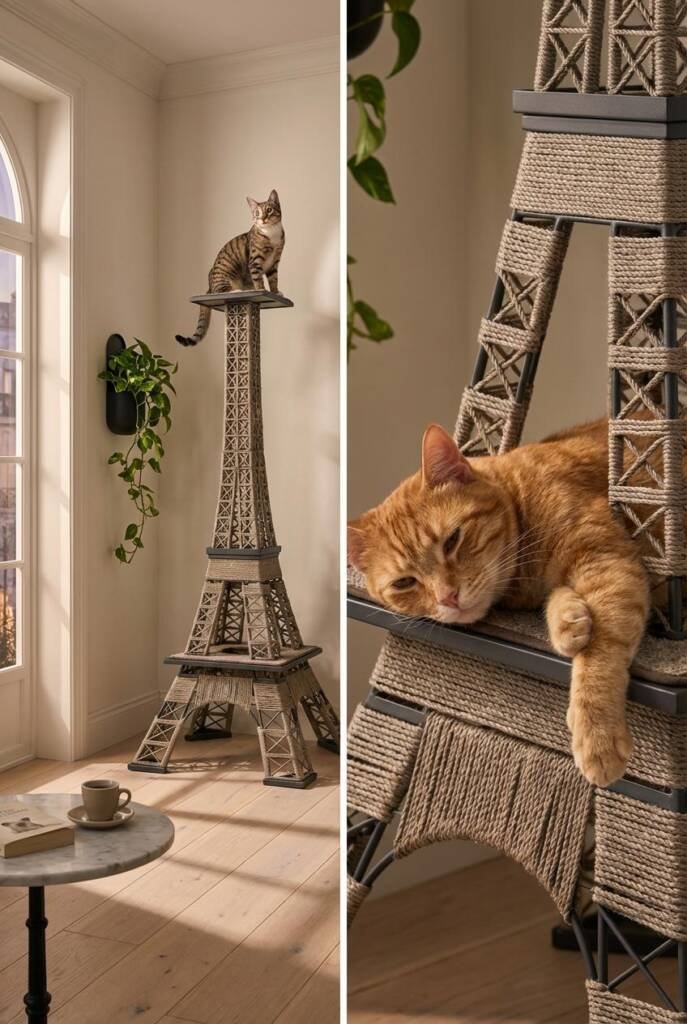
Your cat gets a six-foot climbing tower, your guests get a double-take moment — everybody wins.
An Eiffel Tower cat tree takes the classic lattice silhouette of Paris’s most iconic structure and turns it into a multi-level climbing experience your cat will actually use. The best versions feature an open metallic or wood-tone frame that tapers upward with three to four perching platforms at different heights, topped with a cozy nest at the peak. It reads as sculptural art first, cat furniture second — which is exactly the point.
Cats love it because the open framework gives them multiple climbing routes and unobstructed sightlines from every level, satisfying that hardwired need to survey their territory from up high. You can find lattice-style tower cat trees on Amazon for roughly $90–$180 depending on height and materials. Look for one in the 5- to 6-foot range with sisal-wrapped support posts so it pulls double duty as a scratcher without needing a separate one cluttering your floor.
How to Style an Eiffel Tower Cat Tree Without Your Room Looking Like a Theme Park
- Anchor it with neutral tones: Place the tower against a white or light gray wall so the silhouette pops. A natural jute area rug underneath (grab one on Amazon for around $30–$45) grounds it without competing.
- Keep surrounding decor minimal: One framed black-and-white Paris print hung 6–8 inches to the side is enough context. More than that and you’re building a gift shop.
- Light it like a landmark: A warm-toned LED uplighting strip placed at the base — available on Amazon for under $15 — makes the lattice cast dramatic shadows at night and turns it into an actual conversation piece.
- Edit the accessories: Skip the dangling toy overload. One simple hanging feather toy attached to a middle platform keeps play built-in without visual clutter.
- Budget move: You can style the full setup for under $60 on Amazon — a jute rug for ~$35, an LED strip light for ~$12, and a single framed print for around $10.
2. This Pyramid Cat Tree Has a Hidden Cave Your Cat Will Obsess Over
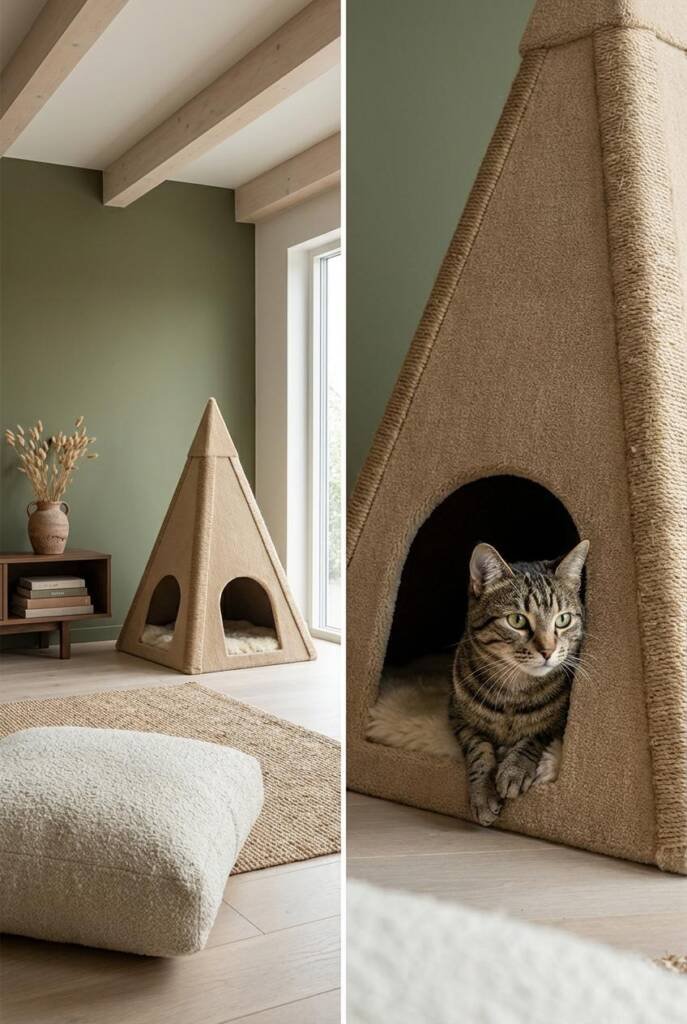
Your cat already thinks it’s a pharaoh — now give it a tomb to match.
A pyramid cat tree takes one of the world’s most iconic shapes and turns it into a piece of functional cat furniture that actually looks intentional in your living room. The best versions feature clean geometric lines with a wide base tapering to a point, wrapped in neutral tones like sand, warm beige, or charcoal. The enclosed cave at the base gives the whole structure purpose beyond aesthetics — it’s architecture your cat can disappear into.
Cats are hardwired to seek out enclosed, dark spaces when they want to feel safe, which is exactly why that hidden base cave works so well. The angled sisal-wrapped edges double as scratching surfaces, letting your cat stretch and climb without destroying your couch. You can find pyramid-style cat houses with sisal detailing on Amazon for roughly $45–$75, depending on size and material quality. Look for one with a removable cushion inside the cave — it makes cleanup painless and keeps the hideaway fresh.
How to Choose a Pyramid Cat Tree That Actually Fits Your Decor
- Measure your floor space first: Most pyramid cat trees have a base footprint of 18–24 inches square. Confirm your spot can handle that without blocking a walkway or door swing.
- Match the material to your room: Choose a linen or felt-covered pyramid for modern spaces, or a jute-wrapped version for boho rooms. Both styles are available on Amazon for under $70.
- Add a weighted base if needed: If your cat is a heavy climber, slip a non-slip furniture pad underneath — grab a pack on Amazon for around $10 — to keep the pyramid from sliding on hard floors.
- Layer the cave with a washable cushion: Swap the stock insert for a small round pet bed cushion (~$15 on Amazon) in a contrasting color to make the cave entrance pop visually.
- Budget move: You can pull together a pyramid cat tree setup for under $85 on Amazon — the tree itself for ~$60 plus a cushion insert and non-slip pad for about $25 total.
3. A Big Ben Clock Tower Cat Tree That’s Actually a Vertical Playground
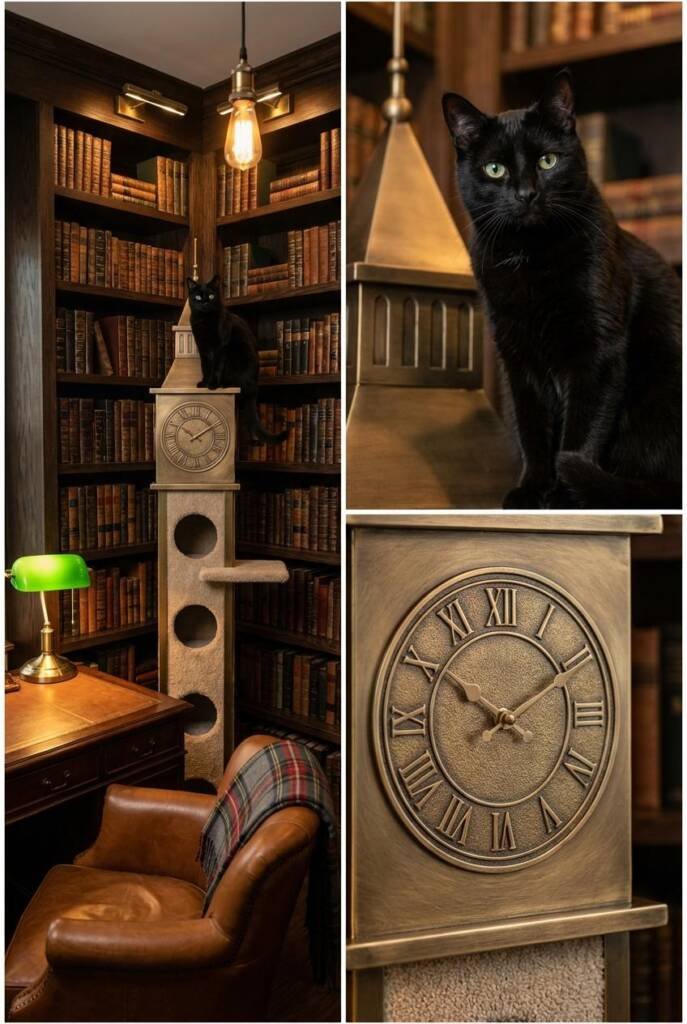
Big Ben has survived wars, renovations, and over 160 years of London weather — your cat’s version just needs to survive zoomies.
Picture a narrow tower cat tree climbing nearly five feet tall, with stacked cube compartments forming the iconic stepped silhouette of Big Ben. Each box section serves as a hideaway or perch, wrapped in sisal or carpet, while a decorative clock face crowns the top — printable or hand-painted on a lightweight wooden disc. The proportions actually work in a living room corner because the footprint stays tight (about 18″ square) while the height commands attention. It reads more like an architectural accent piece than a cat tree, which is exactly the point.
Cats are hardwired to climb vertically, and a tower design with alternating entry holes on each level turns the whole structure into a stacked puzzle gym. They’ll weave up through offset openings, nap in the middle compartments, and claim the clock-tower summit as their personal lookout.
If you’re not building from scratch, start with a set of stackable storage cubes — you can find modular cube organizers on Amazon for around $35–$50 — then reinforce the joints, wrap exposed surfaces in sisal rope, and add the clock topper. The result is a tall cat tree that earns its floor space.
How to Anchor a Tall Landmark Cat Tree So It Won’t Tip Over
- Secure the base with extra weight: Screw or bolt the bottom cube to a 24″ × 24″ plywood base (¾” thick), then add a layer of adhesive-backed carpet tiles — grab a pack on Amazon for roughly $20.
- Stack and reinforce each level: Use L-brackets at every interior joint between cubes, offsetting the entry holes left-right-back so your cat zigzags upward. A set of steel corner braces runs about $8 on Amazon.
- Tether the tower to the wall: Attach a furniture anti-tip strap to the top cube and anchor it into a wall stud — these straps are available on Amazon for around $10 and they’re non-negotiable for anything over 4 feet tall.
- Add the clock-face topper: Cut a 12″ wooden disc, paint or decoupage a clock face onto it, and mount it flush to the top panel with wood glue and a single screw for a clean finish.
- Budget move: You can pull together the entire Big Ben tower for under $75 using modular cubes (~$40), sisal rope (~$15), and hardware (~$18) all sourced from Amazon.
4. The Leaning Tower of Pisa Cat Tree Your Instagram Followers Won’t Believe
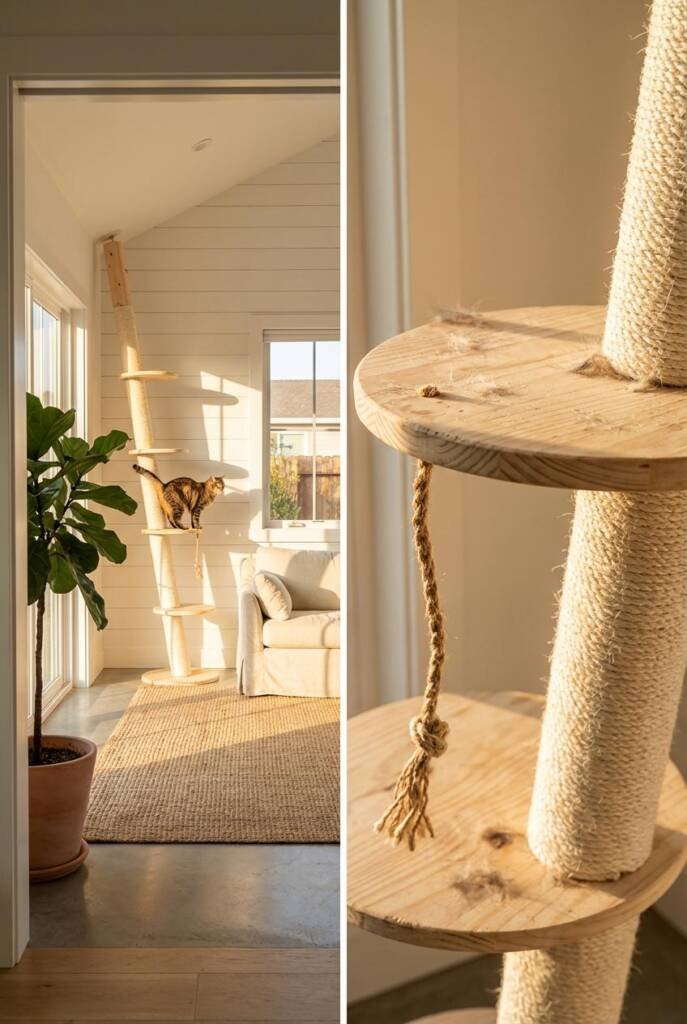
Finally, a cat tree where the engineering flaw is the whole point.
This cat tree leans at roughly 10–15 degrees off vertical, mimicking the Leaning Tower of Pisa with stacked circular platforms that spiral upward at an offset angle. Wrapped in white or cream sisal rope with arched window cutouts carved into the central column, it’s the kind of piece that stops people mid-scroll. The slight tilt creates visual drama that a straight tower simply can’t match.
Here’s the thing cats don’t care about — your angled tower is actually better for climbing. The offset platforms create varied gap distances, forcing cats to engage different muscle groups and choose between routes. It’s enrichment disguised as architecture.
You can build the base from a round wooden platform (find pre-cut wooden rounds on Amazon for ~$20) and stack progressively smaller tiers using threaded rod through the center for structural integrity. Wrap the column in natural sisal rope — a 200-foot roll runs about $15 on Amazon — and you’ve got a scratchable surface from base to peak.
How to Safely Position an Angled Cat Tree Against a Wall
- Anchor the weighted base: Use a 24-inch round wooden base at least 1.5 inches thick, loaded with a steel plate underneath for counterweight. Bolt it to the floor or secure it to the wall with an L-bracket (grab a heavy-duty set on Amazon for around $12).
- Install the threaded center rod at your angle: Run a 3/4-inch steel threaded rod through the base at a 10–15 degree angle, securing it with flange nuts on both sides. This is your spine — everything stacks onto it.
- Stack and space the platforms: Slide circular platforms (graduating from 18 inches down to 10 inches) onto the rod, separated by 12–14 inch spacers. Each platform gets a flange nut tightened above and below to lock it in place.
- Wall-tether the top: Attach a braided steel cable or heavy-duty furniture anchor strap from the top platform to a wall stud. You can find furniture anti-tip straps on Amazon for under $10 — non-negotiable for an angled build.
- Budget move: The full build comes in under $90 using Amazon — wooden rounds for ~$20, a threaded rod kit for ~$18, sisal rope for ~$15, and hardware for roughly $30.
5. A Colosseum Cat Tree With Tiered Seating Your Multi-Cat Home Needs
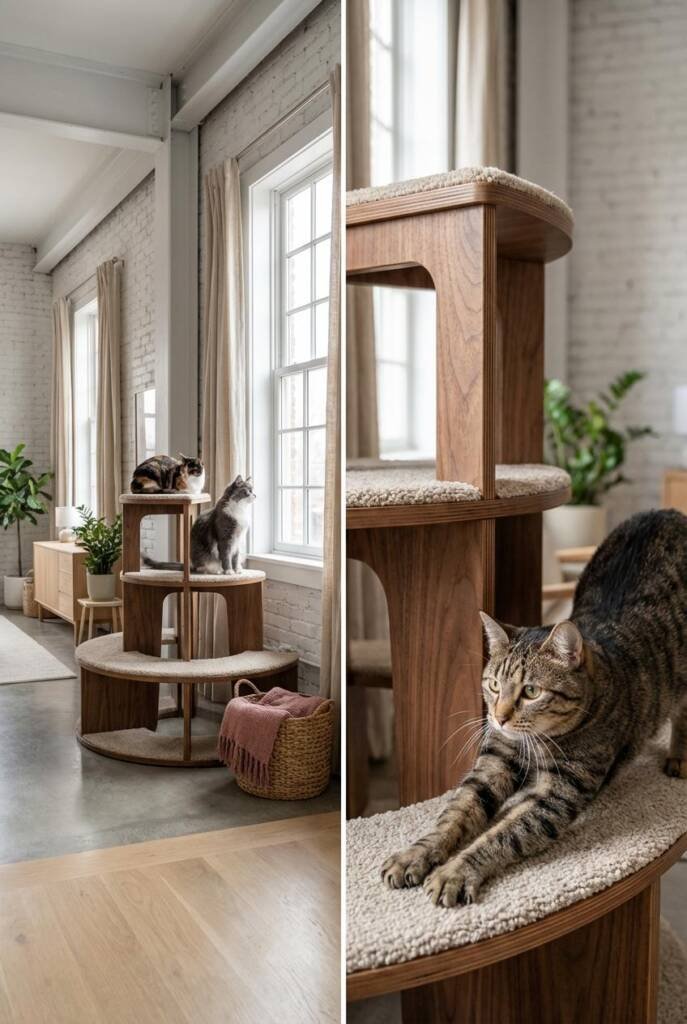
Every cat in your house thinks they’re the emperor — give them all a throne.
Picture a miniature Roman Colosseum — round, tiered, and built entirely for feline gladiators who’d rather nap than fight. A Colosseum cat tree uses amphitheater-style semicircular shelves stacked at ascending heights, wrapped around a central scratching column. The curved silhouette is an immediate conversation piece, and the warm, sandy-toned sisal or carpet covering sells the ancient stone aesthetic without looking like a theme park prop.
Here’s why it actually works: in multi-cat households, vertical territory is everything. Tiered seating means each cat claims their own level, reducing standoffs over who gets the top perch. The curved, open design eliminates dead-end corners where one cat can trap another — every level has multiple escape routes. If you can’t find a round cat tree that nails the look, a set of curved wall-mounted cat shelves (a quick Amazon search turns up options for $30–$50 per shelf) arranged in a semicircular, staggered pattern gives you the same amphitheater effect without taking up floor space.
How to Use a Tiered Cat Tree to Reduce Multi-Cat Conflict
- Map Your Tiers: Plan 3–5 shelf levels spaced about 12–14 inches apart vertically. One level per cat is the golden rule for keeping peace.
- Build the Arena Shape: Arrange curved floating shelves in a semicircle on your wall — grab a set on Amazon for around $40–$50 per pair. Stagger them so no two shelves sit directly above each other.
- Wrap the Central Column: Mount a sisal-wrapped scratching post (available on Amazon for roughly $20–$30) in the center of the arrangement to anchor the Colosseum look and give cats a climbing path between levels.
- Add the Finishing Texture: Line each shelf with a sandy-beige carpet remnant or a small jute mat — find packs of jute placemats on Amazon for ~$12 — to complete the ancient stone vibe and give paws some grip.
- Budget move: You can build the full Colosseum wall setup for under $120 from Amazon — curved shelves for ~$80, a sisal post for ~$25, and jute mats for ~$12.
6. This Japanese Pagoda Cat Tree Is the Zen Upgrade Your Space Deserves
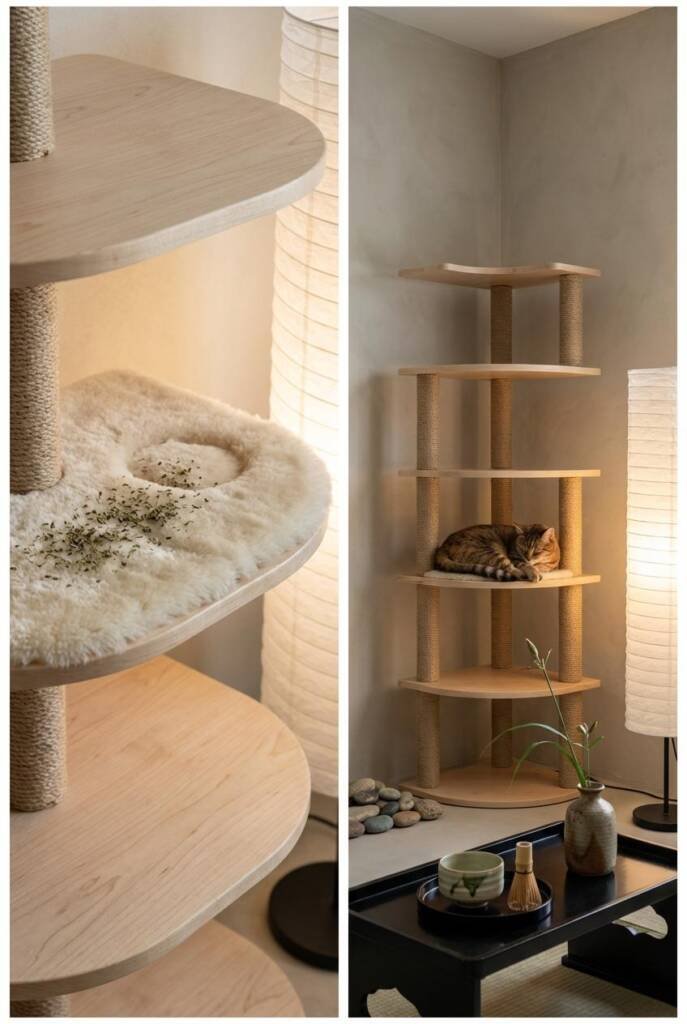
Your cat already thinks it’s a monk meditating on a mountaintop — give it the architecture to match.
Pagoda-style cat trees stack multiple tiers with gently curved roof platforms, mimicking the silhouette of a traditional Japanese temple. The best versions use natural wood tones — light bamboo or warm cedar finishes — paired with sisal-wrapped posts that blend right into the architectural vibe. It’s one of those cat trees shaped like landmarks that actually looks like furniture, not a novelty piece. The upswept roof edges double as cozy perching ledges, and the tiered layout gives multi-cat households vertical territory without hogging floor space.
Cats are natural climbers, so a multi-level pagoda structure hits every instinct — elevated lookout points, enclosed cubbies between tiers for hiding, and textured posts for scratching. If you can’t find a pagoda cat tree that nails the aesthetic you want, a solid workaround is a tiered wooden plant shelf (you can find these on Amazon for ~$45) customized with sisal rope and cushioned platforms. Same silhouette, fraction of the cost, and you control the finish.
How to Build a Zen Corner Around a Pagoda Cat Tree
- Set the Foundation: Place the pagoda cat tree in a corner on a natural jute rug — grab a 4×6-foot one on Amazon for around $30 to anchor the zen zone.
- Add Bamboo Accents: Flank the tree with a set of bamboo rolling screens or room dividers (available on Amazon for roughly $25–$40) to frame the space and create a sense of enclosure.
- Layer in Greenery: Set 2–3 artificial bamboo plants at varying heights around the base — a quick Amazon search turns up realistic options for $15–$25 each.
- Finish with Soft Lighting: Hang a paper lantern pendant or set a small rice paper table lamp nearby (on Amazon for about $18) to complete the tranquil glow.
- Budget move: You can build this entire zen corner for under $100 with Amazon finds — the rug, divider, faux plants, and lantern together run about $90.
7. A Cactus-Shaped Cat Tree Inspired by the American Southwest That Doubles as a Scratching Post
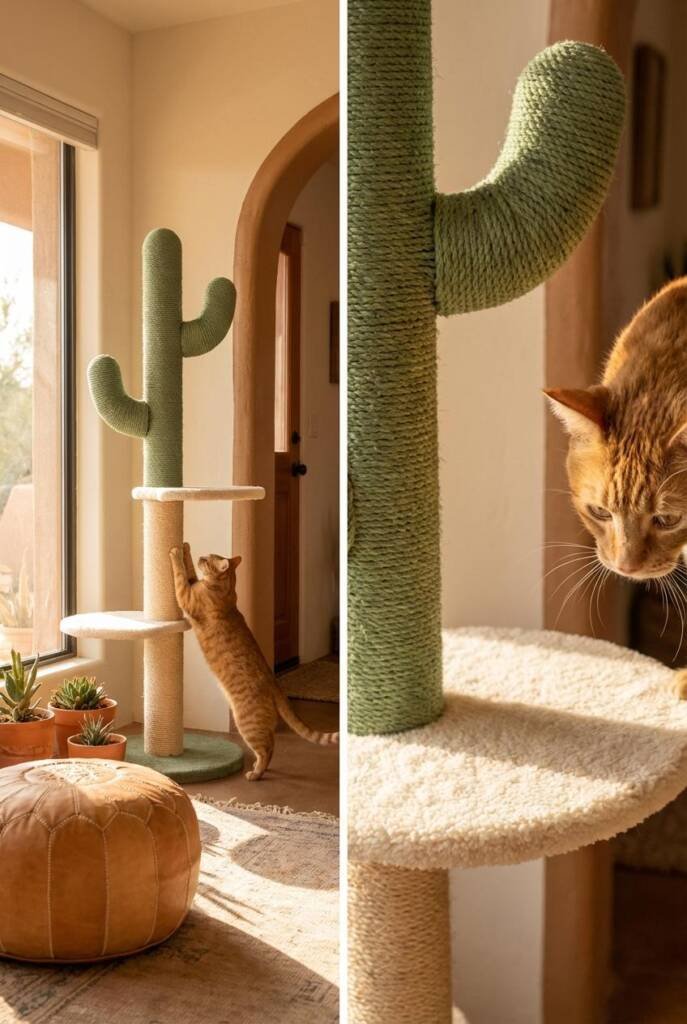
Your cat already thinks it rules the desert — now give it a Saguaro to prove it.
The Saguaro cactus is as iconic to the American Southwest as the Grand Canyon itself, and a cactus-shaped cat tree captures that desert landmark energy without a grain of sand in sight. These cat trees shaped like landmarks typically feature a thick central trunk wrapped in sisal rope with two or three arm-like branches extending outward as perches — the silhouette is unmistakably Saguaro. Finished in earthy greens and browns, they look more like sculptural décor than pet furniture.
What makes a cactus cat tree genuinely brilliant is that the entire structure doubles as a scratching post. Every inch of that trunk and those arms is wrapped in sisal, giving your cat hundreds of square inches of scratchable surface — far more than a standard single-post scratcher. The arm-branch perches sit at different heights, so multiple cats can lounge without territorial drama.
You can find sisal-wrapped cactus cat scratching trees on Amazon for roughly $45–$90 depending on height and number of arms. Pair it with a desert-toned woven rug underneath (grab one on Amazon for around $25) and you’ve got a Southwest vignette that earns compliments from guests who don’t even like cats.
How to Pick a Cactus Cat Tree With Enough Scratching Surface
- Check the sisal coverage: The whole trunk and every arm should be fully wrapped in sisal or jute rope — not just a patch at the base. Look for at least 30 inches of vertical scratching surface on the main post.
- Count the arm perches: A proper Saguaro silhouette needs at least two arm branches at staggered heights. Each perch platform should be roughly 8–10 inches wide so your cat can actually sit on it.
- Confirm the base stability: Desert vibes lose their charm when the cactus topples over. Choose a model with a weighted base at least 16 × 16 inches — a quick Amazon search turns up sturdy options for $50–$85.
- Match the desert palette: Pick a cactus cat tree in muted sage green or olive, then place a small terracotta-style planter nearby to sell the Southwest look without spending extra.
- Budget move: You can pull together the full desert landmark look for under $75 on Amazon — a cactus cat scratching tree for ~$50 and a woven jute rug for around $25.
8. The Space Needle Cat Tree That Turns Ceiling Height Into Prime Cat Real Estate
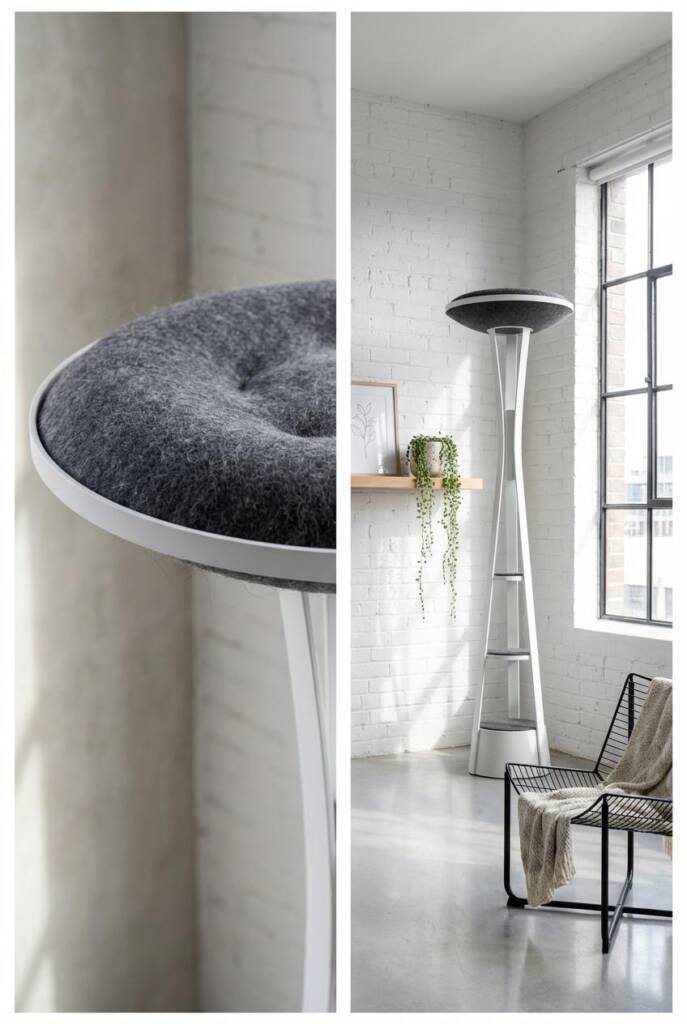
Your cat already thinks they’re above everyone — give them the architecture to prove it.
Picture Seattle’s Space Needle — that impossibly slim tower topped with a flying-saucer observation deck — and now picture your cat sitting smugly at the top of it. A Space Needle cat tree uses a narrow single-pole design that barely occupies a square foot of floor space, then explodes into a wide circular platform near the ceiling where your cat can survey the entire apartment like a furry air traffic controller. Wrapped in sisal rope with a sleek painted finish, it’s the kind of piece guests notice immediately.
Cats are hardwired to seek the highest point in any room, and a floor-to-near-ceiling tower satisfies that instinct without eating into your living area. The wide top platform — think 18 to 24 inches across — gives them a secure perch instead of a wobbly ledge, which matters for confident lounging.
You can find tall floor-to-ceiling tension cat poles with platforms on Amazon for roughly $55–$90, and they anchor securely between floor and ceiling so nothing tips. Add a circular cushion pad on top (grab one on Amazon for under $12) and you’ve got the observation deck.
How to Choose a Floor-to-Near-Ceiling Cat Tree for Small Spaces
- Measure your ceiling height: Check your exact floor-to-ceiling measurement before ordering — most tension-mounted cat poles adjust between 7.5 and 9.5 feet, so confirm yours falls in range.
- Pick a slim tension-mount tower: Look for a floor-to-ceiling tension cat pole with at least one wide upper platform; a quick Amazon search turns up options for $55–$90.
- Create the observation deck effect: Attach or place a round cushion pad (under $12 on Amazon) on the top platform to mimic the Space Needle’s iconic saucer shape and give your cat a plush landing spot.
- Anchor and stability-check: Tighten the ceiling tension mount until there’s zero wobble, and place a small non-slip furniture pad underneath — available on Amazon for around $6 — to protect your floor.
- Budget move: The full Space Needle setup runs under $100 on Amazon — about $75 for the tension pole tower and $12–15 for the cushion pad and floor grip.
9. A Mayan Temple Cat Tree With Step-Pyramid Levels Cats Actually Love to Climb
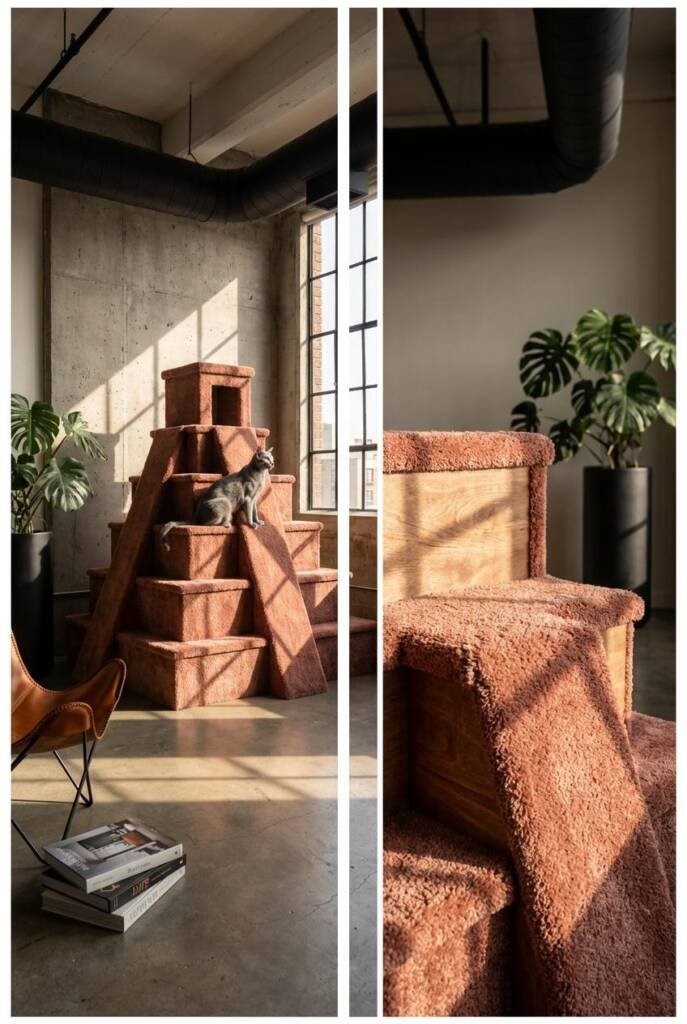
Your cat already thinks it’s a god — now give it a temple to match.
A stepped Mayan temple cat tree turns ancient architecture into a functional climbing sculpture your cats will obsess over. The geometric silhouette — wide at the base, narrowing as it rises through four or five tiers — reads as a bold art piece in any room, especially when wrapped in a warm sand or terracotta-toned carpet. It’s the kind of cat tree that makes people stop and ask where you got it, which is the whole point.
Cats are hardwired to climb vertically and claim the highest perch, and a step-pyramid design gives them a clear path upward with wide landings to rest on each level. The broad tiers double as lounging platforms, so multiple cats can coexist without territorial drama.
For the base structure, a set of stackable wooden storage cubes (find them on Amazon for roughly $40–$60) gives you the graduated footprint you need — just wrap each tier in carpet tiles, available on Amazon for around $15 for a pack of twelve.
How to Integrate a Bold Geometric Cat Tree Into a Neutral Room
- Build the stepped base: Stack 3–4 open-back wooden cubes in descending size (largest on bottom, smallest on top) and secure them together with L-brackets. A set of stackable cubes runs about $50 on Amazon.
- Wrap each tier in carpet: Use self-adhesive carpet tiles in a neutral sand or clay tone — cut to fit and press onto each exposed surface. A 12-pack goes for ~$15 on Amazon.
- Add a summit lounging pad: Top the pyramid with a 14″ × 14″ cushion or fleece pad so the highest perch doubles as a nap spot. Grab a small pet cushion on Amazon for under $12.
- Anchor it to the wall: Attach a furniture anchoring strap from the top tier to a wall stud — a two-pack is available on Amazon for around $8. Non-negotiable with a structure this tall.
- Budget move: The full build comes in under $90 with everything sourced from Amazon — cubes (~$50), carpet tiles (~$15), cushion (~$12), and anchoring straps (~$8).
10. This Lighthouse Cat Tree Has a Built-In Night Light Your Cat (and You) Will Love
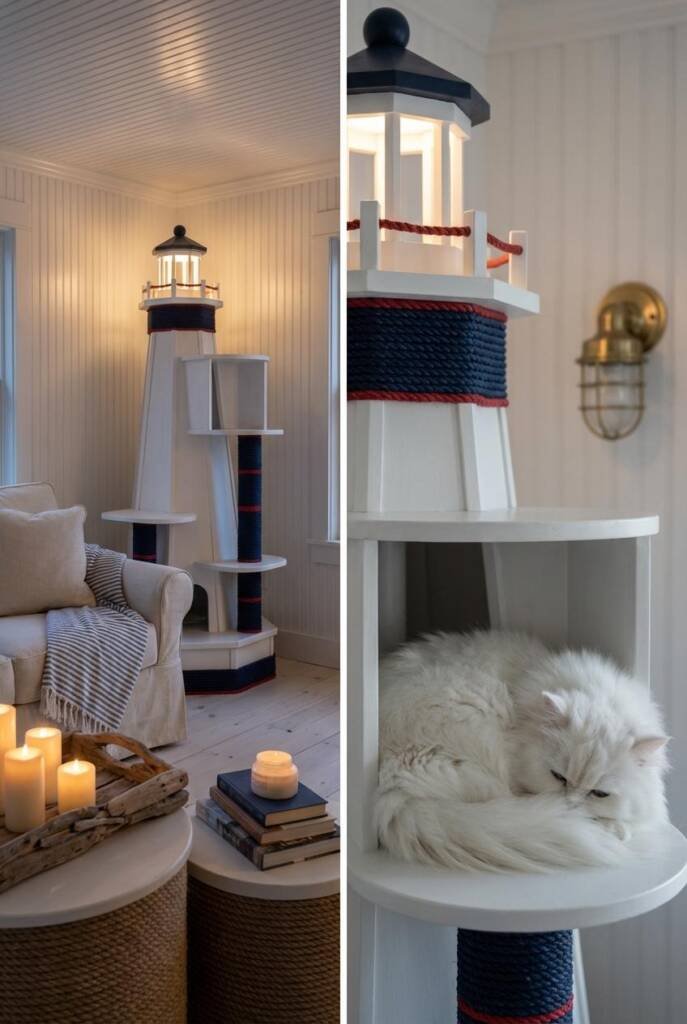
Your cat wants to be a lighthouse keeper — just give them the tower and the night light to prove it.
A lighthouse cat tree takes the classic tall, cylindrical tower shape and wraps it in nautical charm — whitewashed wood tones, a railed observation deck near the top, and a softly glowing LED cap that actually functions as a night light. It’s the kind of piece that makes visitors do a double-take because it reads as coastal decor first, cat furniture second. The warm glow from the top creates genuinely useful ambient light for hallways, reading nooks, or bedrooms without adding another lamp to the mix.
Cats are obsessed with height, and a lighthouse design delivers a narrow vertical climb that ends in a 360-degree lookout perch — exactly the kind of elevated vantage point that makes them feel secure. The cylindrical base is perfect for wrapping in sisal rope, turning the entire structure into a floor-to-ceiling scratching post.
If you don’t find a ready-made lighthouse tree you love, start with a tall circular cat tower (options on Amazon run $55–$90) and customize from there. Add a battery-operated LED puck light to the top platform — you can find multi-packs on Amazon for around $12 — and you’ve got the signature glow without any wiring.
How to Use a Lighthouse Cat Tree as Functional Ambient Lighting
- Pick your tower base: Start with a tall cylindrical cat tree, at least 48 inches high, with a top platform. A quick Amazon search turns up solid options for $55–$90.
- Wrap the base in sisal: Wind natural sisal rope (a 100-foot roll runs ~$14 on Amazon) tightly around the lower two-thirds of the tower, securing with hot glue every few inches.
- Add the lighthouse glow: Attach a warm-white LED puck light or a small battery-operated lantern to the top cap — grab a set on Amazon for under $15.
- Finish with nautical details: Paint the exterior in alternating white and red stripes using non-toxic acrylic paint, and add a small wooden railing around the top perch for the authentic lighthouse silhouette.
- Budget move: You can build this entire lighthouse look for under $85 using a basic cat tower and LED puck lights from Amazon.
Cat Trees, Cat Trees Shaped Like Landmarks That Welcome Pets
Whether you went all-in on the Mayan temple step-pyramid or bookmarked the lighthouse with the built-in night light, every one of these cat trees shaped like landmarks proves the same thing: pet furniture doesn’t have to look like pet furniture. These builds pull double duty — they give your cats the climbing, scratching, and hiding spots they crave while giving your room a sculptural centerpiece that actually reflects your personality.
The best designs are the ones that make visitors ask where you got them and make your cats forget they ever wanted to sit on the kitchen counter. Mix and match ideas, scale them up or down to fit your space, and don’t be afraid to customize finishes and textures to match your existing decor. Cat trees shaped like landmarks work in minimalist apartments, eclectic living rooms, and dedicated cat rooms alike — it’s all about choosing the build that fits your skill level and your cats’ play style.
Here at Sweet Purrfections, we create content at the intersection of cool home decor and real life with pets. Because we believe your home should look like it belongs in a design magazine AND work for the furry family members who actually run it.
Leave a Reply