
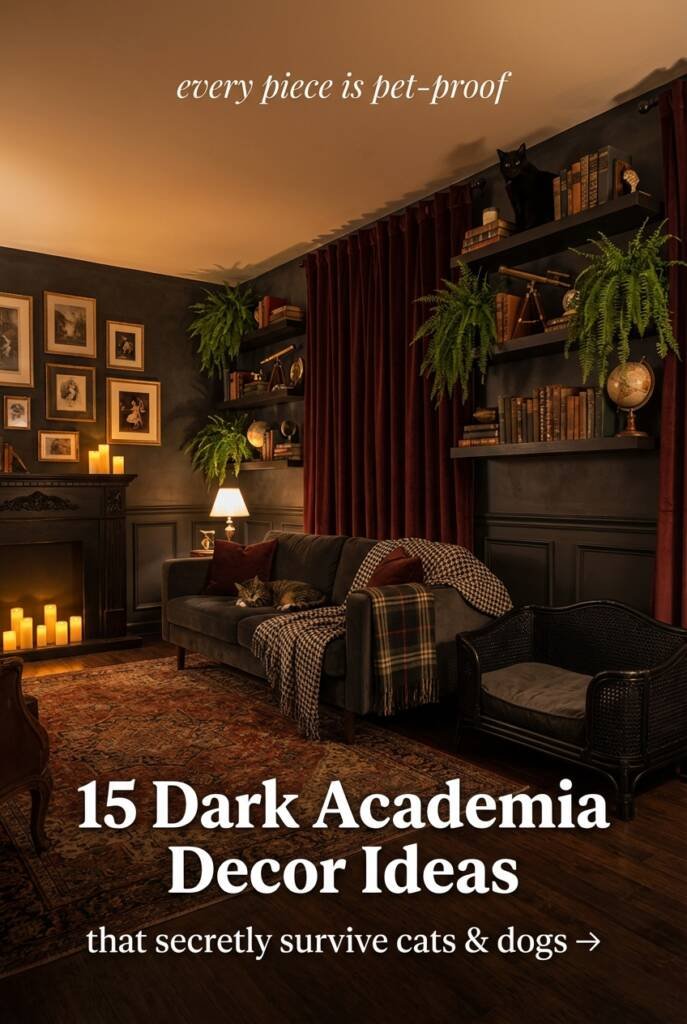
If you’ve ever scrolled through dark academia Pinterest boards and thought, “that’s gorgeous, but it would never survive my cat” — we need to talk. Because here’s the thing nobody in the decor world is saying out loud: dark academia might be the single most pet-friendly interior design style that exists.
Think about what defines the aesthetic. Dark tones that don’t show stains or fur. Heavy, weighty objects that can’t be knocked off shelves. Textured walls that absorb scuffs instead of highlighting them. Vintage furniture that’s supposed to look worn. Layered fabrics in forgiving colors.
Every core element of dark academia quietly solves a problem that pet owners deal with daily. Not as a compromise — as a feature.
This isn’t a “how to do dark academia” guide (there are a hundred of those). This is a guide for people who love the aesthetic AND share their home with animals who shed on velvet, scratch walls, knock things off surfaces, and need a litter box somewhere. For each idea, we’ve included a quick DIY breakdown so you can actually make it happen this weekend — not just pin it for “someday.”
Let’s get into it.
Already into dark decor? You’ll also love our 11 Dark Home Decor Ideas That Are Surprisingly Pet-Friendly.
1. Dark Velvet Furniture That Hides Every Strand of Pet Hair
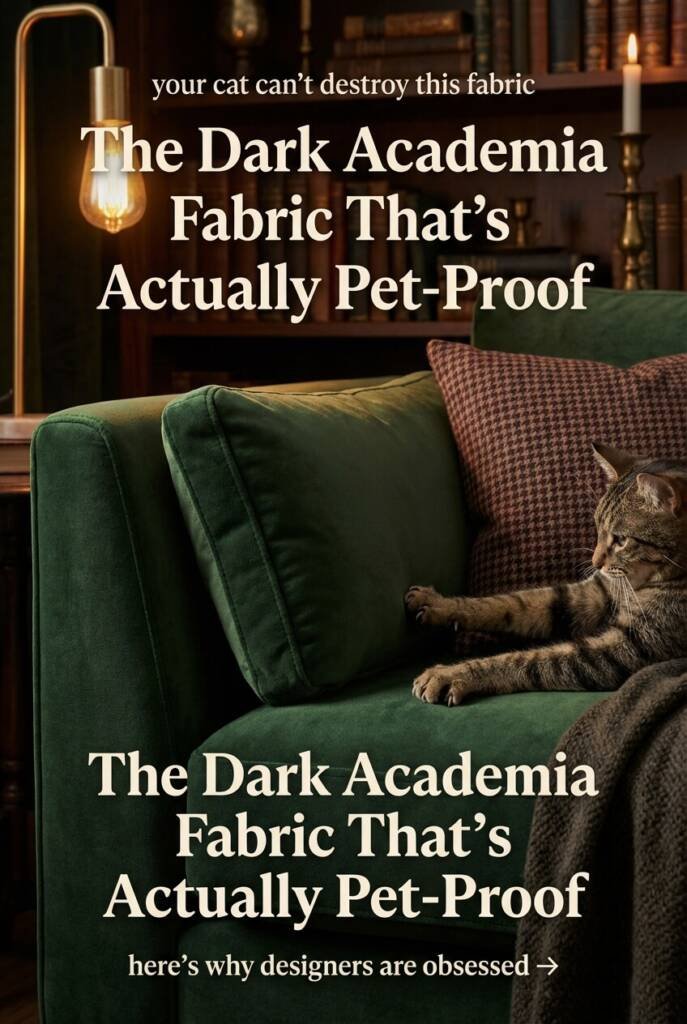
There’s a myth floating around that velvet and pets don’t mix. It’s wrong — and once you understand why, you’ll never look at light-colored sofas the same way again.
Velvet’s dense, tightly woven pile actually resists claw snags far better than loosely woven fabrics like linen or cotton twill. The fibers sit so close together that claws slide across the surface instead of catching and pulling. That’s why cats can knead on velvet for years without destroying it the way they’d shred a chunky knit throw in one afternoon.
Now add dark color to the equation. A cream velvet sofa is a living pet hair billboard. But a deep burgundy, forest green, charcoal, or navy velvet sofa? You’d need a forensic light to find the fur. Dark jewel tones don’t just look moody and sophisticated — they’re functional camouflage.
The key is choosing performance velvet (sometimes labeled “pet-friendly velvet” or “stain-resistant velvet”). These are typically polyester-blend fabrics that maintain velvet’s signature sheen and softness but add stain resistance and washability. They cost roughly the same as regular velvet but last dramatically longer in a pet household.
How to Bring Dark Velvet Into Your Space
- The easy entry point: Start with 2-3 dark velvet throw cushions on your existing sofa. Burgundy, emerald, or charcoal. This costs under $40 and instantly shifts the mood of your room toward dark academia without any commitment. If you love the look, upgrade from there.
- The full commitment: Measure your sofa and order a dark performance velvet slipcover. Charcoal is the single most forgiving color for multi-pet homes — it hides light fur, dark fur, stains, and general life. A quality washable slipcover runs $60-80 and transforms a basic sofa into something that looks intentionally moody.
- The layering trick: Once you have your dark velvet base, layer a throw blanket in a complementary jewel tone (burgundy throw on a navy sofa, emerald throw on charcoal). Then add one patterned cushion — houndstooth, plaid, or dark floral — to break up the solid color. This layered look IS dark academia, and every piece is individually washable.
- Before you buy, do this: Order a fabric swatch and press it against your pet’s fur. Take a photo. If the fur disappears, you’ve found your color. Five minutes of testing saves you from a $200 mistake.
- Budget move: Thrift store sofas are everywhere and often free or under $50. A $70 dark velvet slipcover on a free thrift sofa looks identical to a $1,200 new velvet couch. The slightly rumpled, draped look actually enhances the dark academia vibe — this aesthetic favors “lived-in scholarly” over “showroom perfect.”
2. Faux Candlelight & Edison Bulbs for Pet-Safe Moody Glow
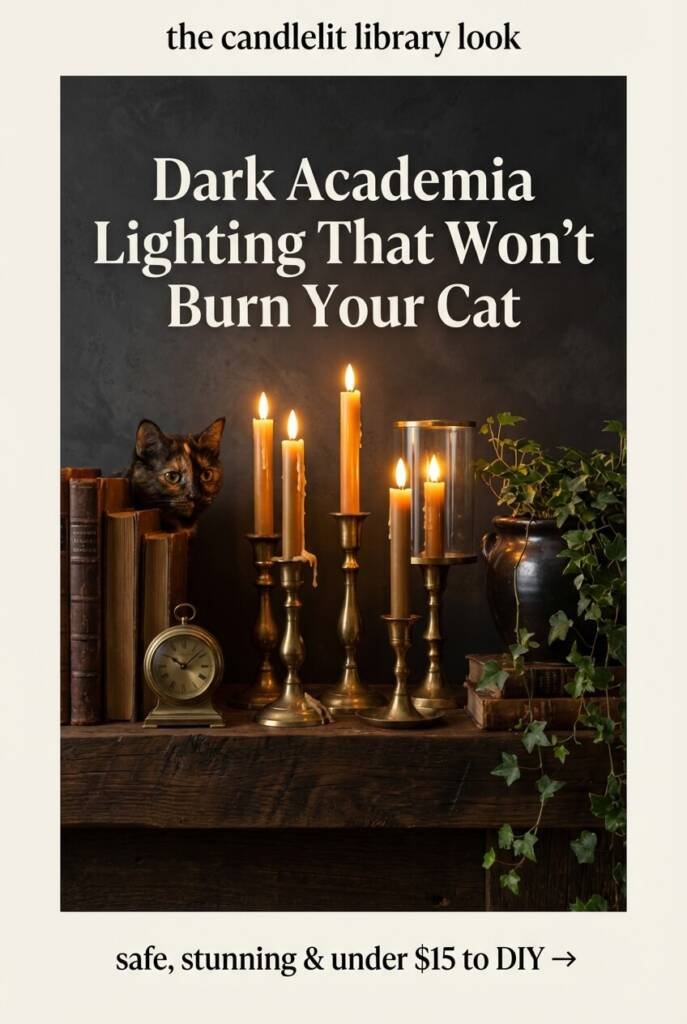
Lighting makes or breaks dark academia. Without the right glow, a dark room is just… a dark room. With warm, amber, flickering light? It’s a candlelit library where you half-expect to find a leather-bound spell book on the desk.
The problem is obvious: real candles and pets are a terrible combination. One tail swipe, one curious nose, one ambitious jump near a shelf — and you’re dealing with singed fur at best, a house fire at worst. This isn’t a risk worth taking, no matter how beautiful those taper candles look.
The good news is that faux candlelight technology has gotten remarkably convincing. We’re not talking about those cheap, obviously-plastic tea lights from 2012. Modern LED flameless candles have real wax exteriors, realistic flickering patterns, and warm amber tones that are genuinely indistinguishable from the real thing — especially in a dimly lit room, which is the whole point of dark academia.
The second game-changer is Edison bulbs. Those exposed-filament bulbs in warm amber (look for 2200K color temperature) cast the exact same golden, nostalgic glow that candles do, but from a fixed, pet-safe position in a lamp or light fixture. One Edison bulb table lamp can transform an entire room’s mood.
How to Set Up Pet-Safe Dark Academia Lighting
- The candle swap: Go through your home and replace every real candle with a flameless LED version. The key to making them look real is grouping. A single flameless candle looks fake. A cluster of 3-5 at different heights on a dark tray? That looks like a still life painting. Place them in vintage brass candleholders (thrift stores are overflowing with these for $3-5 each), inside glass hurricane lanterns, or directly on dark wood surfaces.
- The bulb swap: Replace your overhead and lamp bulbs with warm Edison bulbs in 2200K color temperature. This single change — which takes five minutes and costs about $15 for a pack of four — transforms the entire atmosphere of a room from “harsh apartment lighting” to “moody scholarly retreat.” It’s the highest-impact, lowest-effort dark academia upgrade that exists.
- The timer trick: Most quality flameless candles have built-in timers (6 hours on, 18 hours off). Set them to auto-light at dusk. Every evening, your room transitions from daylight to candlelit dark academia without you lifting a finger. It sounds small, but the daily ritual of watching your space shift into that warm glow is genuinely mood-changing.
- The layering approach: Combine multiple light sources at different heights for depth. A table lamp with an Edison bulb for your main reading area. A cluster of flameless candles on a shelf or mantel. A strand of warm fairy lights along a bookshelf. Dark rooms need MORE light sources, not fewer — they just need to be warm, dim, and scattered rather than one bright overhead fixture.
- Budget move: Dollar stores carry flameless LED candles. They’re not as realistic as the $20 wax versions, but inside a glass lantern or brass holder, the container does most of the visual work. Six dollar-store candles in a $5 thrift store brass tray = a $11 centerpiece that looks like it costs ten times that.
3. Dark Floating Shelves That Double as a Cat Climbing Wall
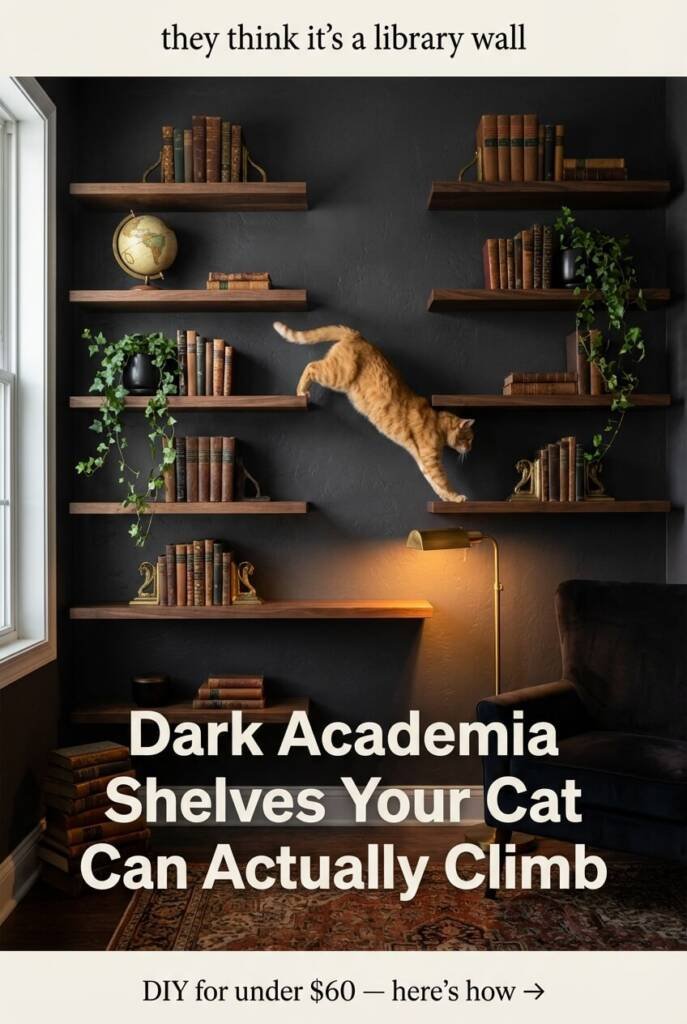
This one is a genuine two-for-one — and once you see it, you can’t unsee it.
Floating dark wood shelves are a dark academia staple. They line the walls of every inspiration photo: loaded with old books, vintage objects, trailing plants, and that general “personal library” energy. They’re functional, architectural, and they add drama to any blank wall.
Now look at what cat behaviorists recommend for enrichment: elevated platforms at staggered heights that allow cats to climb, perch, and survey their territory from above. Sound familiar?
A wall of dark floating shelves IS a cat climbing wall. The only difference between “dark academia bookshelf display” and “cat enrichment system” is the spacing between shelves. Get that spacing right — 12 to 16 inches vertically, slightly offset horizontally — and your cat can leap from shelf to shelf while your wall looks like it belongs in an old English study.
The trick is leaving enough open space on each shelf for your cat to land and sit comfortably. You don’t need to choose between books and your cat — you just need to be intentional about what goes where. Heavy books and objects on the shelves your cat doesn’t use. Open landing space on the ones they do.
How to Build Dark Academia Cat-Climbing Shelves
- Choosing shelves: Go at least 10 inches deep (your cat needs room to sit) and at least 24 inches wide. Dark walnut, espresso, or matte black finishes are the most versatile. Avoid glossy finishes — they’re slippery for cat paws and show dust more.
- The layout: Start your lowest shelf at about 2-3 feet off the ground (an easy first jump) and stagger upward. Each shelf should be 12-16 inches above the previous one and offset to the left or right by about half a shelf width. This creates a natural “staircase” that cats intuitively understand. The top shelf should be the most spacious — that’s the throne, and your cat will claim it immediately.
- Critical safety step: Anchor into wall studs wherever possible, using brackets rated for at least 30 pounds per shelf. Cats don’t just sit on shelves — they leap onto them with force. A shelf that can hold books might not survive a 12-pound cat launching itself from three feet away. Over-engineer the mounting. Always.
- The traction fix: Bare wood or laminate can be slippery for cats. Cut a thin piece of dark felt, dark fabric, or non-slip shelf liner to fit each shelf surface. This gives your cat grip for landing and launching, and it’s invisible from below.
- Styling around your cat: Place your heaviest books and decorative objects on the shelves closest to the ground (less damage if anything falls, and your cat is less likely to use the lowest shelves anyway). Leave the upper shelves more open with just 1-2 small items pushed to the back. The negative space actually looks more sophisticated — cluttered shelves feel busy, while shelves with breathing room feel curated.
- Budget move: IKEA LACK shelves in black-brown cost about $10 each. Five of them stained slightly darker with a quick coat of espresso wood stain = a full climbing wall for under $60 that looks indistinguishable from custom carpentry.
For a deeper dive on this concept, see our full guide: DIY Cat Wall Ideas That Look Like Art
4. Vintage Oriental Rugs With Patterns That Camouflage Pet Mess
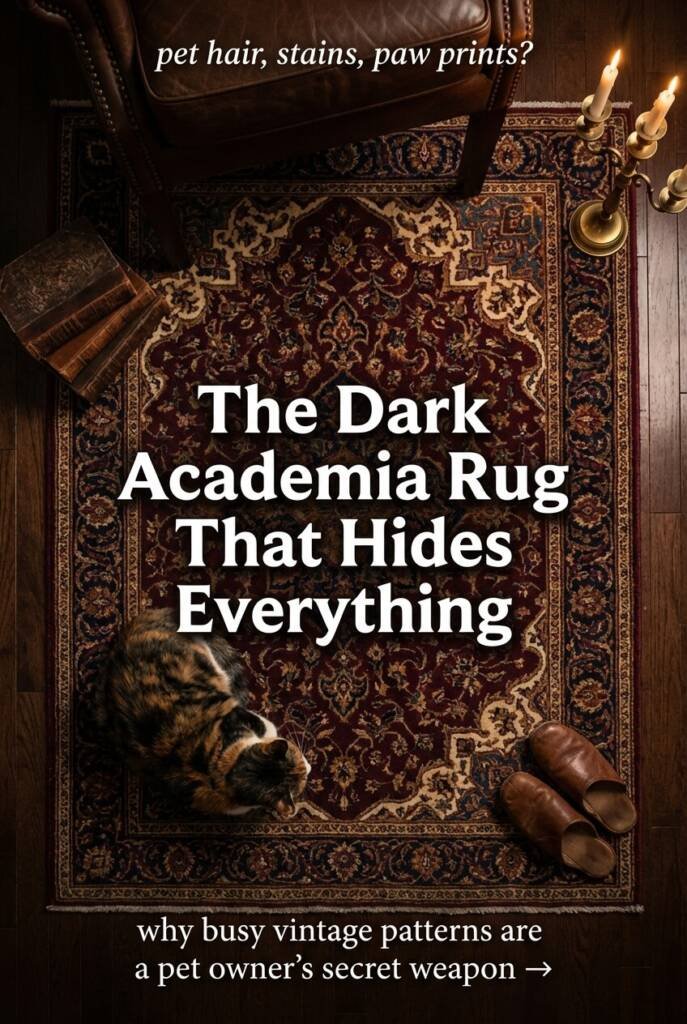
If there’s one item on this list that pays for itself in reduced stress alone, it’s this one.
Light, solid-colored rugs in a pet household are an ongoing source of anxiety. Every muddy paw print, every hairball, every “accident” is immediately visible and requires immediate cleaning. You spend more time maintaining the rug than enjoying it.
Now look at a vintage-style Oriental or Persian rug. Deep burgundy, navy, gold, and forest green all woven together in intricate, multi-layered patterns. These rugs were literally designed for high-traffic environments — they originated in cultures where shoes stayed on indoors, animals roamed freely, and rugs took daily abuse for decades.
The busy pattern does all the work. A muddy paw print on a white rug is a crisis. A muddy paw print on a burgundy Persian rug with 47 colors in its design? You wouldn’t see it from three feet away. Pet hair in five different shades? Lost in the pattern. A small stain? It looks like it was always part of the design.
And here’s the beautiful irony: the more “worn” these rugs get, the more authentic and valuable they look. A pristine Persian rug looks mass-produced. One with some fading, some soft spots, some signs of real life? That looks like a genuine antique that’s been in the family for generations. Your pets are actually aging your rug into something more beautiful.
How to Choose and Care for Dark Academia Rugs
- Color selection: Choose rugs with dark base colors — deep red, navy, black, or forest green backgrounds. These are the most forgiving for everyday pet life. Avoid rugs with large areas of cream or white, even if the overall palette is dark.
- Pattern density: More colors and more intricate patterns = more camouflage. A rug with 5-6 colors in a dense, all-over pattern will hide virtually anything. A rug with large open fields of solid color (even dark ones) will show more.
- Material matters: Wool rugs are naturally stain-resistant, odor-resistant, and incredibly durable — they’re genuinely the best material for pet households. Polypropylene (synthetic) rugs are the most affordable option and are easy to clean but won’t develop that authentic aged patina. Avoid silk rugs entirely if you have pets.
- Size it right: For dark academia, your rug should be large enough that your main furniture pieces sit partially on it. A rug that’s too small for the room looks like an afterthought. Bigger is almost always better.
- The rug pad is non-negotiable: Place a non-slip rug pad underneath every rug in a pet household. When your cat does zoomies at 3 AM, you don’t want the rug bunching up under them and causing a slip injury (for them or you).
- Maintenance reality check: Vacuum weekly as part of your normal routine. Spot-clean stains with a damp cloth and mild soap. That’s it. These rugs require dramatically less obsessive cleaning than light, solid-colored alternatives because the pattern is doing the heavy lifting.
- Budget move: Facebook Marketplace and estate sales are goldmines for real vintage rugs at a fraction of retail. Search “Oriental rug” or “Persian rug” and filter by your area. You’ll find stunning pieces for $50-150 that would retail for $500+. The more worn they look, the more authentic — and that’s not a consolation prize, that’s genuinely what makes them beautiful.
5. Textured Dark Walls That Turn Pet Scratches Into “Patina”
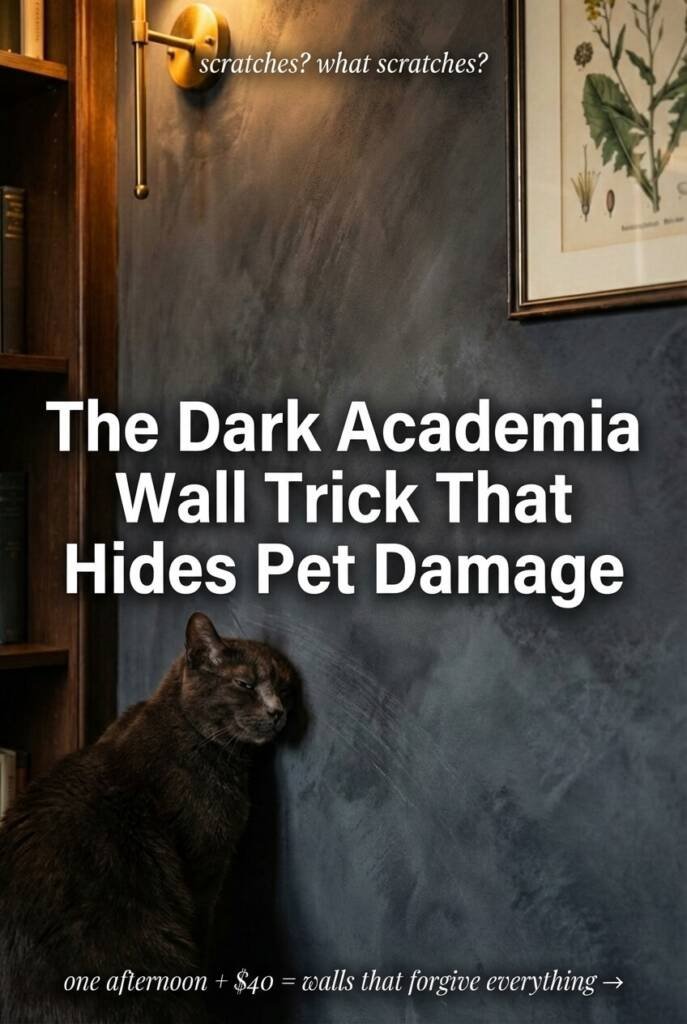
Let’s talk about why smooth, flat walls are a pet owner’s worst enemy — and why dark academia’s preference for texture is accidentally genius.
A flat matte wall in any color shows every scratch, scuff, and bump like a spotlight. Cats brush against walls. They occasionally claw at corners. Dogs bonk into things. Kids, doors, pet carriers, vacuum cleaners — everything leaves a mark on flat drywall, and once you notice it, you can’t un-notice it.
Textured walls solve this completely. A limewashed wall in deep charcoal or dark blue is supposed to look varied, cloudy, and imperfect — that’s the entire appeal. A scratch blends right into the natural variation. A plaster-effect finish has inherent depth and dimension that absorbs minor surface damage. Textured wallpaper — grasscloth, linen, or faux plaster — hides scuffs in its own tactile surface.
And dark colors amplify the effect. A scratch on a white limewash wall is still somewhat visible because the underlying white drywall shows through. A scratch on a charcoal limewash wall? The shadow of the texture swallows it whole.
This is what designers mean by “patina.” It’s damage that makes something look more authentic, more aged, more valuable. On a smooth white wall, a scratch is damage. On a textured dark wall, a scratch is character.
How to Create Dark Textured Walls
1. Limewash (the most dark academia look)
Limewash is a mineral-based paint that creates soft, cloudy variation on walls. It looks like aged European plaster and it’s far easier to apply than it looks. Brands like Romabio make user-friendly versions that require zero professional experience.
Start with a single accent wall — the wall behind your sofa or your bed headboard wall. Apply a coat of dark primer first and let it dry completely. Then apply limewash with a large brush using random, overlapping cross-hatch strokes. You’re not aiming for smooth, even coverage — the variation IS the look. Build up 2-3 thin layers, letting each dry, until you reach the depth you want.
Materials cost: about $40-60 for one wall. Time: one afternoon. Impact: transformative.
2. Color washing (the budget version)
If limewash paint isn’t available or feels intimidating, you can create a similar effect with regular paint and a glaze. Paint your wall a dark base color (charcoal, deep navy, or forest green) and let it dry. Then mix a second shade — 1-2 tones lighter — with clear glaze at a ratio of about 1 part paint to 4 parts glaze. Apply the mixture with a scrunched-up rag in random circular motions over the base coat. This creates depth and movement that mimics aged plaster. Total cost: about $25.
3. Peel-and-stick (rental friendly)
If you can’t paint, dark textured peel-and-stick wallpaper is the answer. Look for grasscloth, linen texture, or faux plaster finishes in charcoal, dark navy, or black. These apply in minutes, remove cleanly, and add genuine texture that helps hide pet scuffs. They’re not as dramatic as real limewash, but they’re vastly better than flat painted walls.
6. Black Rattan Pet Beds That Pass as Vintage Furniture
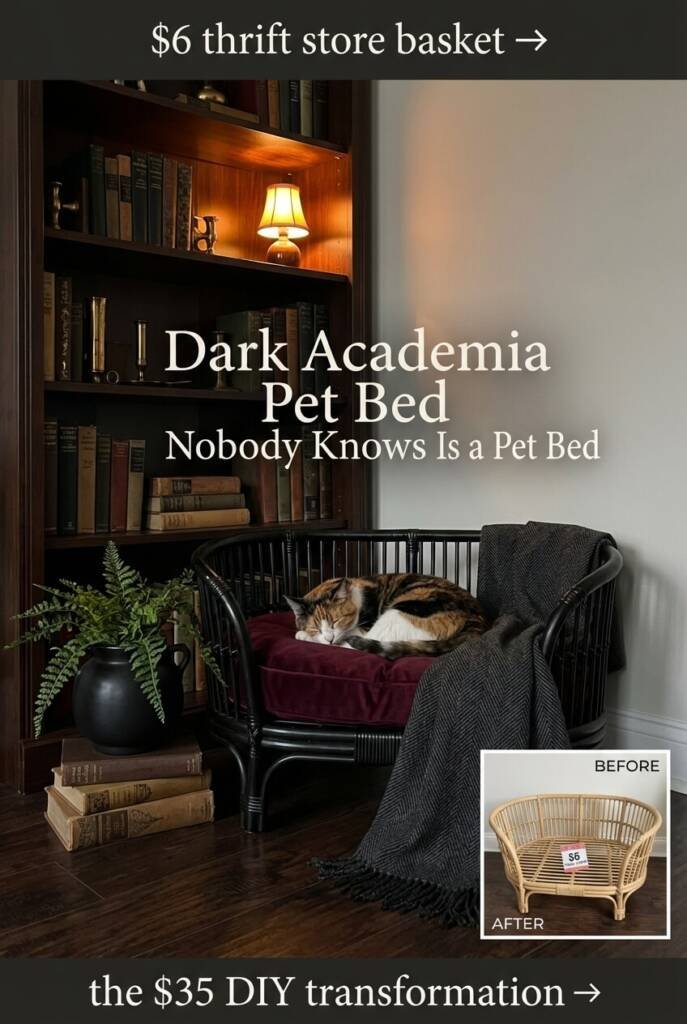
This is one of those ideas that sounds simple but genuinely changes how people see your space.
A standard pet bed screams “I have a pet.” It’s usually an awkward color, an awkward shape, and it sits in your room like an uninvited guest. You tolerate it because your cat or dog needs it, but it never feels like it belongs.
A black rattan pet bed, styled correctly, reads as vintage furniture. Place it next to a bookshelf. Add a dark velvet cushion inside. Drape a throw over one edge. Stack a few old books beside it on the floor. Nobody — and we mean nobody — will identify it as a pet bed until your cat walks over and curls up inside it.
Rattan also has practical advantages for pets. The open weave provides airflow, which cats appreciate in warm weather. The slightly enclosed shape creates that “nest” feeling cats instinctively seek. And rattan is surprisingly durable — much tougher than it looks.
How to Make a Dark Academia Rattan Pet Bed
The thrift store route (our recommendation): Thrift stores, estate sales, and Facebook Marketplace are full of round or oval rattan baskets and chairs in natural light tones. They usually cost between $5-15 because nobody wants them in their original beige color. That’s your opportunity.
Clean the basket thoroughly and let it dry. In a well-ventilated area, apply 2-3 light coats of matte black or dark espresso spray paint — matte finish is important because glossy spray paint on rattan looks cheap. Let each coat dry before applying the next.
For the cushion, measure the interior and either buy a dark velvet cushion that fits or cut a piece of memory foam to size and slip it into a dark velvet pillowcase. Burgundy, charcoal, and forest green all work beautifully against black rattan.
Styling it into the room: Place the bed in a corner or beside a bookshelf — somewhere it looks like a permanent piece of furniture, not something you set down temporarily. Drape a textured dark throw partially over one edge. Put a small stack of 2-3 old books on the floor next to it. If there’s a shelf above, place a trailing plant so it cascades down nearby. These contextual cues tell visitors’ brains “this is furniture” before they have time to think “this is a pet bed.”
Total cost: $5-15 for the thrift store basket + $8 for matte black spray paint + $12 for a dark velvet cushion cover = under $35 for something that looks like a $200 vintage find.
For more pet furniture that doubles as design pieces, see our Art Deco Cat Trees That Double as Statement Furniture
7. Dark Washable Slipcovers That Look Intentionally Scholarly
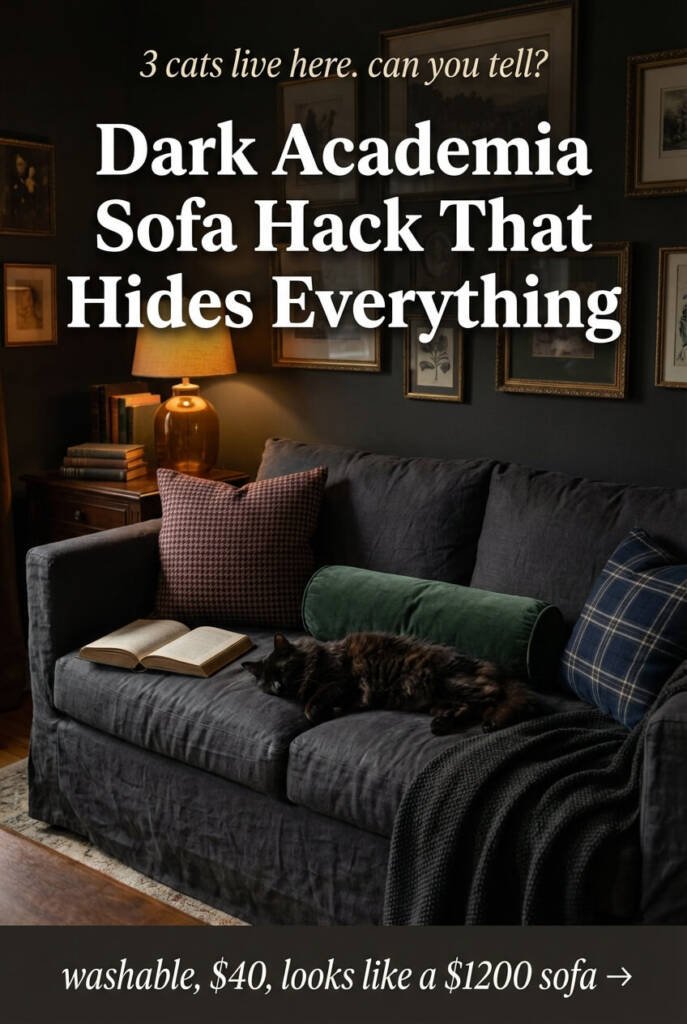
We need to retire the idea that slipcovers are a downgrade. In the context of dark academia, a draped, slightly rumpled slipcover on a sofa doesn’t just work — it actually looks more authentic than pristine, tight-fitted upholstery.
Think about the spaces that inspired dark academia. A professor’s study in an old English university. The lounge of a Gothic estate. A reader’s parlor in a centuries-old townhouse. The furniture in those spaces isn’t pristine. It’s layered, textured, draped, slightly lived-in, and invitingly worn. That’s the vibe.
A charcoal or navy slipcover captures this perfectly. It says “this sofa has hosted a thousand late-night reading sessions” in a way that a tight, showroom-perfect sofa never could. And for pet owners, the practical benefits are obvious: washable, replaceable, and dark enough to hide everything between washes.
How to Style Dark Academia Slipcovers
- Choosing the right fit: Stretch-fit slipcovers give the cleanest, most modern look. Oversized, loose-fitting slipcovers give a more romantic, “draped in fabric” look. Both are dark academia-appropriate — it depends on whether you lean more “modern scholar” or “Victorian poet.”
- Color choices ranked by pet-forgiveness: Charcoal (hides everything, works with all decor), deep navy (hides most fur, beautiful with brass accents), dark brown (great with leather and wood, shows light-colored fur slightly more), forest green (stunning but shows some light fur — best if your pets are dark-furred).
- The layering formula: Dark slipcover as your base. One textured throw blanket draped asymmetrically (herringbone, waffle knit, or chunky cable knit in a complementary dark tone). Two to three cushions: one large solid dark velvet, one medium patterned (houndstooth or plaid — classic dark academia patterns), and one smaller accent. This layered look is the difference between “sofa with a cover” and “intentionally styled dark academia seating.”
- The two-cover system: Buy two identical slipcovers in the same color. When one is in the wash (or covered in fur after a week), the other goes on immediately. You’ll never have a bare, exposed sofa, and the rotation keeps everything fresher longer. At $30-50 each, two covers cost less than a single professional upholstery cleaning.
- The “I was just reading” touch: Leave a single old hardcover book open and face-down on the sofa arm or cushion. It sounds like a tiny detail, but it shifts the entire energy of the sofa from “furniture” to “someone’s reading spot.” That’s the dark academia magic — small details that tell a story.
8. Pet-Safe Dark Academia Plants in Moody Ceramic Pots
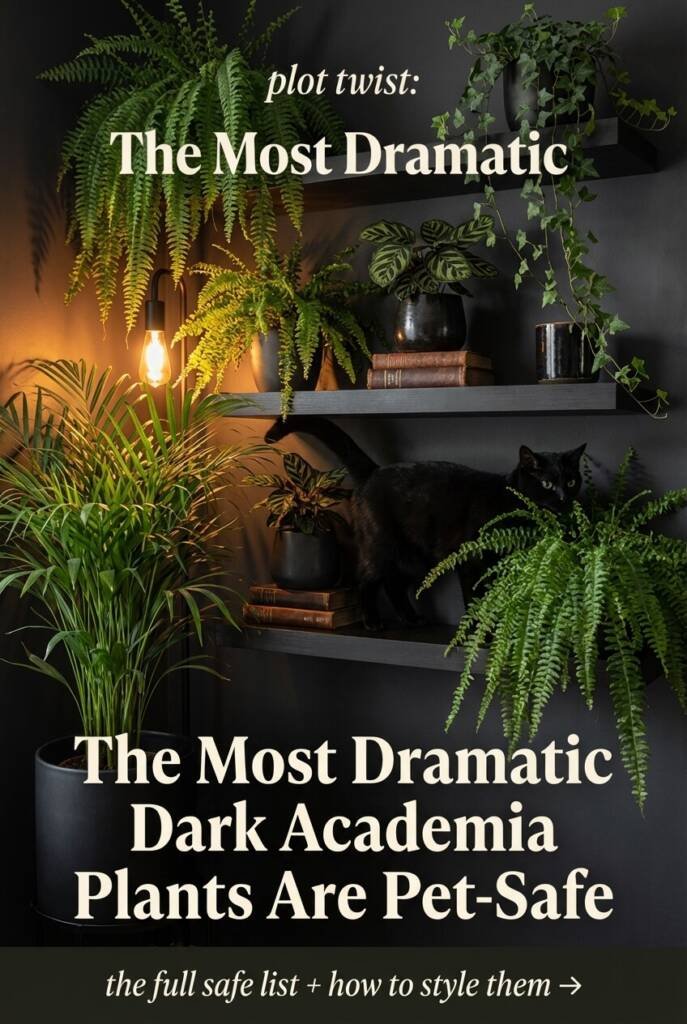
The botanical element of dark academia is non-negotiable. Those trailing vines, lush ferns, and dramatic green leaves are what prevent a dark room from feeling cold or sterile. They add life — literally — and they create that “overgrown greenhouse in an old university” atmosphere that makes dark academia feel warm and organic rather than just dark.
The concern for pet owners is real: many popular houseplants are toxic to cats and dogs. Lilies, pothos (in large quantities), philodendrons, and several others can cause serious problems if ingested. But here’s the good news — the most visually dramatic dark academia plants happen to be pet-safe.
Boston ferns are lush, dramatic, trailing, and completely non-toxic. Spider plants are wild and architectural. Parlor palms are tall and elegant. Calatheas have dramatic dark-patterned leaves. African violets add moody color. Prayer plants fold their leaves at night, which is frankly magical. All of them are safe for pets, and all of them look like they were placed by a Victorian botanist.
How to Create a Pet-Safe Dark Academia Plant Corner
- Choosing your plants: You want a mix of shapes for visual interest. One tall plant (parlor palm — adds height and drama). One trailing plant (Boston fern — the most “dark academia” plant that exists). One bushy plant (calathea — dark, patterned leaves that look scholarly). One or two small accents (African violets or small prayer plants for color and texture).
- The container matters enormously. The same $5 fern looks completely different in a cheap plastic nursery pot versus a matte black ceramic planter. Dark containers — matte black, dark brown, deep green glazed — instantly elevate basic plants to dark academia status. If budget is tight, spray-painting basic terracotta pots matte black costs about $2 each and the result is indistinguishable from $25 designer ceramics.
- Arrangement: Group plants at varying heights to create depth. Tall plant on the floor. Medium plant on a shelf, a stack of old books, or a dark plant stand. Trailing plant on a high shelf or hanging from a ceiling hook in a dark macramé hanger. The grouping should feel lush and slightly wild — resist the urge to space them out neatly. Dark academia plants should look like they’ve been growing there for years, not like they were arranged yesterday.
- Let them grow wild. This is important. Don’t trim trailing plants into neat, contained shapes. Let the Boston fern cascade. Let the pothos trail down the shelf and along the wall. The slightly overgrown, untamed look IS the aesthetic. Think “professor who’s been too absorbed in research to prune the plants” — that’s the energy.
- A note on pothos/Devil’s ivy: Pothos is the quintessential trailing plant for dark academia shelves, but it is mildly toxic if eaten in large quantities. If your cat is a known plant-chewer, substitute with a prayer plant (calathea) or hang your pothos high enough that it’s completely out of reach. If your cat ignores plants entirely, pothos is generally fine — but know your pet.
- Propagation tip: Spider plants and pothos produce babies constantly. Start with one $5 plant and within a few months you’ll have enough to fill an entire shelf wall. Propagation is the dark academia plant strategy — it’s slow, intentional, and costs almost nothing.
9. Cat-Proof Gallery Walls: Ditch the Glass, Keep the Drama
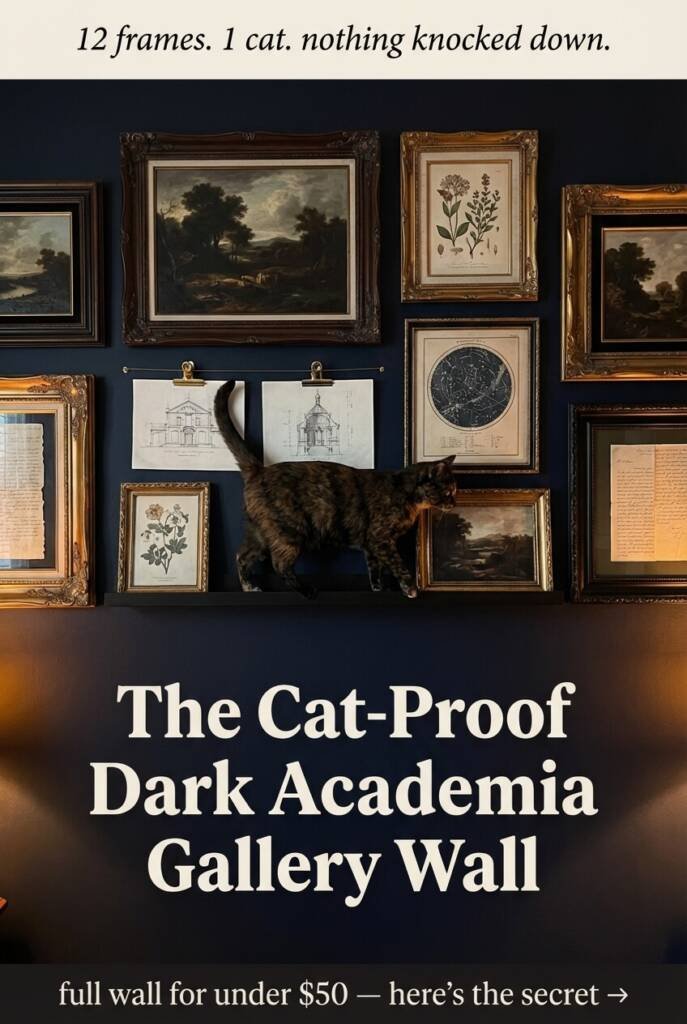
A gallery wall packed with vintage oil paintings, moody landscapes, botanical prints, and old-world portraits is the visual heartbeat of dark academia. It’s what transforms a dark room from “needs more light” to “this person has taste.”
But for pet owners — especially cat owners — traditional gallery walls have an obvious vulnerability. Glass-fronted frames. Cats jump. Cats rub against walls. Cats occasionally swat at things for sport. One loosened frame tumbling off the wall means shattered glass, ruined art, and a potential injury.
The solution isn’t to give up on gallery walls. It’s to rethink the materials — and in doing so, you’ll actually end up with something that looks MORE authentically dark academia, not less.
Here’s why: real old university halls, estate libraries, and scholars’ studies didn’t have pristine glass-covered frames everywhere. They had oil paintings mounted directly. Prints pinned to cork boards. Sketches clipped to wire lines. Frames that had been hung for decades and showed their age. Your cat-proof gallery wall isn’t a compromise — it’s more historically accurate.
How to Build a Cat-Proof Dark Academia Gallery Wall
- Choosing frames: Hit thrift stores and estate sales for dark wooden frames — ornate carved frames, simple dark wood rectangles, antique gold-toned frames. Mix sizes and styles. Odd numbers (7, 9, 11 pieces) look more natural than even numbers. The mix of different frame styles creates that “collected over a lifetime” look that dark academia is all about.
- The glass swap: For every frame, replace the glass insert with a piece of acrylic/plexiglass cut to the same dimensions. Most frame shops will cut acrylic to size for a few dollars per piece. Acrylic is lighter than glass (less damage if anything falls), completely shatter-proof, and nearly invisible once installed. Your art looks the same; your risk drops to zero.
- The frameless option: For an even more authentic vintage look, skip frames entirely on some pieces. Use brass bulldog clips to hang prints directly from a horizontal wire or dark wooden rail. This looks like a working artist’s or scholar’s display and is completely cat-proof — there’s nothing to knock off the wall because everything is flat-mounted.
- Choosing art: Dark academia gallery walls typically include: moody landscape paintings (stormy skies, dark forests), vintage botanical illustrations, old-world portraits, antique maps, astronomical charts, classical architecture sketches, and pages from old books. Etsy has incredible affordable printable dark academia art — you can print an entire gallery wall’s worth of art for under $20 on matte cardstock. Matte paper is essential — glossy printouts immediately look like modern reproductions.
- Securing everything: Apply a small blob of museum putty (also called earthquake putty) to each bottom corner of every frame. This invisible adhesive holds frames firmly in place against the wall — cats can’t nudge them crooked or vibrate them loose by rubbing against the wall below. A $5 pack secures 20+ frames.
- Layout tip: Lay your entire arrangement on the floor first and photograph it from above with your phone. This gives you a reference map before you start drilling. Hang the largest piece first (slightly off-center for a more organic feel) and build outward. Maintain roughly equal spacing between frames — about 2-3 inches — for cohesion.
- Budget breakdown: Thrift store frames at $2-5 each. Printable art for $1-3 per piece from Etsy. Matte cardstock for printing at home. Museum putty for $5. A full 9-piece dark academia gallery wall can cost under $50 total — and it looks like you’ve been collecting art for decades.
10. Dark Cat Trees & Black-Washed Pet Furniture That Vanish Into the Room
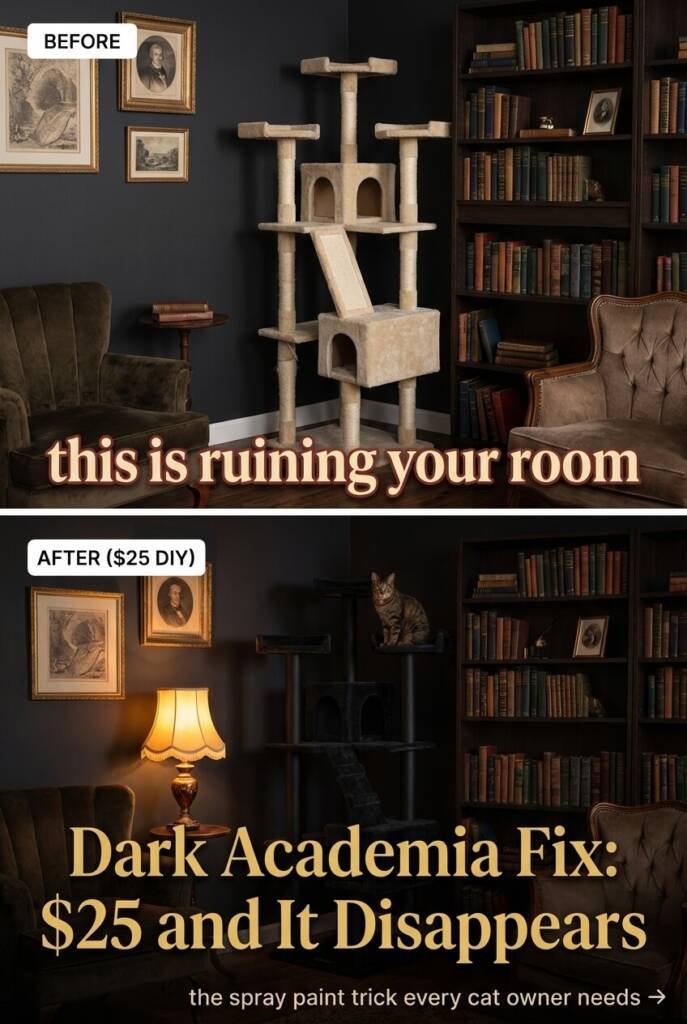
This isn’t about making your cat tree “blend in.” It’s about making it disappear.
Here’s the visual principle at work: when two objects are the same dark tone and texture, your eye reads them as one continuous surface. A matte black cat tree placed against a dark charcoal wall stops being a separate object. It becomes part of the wall. Part of the architecture. Your brain literally doesn’t register it as “cat tree” — it registers it as “dark corner of the room.”
This only works when the tones match. A beige cat tree against a dark wall is the most visible piece of furniture in the room. A black cat tree against a dark wall? You’d walk past it without noticing.
The same applies to every piece of pet furniture in your home. Dark wood litter box enclosures. Black-finished pet gates. Espresso-toned feeding stations. In a light room, these items are always an eyesore. In a dark academia room, they’re invisible infrastructure.
How to Create Invisible Dark Academia Pet Furniture
- If you’re buying new: Search specifically for “black cat tree,” “dark espresso cat tree,” or “matte black cat tower.” They’re harder to find than standard beige/brown options but they exist. Look for clean, simple designs with dark wood posts and dark fabric platforms — ornate designs in dark colors can look cluttered.
- If you’re transforming what you already own (the budget move): This is where the real value is. Most cat trees are made of particle board wrapped in carpet or sisal. Both can be transformed.
- Disassemble your cat tree as much as possible. Sand any glossy surfaces lightly so paint adheres. Spray paint all exposed wood or particle board with matte black or dark espresso paint — apply 2-3 light coats with drying time between each. Heavy single coats drip and look terrible; light multiple coats look professional.
- Replace light-colored platform covers by cutting dark velvet or dark faux fur to size and stapling it underneath the platforms. This takes about 10 minutes per platform and the transformation is dramatic.
- If the scratching posts are wrapped in light-colored sisal, you can re-wrap with dark-dyed sisal rope. Soak natural sisal rope in black fabric dye according to the package directions, dry it completely, then rewrap tightly around the posts, securing with hot glue at the top and bottom. This is optional — sisal posts in natural color are actually less noticeable than you’d think once the rest of the tree is dark.
- Placement is everything: Put your dark cat tree against your darkest wall, ideally in a corner or next to other dark furniture like a bookshelf. The surrounding darkness absorbs its silhouette. If you really want it to vanish, position a floor lamp or shelf nearby so your eye is drawn to the lit area rather than the dark corner where the cat tree lives.
- Cost of transformation: $8-12 for matte black spray paint + $15-20 for dark fabric to re-cover platforms = about $25-30 to transform an existing cat tree. Compare that to $80-200+ for a new dark-toned cat tree.
11. A Dark Academia Reading Nook That Doubles as a Cat Cave
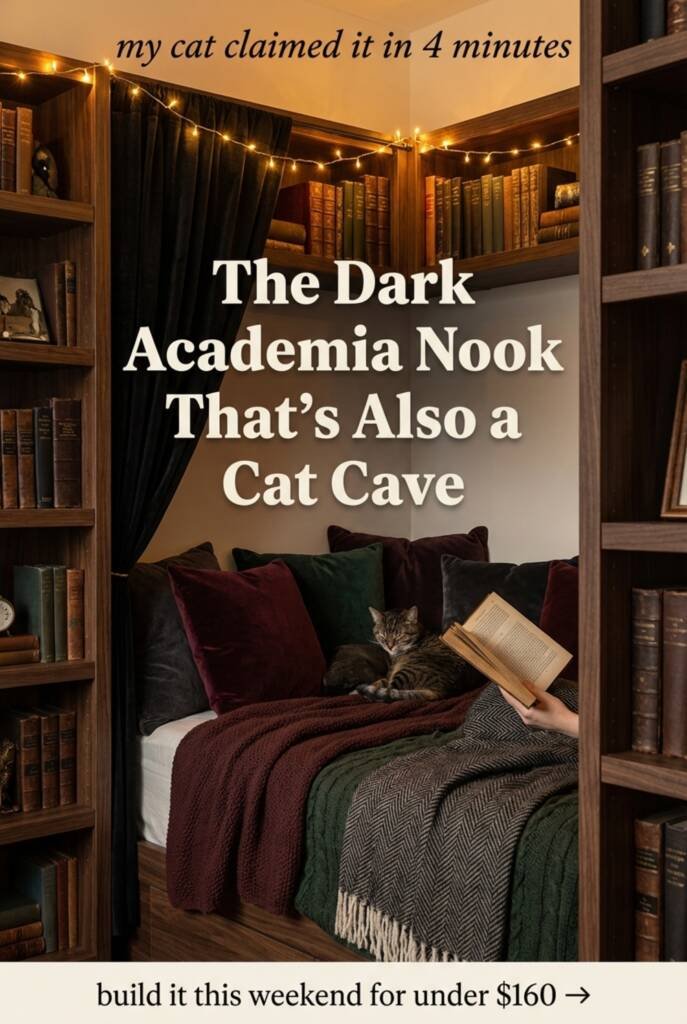
If there’s one image that defines the dark academia dream, it’s the reading nook: a built-in alcove framed by dark bookshelves, lined with velvet cushions, surrounded by old books, bathed in warm amber light. It’s the space where you imagine spending rainy Sunday afternoons with tea and a novel.
It’s also, structurally, a cat’s paradise. Enclosed on three sides. Warm and padded. Elevated slightly off the ground. Surrounded by soft fabrics. Tucked away from foot traffic. Every instinct a cat has — the need to feel enclosed, warm, and slightly hidden while still being able to observe the room — is satisfied by this exact design.
You don’t need built-in carpentry to create this. Two tall dark bookshelves placed with a gap between them against a wall creates the “alcove” effect instantly. Add a low daybed, thick floor cushion, or bench in the gap, layer it with dark cushions and throws, and you have both the most Instagrammable corner in your home and your cat’s new favorite place to sleep.
How to Build a Reading Nook / Cat Cave
- Creating the alcove: If you have a built-in nook or closet alcove, you’re already set — just style it. If not, place two tall dark bookshelves 3-4 feet apart against a wall. IKEA BILLY bookcases in dark brown ($50 each) are the most cost-effective option and look great when loaded with books. The space between them becomes your nook.
- The seating: Place a low daybed frame, wooden bench, or thick floor cushion/mattress pad in the gap between the shelves. The seat height matters: 12-18 inches is ideal because it’s high enough to feel like a real seat, low enough for your cat to jump up easily, and it keeps you at eye level with the lower book shelves (which feels incredibly cozy).
- The cushion and throw layering: Line the back wall with cushions in mixed sizes and textures — dark velvet, corduroy, chunky knit. You want it to feel like a nest. Layer 2-3 throw blankets: one as a base layer over the cushion, one draped casually over the arm or edge, one folded at the foot. Dark, rich colors throughout: burgundy, charcoal, forest green, navy.
- The optional canopy effect: Mount a short curtain rod above the nook opening and hang a single dark velvet curtain panel that can be pulled partially closed. This creates the “cave” entrance that cats find irresistible — they can slip in behind the curtain and feel completely hidden. For you, the semi-closed curtain creates a canopy effect that makes the nook feel like a private world. This is the single most effective way to make both you and your cat obsessed with this space.
- Lighting: Drape warm fairy lights along the top inner edge of the shelves, or place a small reading lamp with an Edison bulb on one shelf. The warm glow inside the nook against the darker room outside creates an irresistible “come sit here” feeling.
- The cat reality: Your cat will claim this nook immediately. Probably within minutes. That’s fine. There’s room for both of you — or you can take turns. Most cats will settle into the back corner, and you can curl up alongside them. It’s the coziest coexistence in your entire home.
- Budget version: Two IKEA BILLY bookcases ($50 each) + a large floor cushion ($30) + thrift store throw blankets and cushions ($20-30) = a dark academia reading nook for under $160 that looks like custom built-in cabinetry.
12. A Vintage Trunk That Secretly Hides the Litter Box
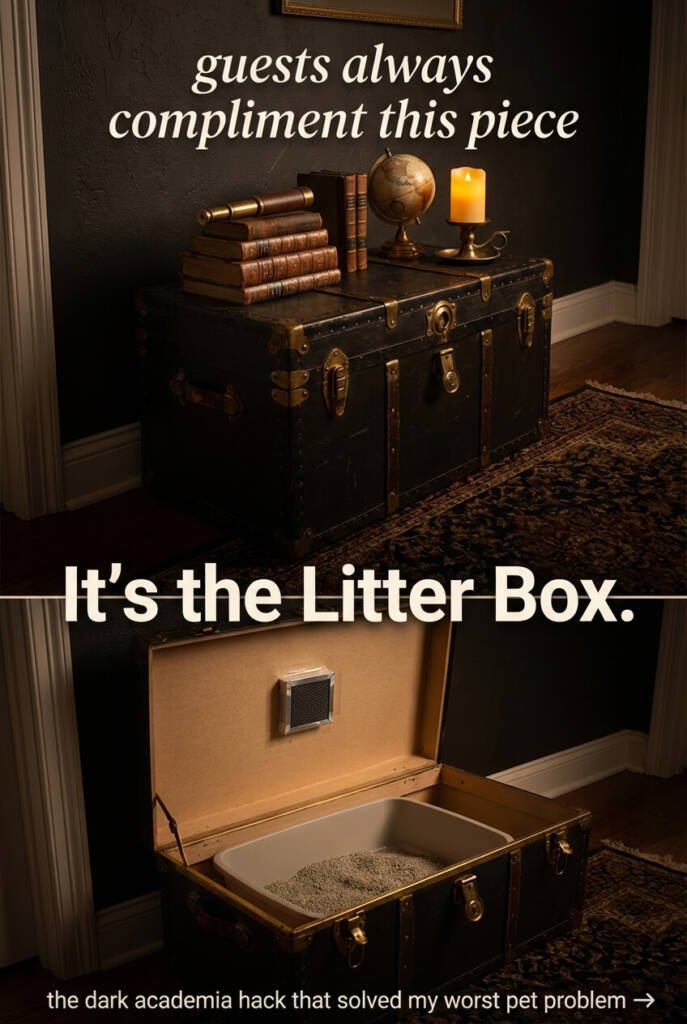
Let’s be honest: the litter box is the single worst-looking item in any cat owner’s home. There is no standard litter box that looks good. The best most people can do is hide it in a bathroom corner and pretend it doesn’t exist.
A dark wood vintage trunk or steamer chest flips this problem entirely. These pieces are quintessential dark academia decor — they evoke well-traveled scholars, old dormitory rooms, and a general sense of “this person has a history.” They’re heavy, substantial, and gorgeous. And with one simple modification — a cat-sized entry hole cut into one side — they become the most elegant litter box solution you’ve ever seen.
Style the top surface with stacked old books, a brass telescope or globe, a candelabra, or a vintage clock — and the trunk becomes a display surface that actively contributes to your room’s aesthetic. Nobody suspects what’s inside. Not guests, not houseguests, not even your most observant friends — until your cat casually strolls around the side and disappears into it.
How to Build a Vintage Trunk Litter Box
- Finding the trunk: Look for vintage trunks, steamer chests, old wooden chests, or large dark-stained wooden boxes at thrift stores, estate sales, or Facebook Marketplace. They typically cost $20-60 depending on size and condition. Size requirements: at least 24 inches long, 16 inches wide, and 16 inches tall internally, so a standard litter box fits comfortably inside with clearance on all sides for your cat to turn around.
- Darker is better for dark academia. Look for dark leather, dark stained wood, or already-black trunks. If you find one with great shape but the wrong color, dark wood stain or matte black paint solves that easily.
- Cutting the entry: On one short side of the trunk (ideally the side that faces away from main sightlines), trace a cat-sized entry hole. A 7-8 inch wide by 8-9 inch tall archway shape looks intentional and elegant. A simple rectangle works too. Cut with a jigsaw — this takes about 10 minutes. Sand all edges completely smooth so nothing can catch on your cat’s fur.
- Finishing the hole: Stain or paint the cut edge to match the rest of the trunk. This makes the entry look like it was always part of the design rather than something you hacked with a power tool.
- Interior setup: Place the litter box inside. For odor control, tape a small activated carbon filter to the inside of the lid (pet stores sell these for litter boxes). Alternatively, drill 4-6 small ventilation holes in the back panel (the side against the wall, invisible from the room). These allow air circulation without letting odor escape into the room.
- Critical safety point: Make sure the trunk lid cannot close and lock your cat inside. Either remove the latch entirely, use a lid support hinge that holds the lid open at any angle, or prop the lid so it stays slightly cracked. Many cat owners remove the lid from the hinges and simply set it on top without fastening — it lifts off easily for cleaning and can never accidentally close on your cat.
- Style the top: Stack 3-4 old books horizontally. Add a brass object — a candlestick, a small telescope, a vintage bell, or a globe. Maybe a small trailing plant in a dark pot. The key is making the top look like it’s been curated over time, not decorated all at once.
- Total cost: Vintage trunk at $20-60 + jigsaw cut (10 minutes if you own one, or ask a handy friend) + carbon filter at $5 = under $70 for a hidden litter box that genuinely looks like a treasure you inherited.
13. Dark Velvet Curtains That Hide a Secret Cat Window Perch
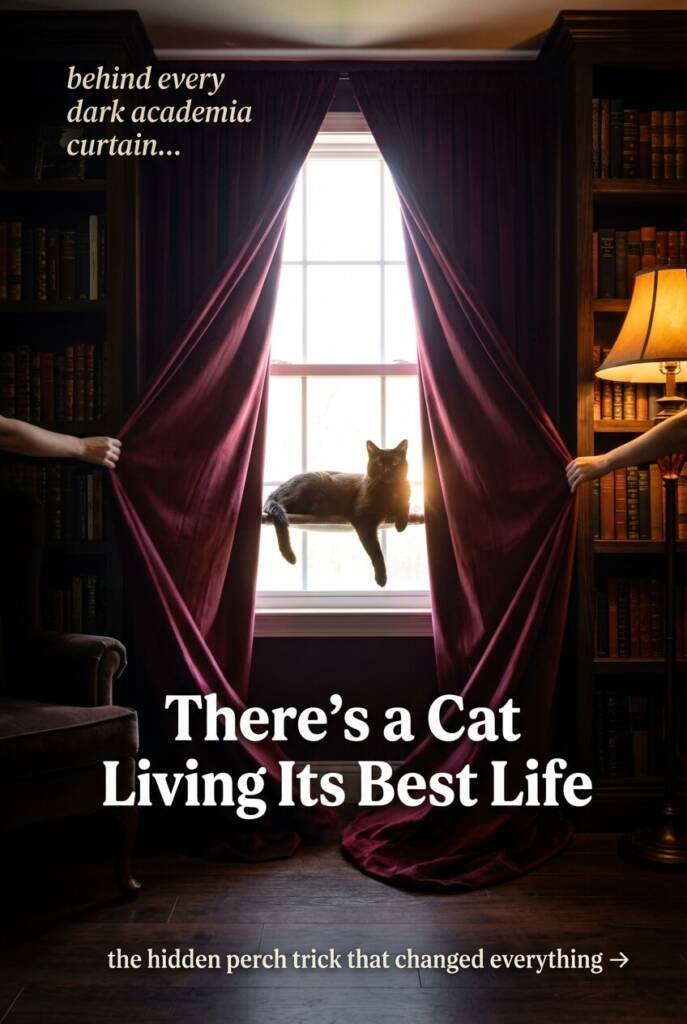
Floor-to-ceiling velvet curtains are dark academia royalty. Deep burgundy, forest green, navy, or charcoal velvet panels falling from ceiling to floor create instant drama, control light for that moody atmosphere, and make any window look twice its actual size.
What nobody shows in the Pinterest inspiration photos is what’s behind those curtains. And that’s where your cat’s secret world lives.
A simple window perch shelf mounted behind floor-length curtains gives your cat a hidden sunbathing, bird-watching, nap station that’s completely invisible from the room when the curtains are drawn. Your cat slips behind the curtain, hops onto the perch, and disappears. The velvet drapes fall back into place. From the room side, all you see is an elegant wall of dark fabric.
When you want to open the curtains to let light in, they part to reveal your cat lounging on the perch, framed by velvet on both sides like a Renaissance portrait. It’s the most photogenic cat setup you’ll ever create — and it costs almost nothing.
How to Set Up Curtains With a Hidden Cat Perch
- The curtains: Buy floor-length dark velvet curtain panels. They should just kiss the floor or pool very slightly — this is the dark academia standard and it also helps conceal the window perch from view. Burgundy, forest green, navy, and charcoal are the go-to colors. Look for panels that are wide enough to cover the window completely when drawn. Velvet is heavy, so invest in a sturdy curtain rod rated for heavy fabric — a cheap rod will bow and eventually fall.
- Mounting tip: Install the curtain rod 4-6 inches above the window frame and extending 6-8 inches beyond each side. This makes the window look significantly larger and more dramatic. It also creates more hidden space behind the curtain for the perch setup.
- The cat perch — suction cup option (easiest): Clean your window thoroughly and attach a suction cup-mounted cat perch. Test the weight capacity with a heavy book before letting your cat use it. These perches are inexpensive ($15-25), easy to install, and easy to remove. They work best on large, clean windows.
- The cat perch — shelf bracket option (most secure): Mount two L-brackets into the wall studs on either side of the window at sill height. Place a dark wood plank across them and secure with screws from underneath. This creates a permanent shelf that can hold any weight. Cut a dark cushion or fold a dark blanket to fit the shelf surface for comfort.
- The reveal experience: Your cat accesses the perch by slipping behind the curtain. When you want to show off the setup (or just let in light), pull the curtains to the sides. The dark velvet drapes frame the window — and your cat on the perch — like a theater curtain parting to reveal the main act. It sounds dramatic because it is. That’s dark academia.
- Budget math: Velvet curtain panels from Amazon or IKEA run $25-40 per panel. A suction cup cat perch is $15-25. Total: under $80 for one of the most impactful dark academia upgrades you can make to any room.
14. Heavy Brass & Vintage Objects: The Shelf Decor Cats Can’t Destroy
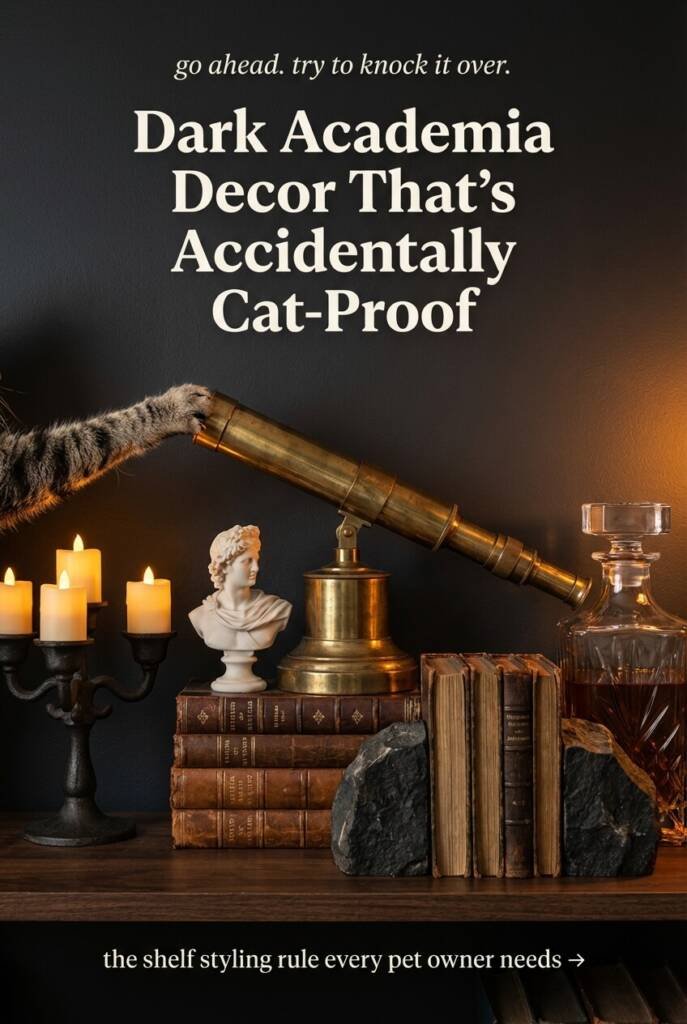
Here’s an observation that changed how we think about pet-proofing: the entire dark academia styling philosophy accidentally gravitates toward objects that cats physically cannot knock off shelves.
Think about what fills the shelves in every dark academia inspiration image. Brass telescopes. Vintage globes. Marble bookends. Iron candelabras. Heavy glass decanters. Old hardcover books stacked four or five deep. Leather-bound volumes. Stone busts. Antique clock mechanisms. Weighty wooden boxes.
Now pick up any of those objects. They’re all heavy. Seriously heavy. A cat could swat at a brass telescope with everything they’ve got and it’s not moving. A marble bookend might as well be bolted to the shelf. An iron candelabra weighs more than most cats.
Compare that to modern minimalist shelf decor: thin ceramic vases, lightweight photo frames, small glass trinkets, dainty succulents in tiny pots. One curious paw swipe sends all of it crashing to the floor. Modern minimalism is an active liability in a cat household.
Dark academia’s preference for substantial, weighty, historical objects isn’t just an aesthetic choice. It’s — entirely by accident — the most cat-proof shelving philosophy in interior design.
How to Style Cat-Proof Dark Academia Shelves
- The one-finger test: Before placing any object on a display shelf, try to knock it over with one finger. If it tips, your cat can tip it. If it doesn’t budge, it’s cat-proof. Only display items that pass this test on open shelves. Everything else goes behind glass doors or in drawers.
- Where to find heavy vintage objects cheaply: Estate sales and thrift stores are overflowing with the exact items that dark academia calls for — and that nobody else is buying. Brass candlesticks ($3-5). Old globes ($10-20). Marble bookends ($5-10). Heavy glass decanters ($5-8). Leather-bound books ($1-3 each). Iron figurines ($3-7). One trip to a single estate sale or Goodwill can furnish every shelf in your room for under $40.
- The arrangement formula: Start with an anchor piece — the largest, heaviest object on the shelf. This goes off-center (not dead middle). Then add progressively smaller items moving outward. Layer in depth: taller items at the back, shorter items at the front, with slight overlap. This creates a “collected over decades” look that feels intentional and scholarly.
- Leave breathing room: Keep 30% of each shelf surface empty. This serves two purposes. First, it gives your cat space to walk across or sit on the shelf without colliding with objects (because they WILL use these shelves, and fighting it is futile). Second, negative space actually makes your styling look more sophisticated — cluttered shelves feel chaotic, while shelves with breathing room feel curated.
- Museum putty for medium-weight items: For anything that passes the one-finger test but you want extra security on — a medium-weight vase, a decorative box, a clock — apply a small blob of museum putty to the bottom. This invisible adhesive keeps things in place without damaging the shelf surface. It peels off cleanly whenever you want to rearrange. A $5 pack handles 20+ objects.
- The “scholar’s desk” vignette: Group a brass lamp, an open old book, a globe, and a heavy glass inkwell or decanter together on a shelf or table surface. Every item is beautiful. Every item is unmovable. And together they tell a story about the person who lives here. That’s what dark academia is really about — objects that suggest a life of the mind.
15. Dark Wainscoting & Panel Molding: Wall Armor That Looks Like Luxury
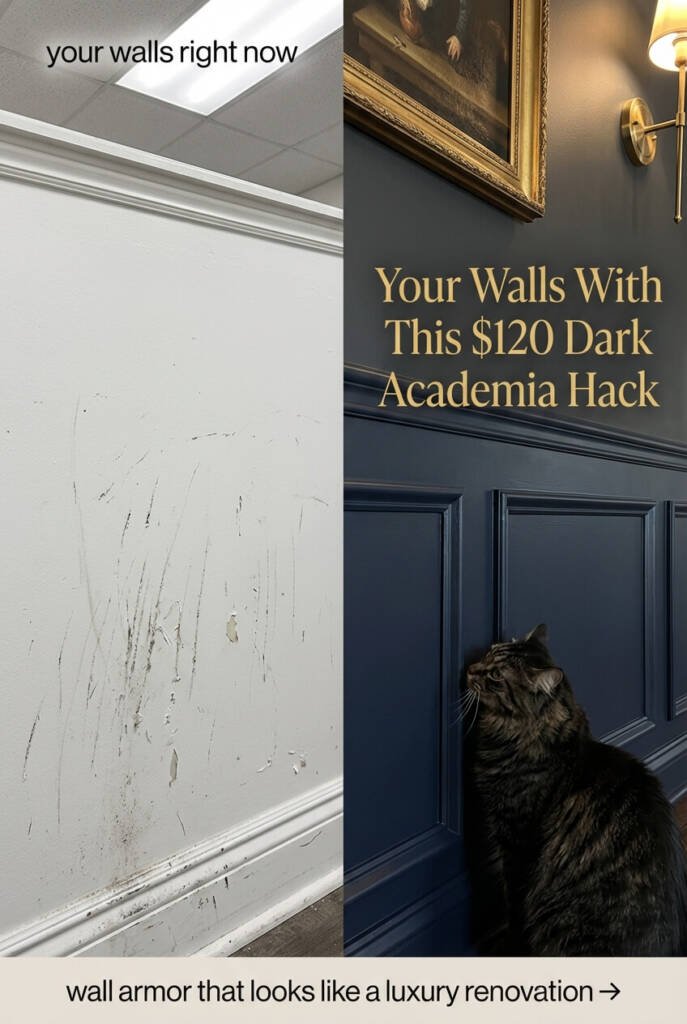
This is the last idea on the list and it might be the most impactful one. Not because it’s flashy — but because it solves a problem most pet owners don’t even realize has a solution.
The bottom three feet of your walls take the most abuse in a pet household. Cats scratch at wall corners. Dogs rub against walls as they walk by. Pet furniture bumps and scrapes. Litter gets kicked against baseboards. Zoomie sessions leave scuff marks at exactly the height where paws and bodies contact the wall.
Now look at wainscoting — paneled woodwork installed on the lower third of walls. It’s one of the defining architectural elements of dark academia, inspired by old libraries, university lecture halls, Gothic estates, and scholarly clubrooms. These institutions installed wainscoting centuries ago for a practical reason: to protect walls from damage in high-traffic areas. The exact same reason it works in your pet household.
Dark-painted wainscoting armors the entire damage zone. It’s made of wood or MDF, which is dramatically more durable than drywall. It’s easy to wipe clean. And when painted dark — black, charcoal, deep navy, or forest green — any minor surface scratches or scuffs disappear into the shadows.
The coincidence is almost too perfect: the most elegant architectural feature in dark academia design exists at exactly the height where your cat does the most damage. It’s functional wall armor disguised as luxury design.
How to Install Dark Academia Wainscoting
The easiest high-impact version — picture frame molding:
This is our recommendation for most people because it looks incredibly sophisticated, requires minimal tools, and costs a fraction of full board-and-batten or traditional raised-panel wainscoting.
What you’ll need: Decorative trim molding from the hardware store (primed MDF molding is cheapest and paints beautifully), construction adhesive (Liquid Nails), a miter saw or miter box with hand saw (for 45-degree angle cuts at the corners), finishing nails, wood filler, sandpaper, caulk, and dark paint.
- Step 1 — Plan your layout: Decide on the wainscoting height. Traditional is 32-36 inches from the floor — roughly one-third of the wall height. This is also, conveniently, the exact height zone where pets do the most damage. Mark a level horizontal line around the room at your chosen height.
- Step 2 — Plan your panels: Picture frame molding creates rectangular “frames” on the wall. Typically, you’ll space 3-4 evenly sized rectangles per wall section, each about 18-24 inches wide with 3-4 inches of space between them and between them and the baseboards/chair rail. Sketch this on paper first and measure precisely.
- Step 3 — Cut and install: Cut your trim molding pieces to size with 45-degree miter cuts at each corner for clean joins. Apply construction adhesive to the back of each piece and press firmly against the wall. Secure with a few finishing nails for extra hold while the adhesive dries. Install a horizontal piece of molding at the top of the wainscoting zone to serve as a “chair rail” — this gives the whole installation a finished, professional look.
- Step 4 — Finish: Fill all nail holes with wood filler. Sand smooth once dry. Run a bead of caulk along every edge where molding meets the wall — this is the step that separates a DIY job from a professional-looking one. Caulking fills tiny gaps and creates seamless transitions.
- Step 5 — Paint: Paint the entire lower wall section (behind and including the molding) in one unified dark color. This creates the most dramatic look and makes the paneling feel architectural rather than applied. Dark navy, charcoal, black, or forest green are all classic dark academia choices. Use a satin or semi-gloss finish for durability and easier cleaning — more important than usual when pets are involved.
The upper wall: Paint it the same dark color for maximum drama (dark-on-dark is stunning) or go slightly lighter for contrast (charcoal wainscoting with a dark navy upper wall, for example). Either approach works for dark academia.
For renters — the peel-and-stick option: Peel-and-stick wainscoting panels and molding strips do exist and look surprisingly convincing when painted. They won’t be as durable as real wood, but they’ll still provide some protection and all of the visual impact. They remove cleanly when you move out.
Cost breakdown: Picture frame molding from Home Depot or Lowe’s costs about $1-2 per linear foot. A standard 12-foot wall needs roughly 40 linear feet of trim, totaling $40-80 in materials. Add paint, caulk, and supplies and the full project runs $100-130. For what is arguably the most transformative architectural upgrade you can make to any room, that’s extraordinary value. Professional wainscoting installation costs $1,000-3,000+ for the same result.
Dark Academia Room Ideas That Welcome Pets
Here’s what we hope you’re seeing by now: this isn’t about making dark academia “work despite” having pets. It’s about recognizing that the aesthetic already works because of its core design principles.
Dark velvet hides fur. Textured walls absorb scratches. Heavy brass objects resist curious paws. Vintage rugs camouflage mess. Wainscoting armor-plates the exact zone where cats scratch. Faux candles deliver the glow without the fire risk. Dark furniture vanishes dark pet furniture. And the entire philosophy of “aged, collected, lived-in” means that wear and tear doesn’t degrade your space — it adds to its story.
Every idea on this list does double duty. Not one of them asks you to sacrifice aesthetics for practicality or practicality for aesthetics. They do both, simultaneously, beautifully. That’s rare in interior design — and it’s why we think dark academia deserves a permanent spot in the pet-owner’s design toolkit.
Here at Sweet Purrfections, we create content at the intersection of cool home decor and real life with pets. Because we believe your home should look like it belongs in a design magazine AND work for the furry family members who actually run it.
Leave a Reply