
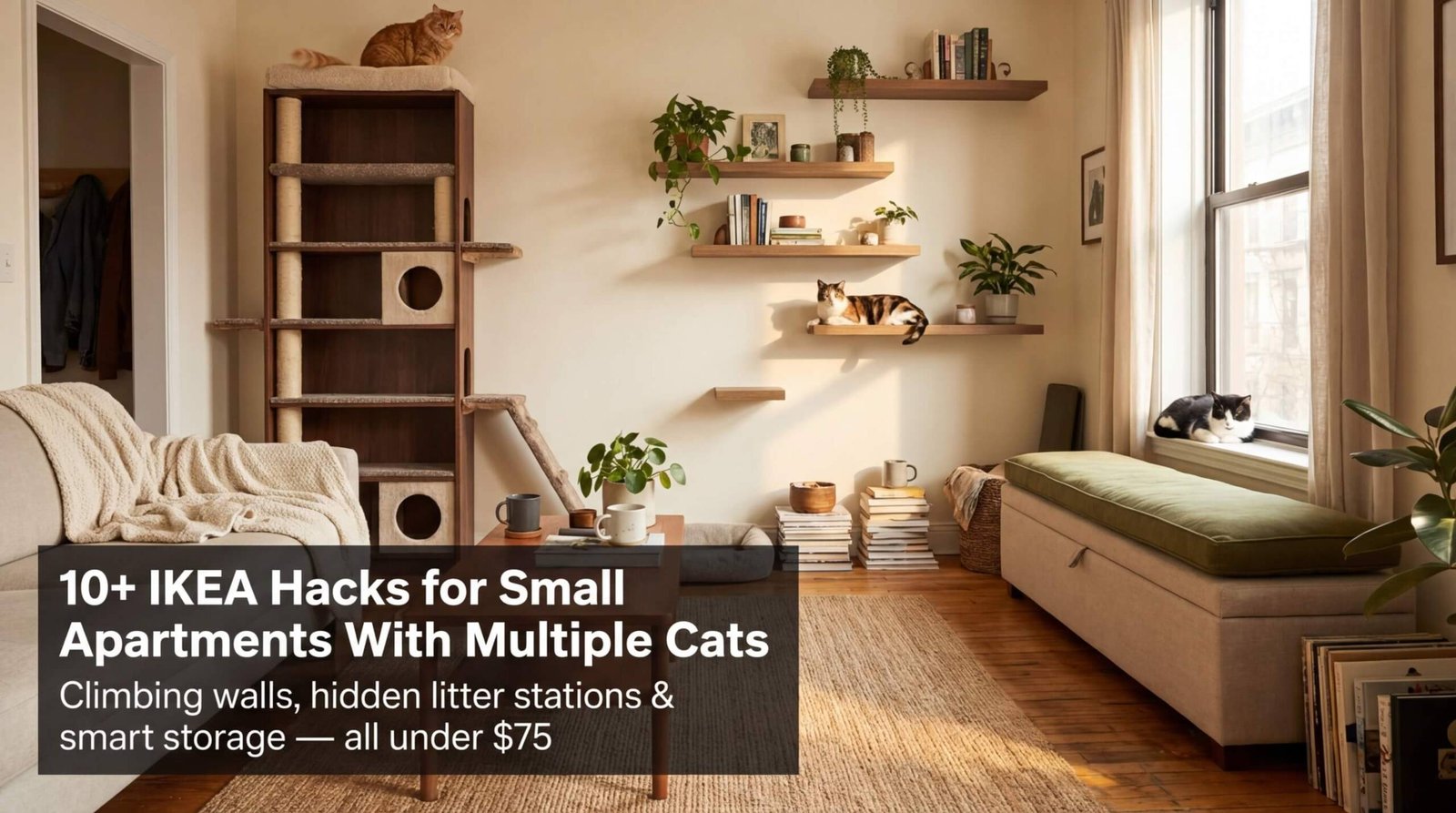
The best IKEA hacks and small apartment hacks for multi-cat households start with one realization: every single piece of furniture needs to pull double duty, and most of it can be built for under $50 using affordable modular pieces you already know.
When you’re sharing 600 square feet with two, three, or four cats, generic storage solutions don’t cut it — you need vertical climbing space, hidden litter stations, and feeding setups that don’t eat up precious floor real estate. The good news is that flat-pack furniture is practically designed to be reimagined, and with a few simple modifications, the same bookcase or storage cube that organizes your books can become a floor-to-ceiling cat playground.
What makes these hacks different from the usual Pinterest fluff is that every single one includes a step-by-step breakdown — specific measurements, realistic price estimates, and notes on how each idea scales when you’re dealing with multiple cats instead of just one. We’re covering everything from hidden litter box cabinets that genuinely fool guests to floating shelf highways that your cats will actually use instead of ignore. Each hack is designed to solve a real space problem while keeping your apartment looking intentional and put-together, not like a pet store exploded in your living room.
Whether you’re working with a studio, a one-bedroom, or just a tight layout that leaves zero room for bulky cat trees, these ideas will change how you think about your square footage. Let’s get into it.
1. Turn a Basic Bookcase Into a Floor-to-Ceiling Cat Climbing Wall
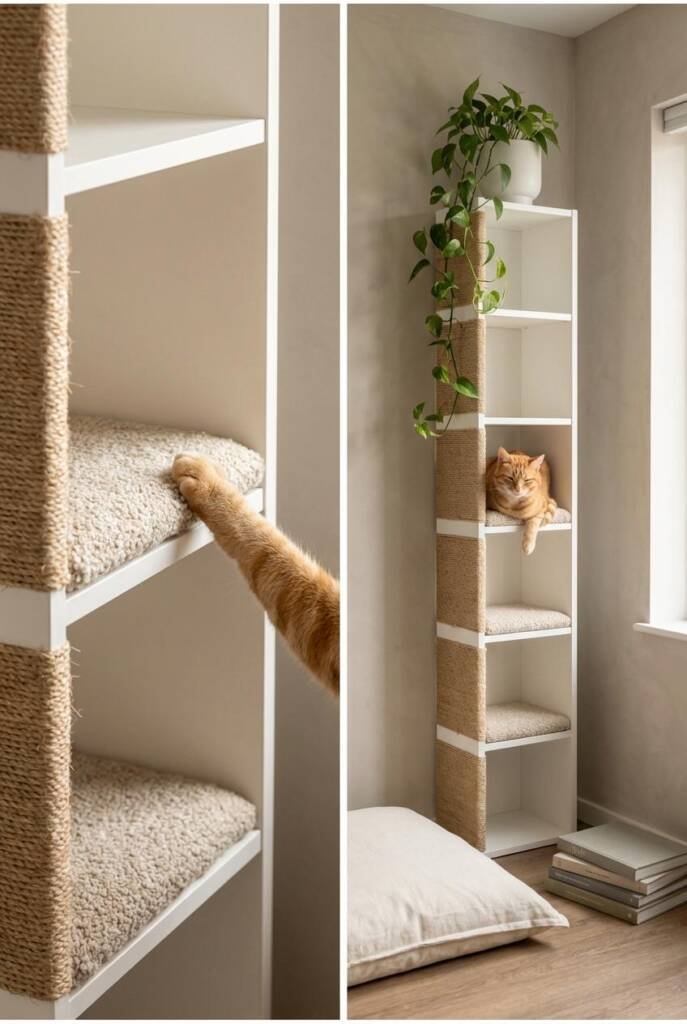
Your cats want to go vertical — let a single bookcase do what a $300 cat tree can’t.
A narrow, floor-to-ceiling bookcase anchored flat against the wall instantly becomes a vertical cat highway — and it looks like an intentional design piece, not a pet compromise. Alternate between open shelves (for climbing and lounging) and closed cubbies fitted with soft cushion inserts (for napping), and you’ve got a setup that reads more “modern shelving unit” than “cat furniture.” Paint it the same color as your wall for a built-in look that disappears into the room.
For multi-cat homes, vertical space is everything. Cats naturally establish hierarchy through height, so giving them six or more levels on a single narrow column reduces territorial tension without eating a single square foot of floor space. Line a few shelves with sisal mats — you can find packs of natural sisal shelf liners on Amazon for around $15 — and suddenly each tier doubles as a scratching surface. Toss in removable fleece cushion pads (~$12 for a set on Amazon) for the cubby levels, and the whole thing becomes a climb-scratch-nap loop your cats will cycle through all day.
How to Transform a Tall Bookcase Into a Cat-Friendly Climbing Tower
- Secure the bookcase: Wall-mount a tall narrow bookcase (at least 72″ high, no wider than 16″) using heavy-duty L-brackets rated for 50+ lbs — grab a pack on Amazon for roughly $10.
- Create the climb-and-rest pattern: Remove every other shelf door or panel so you alternate between open platforms and enclosed cubbies. Cats need both launching pads and hiding spots.
- Add grip and comfort surfaces: Line open shelves with adhesive-backed sisal mats (available on Amazon for ~$15 per pack) and tuck removable fleece pads into the cubbies.
- Build a highway connection: Mount a single floating shelf between the top of the bookcase and an adjacent wall to create a bridge — a 24″ floating shelf runs about $12 on Amazon and gives cats a reason to actually use the top level.
- Budget move: The full setup runs under $75 with everything sourced from Amazon — the bookcase itself starts around $35, plus sisal mats, cushion pads, and brackets for the rest.
2. The Hidden Litter Box Cabinet That Guests Will Never Find
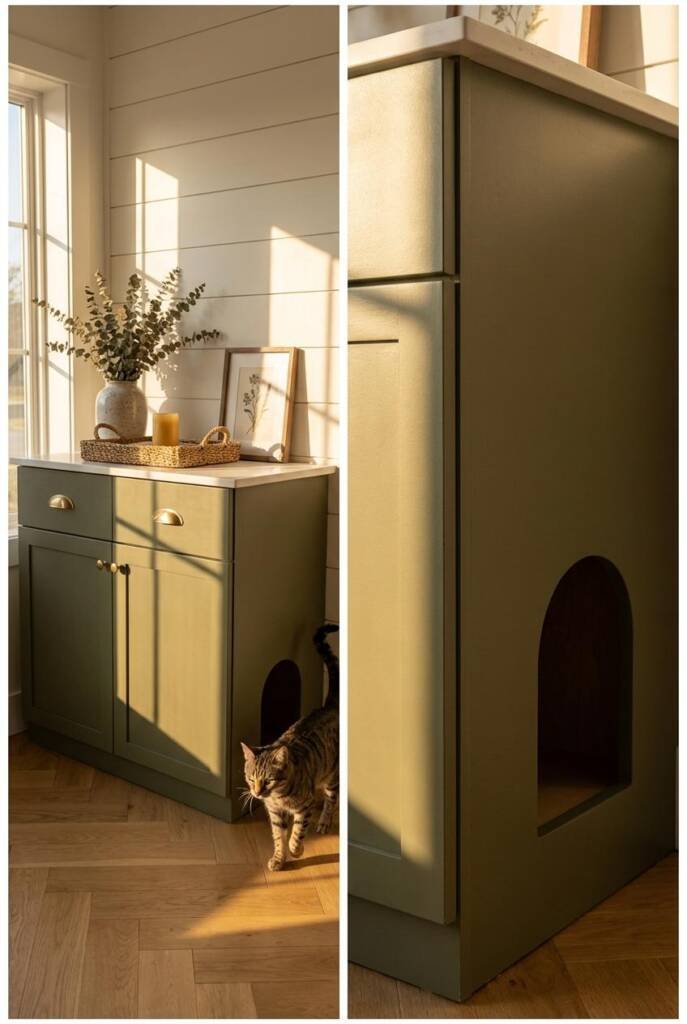
Your guests will sit three feet from the litter box and never know it’s there.
A basic two-door storage cabinet — the kind you’d find in any living room — becomes an invisible litter station with one smart modification: a cat-sized cutout on the side panel. Paint it to match your existing furniture or leave it in a neutral tone, and guests will assume it’s holding blankets or board games. It’s the single most impactful hack for eliminating the “I have cats” aesthetic from your apartment.
For multi-cat homes, this works because you can line up two cabinets side by side, each housing its own box, while looking like one cohesive credenza. Cats prefer separate entrances anyway, so the side-panel cutouts actually serve their territorial instincts. Drop a high-sided litter pan inside — you can find these on Amazon for roughly $12–$18 — and add a small mat just inside the door to catch tracking. The cabinet doors give you full access for scooping without crawling on the floor.
How to Convert a Basic Cabinet Into a Hidden Multi-Cat Litter Station
- Cut the entry hole: Use a jigsaw to cut a 7″ × 7″ opening on one side panel, about 3 inches from the bottom. Sand the edges smooth so nothing catches fur or skin.
- Ventilate the cabinet: Drill a row of small holes along the back panel near the top, or install a USB-powered mini fan (available on Amazon for around $10) to keep airflow moving and odors down.
- Line the interior: Lay down a waterproof cabinet liner — grab a roll on Amazon for under $8 — across the entire bottom to protect against spills and make cleanup effortless.
- Add odor control and the litter pan: Place a high-sided litter pan inside with a thin litter-trapping mat in front of it. A small activated charcoal pouch (about $7 on Amazon) tucked in the back corner handles residual smell.
- Budget move: The full conversion runs under $55 when you source the cabinet, liner, fan, and charcoal pouches all from Amazon.
3. Floating Shelf Highway Your Cats Will Actually Use
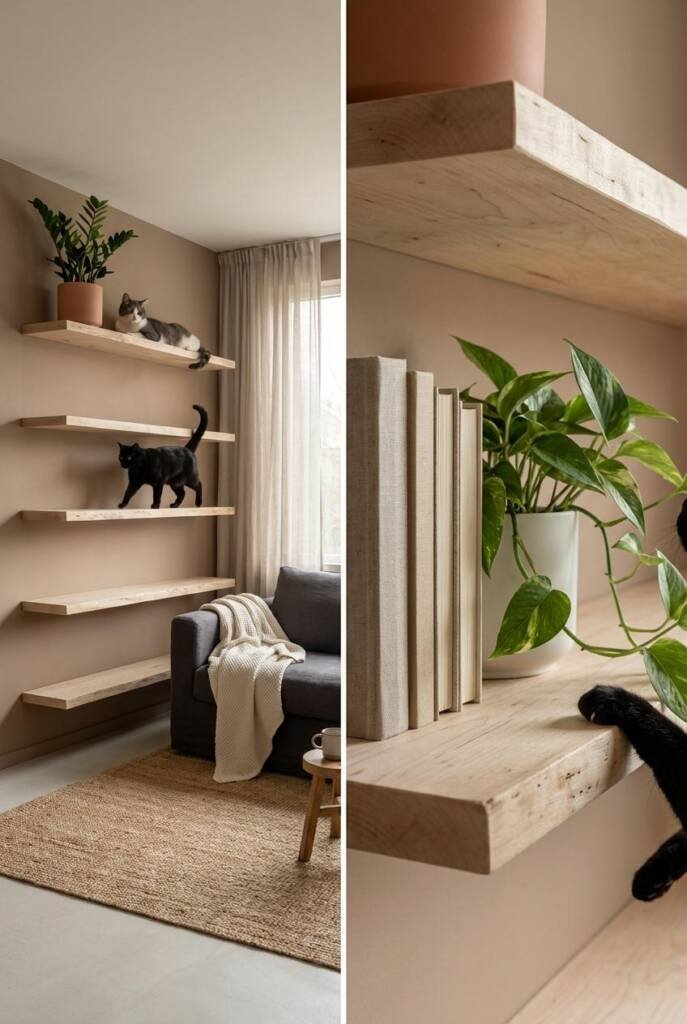
Your cats are going to use the walls whether you plan for it or not — might as well make it gorgeous.
Stagger a set of floating shelves at varying heights along a single wall and you’ve got a cat highway that looks like intentional décor, not a pet compromise. The trick is alternating shelf heights by 10–12 inches vertically and overlapping them horizontally so cats can hop naturally from one to the next. Add a trailing pothos or a few book spines between the landing zones and guests will think it’s an art installation before they notice the cat perched at the top.
Cats need vertical territory, especially in multi-cat homes where floor space is already contested. A wall highway gives each cat an escape route and a vantage point, which reduces tension and redirects that climbing energy away from your curtains. A set of solid wood floating shelves rated for 30+ lbs will handle even a hefty Maine Coon — you can find a three-pack on Amazon for roughly $35–$50. Wrap each shelf top with a scrap of sisal or carpet tile so they get traction on takeoff and landing.
How to Install a Floating Shelf Cat Highway in a Small Apartment
- Plan Your Layout: Map out 4–6 shelf positions on the wall, spacing them 10–12 inches apart vertically and 16–20 inches horizontally so cats can step comfortably between them.
- Choose Heavy-Duty Shelves: Grab a set of floating shelves rated for at least 30 lbs each — a quick Amazon search turns up options for $35–$50 per three-pack. Aim for shelves at least 8 inches deep.
- Anchor Into Studs: Use a stud finder and mount each bracket directly into wall studs with 3-inch screws. Drywall anchors alone won’t survive a 12-lb cat launching off at full speed.
- Add Grip Surfaces: Cut carpet tiles or adhesive-backed sisal mats to fit each shelf top. Self-adhesive carpet stair treads work perfectly — available on Amazon for around $15 for a set of 15.
- Budget move: The full highway runs under $70 with shelves (~$45) and adhesive carpet treads (~$15) both sourced from Amazon.
4. A Slim Rolling Cart That’s Actually a Cat Feeding Station
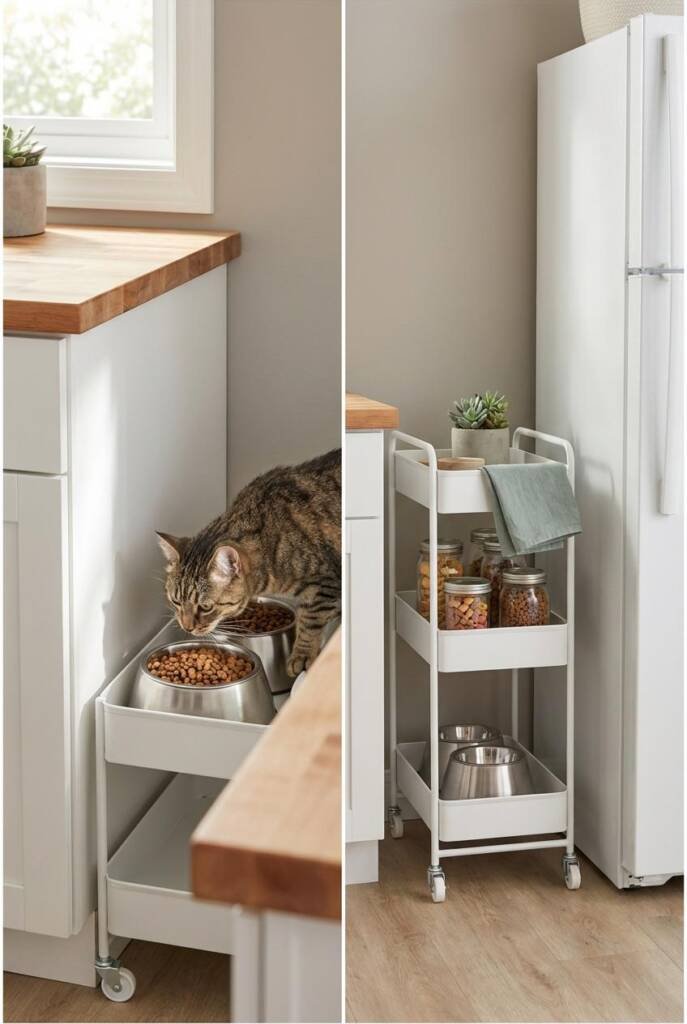
That dead sliver of space next to your fridge is about to become the most organized spot in your apartment.
That awkward 10-inch gap between your fridge and the wall? It’s prime real estate for a slim three-tier rolling cart that doubles as a fully organized multi-cat feeding station. The narrow profile keeps everything off your counters and out of the main walkway, and when you need to refill bowls or wipe down a shelf, you just roll it out. It looks intentional — like you planned your kitchen around it — not like you’re hiding cat food behind the toaster.
The top tier holds elevated feeding bowls (critical for cats with sensitive digestion), the middle tier stores dry food and treat containers, and the bottom tier handles wet food cans and cleaning supplies. Elevated stainless steel cat bowls with a stand run about $15–$20 on Amazon and fit perfectly on a standard 16-inch-wide cart shelf. If you’ve got three or more cats, stagger feeding times and rotate bowls — one cart handles the rotation without needing extra floor stations scattered around your apartment.
The real win here is mobility. Slide it out for mealtimes, tuck it back when company comes over. No permanent footprint, no hardware, no commitment.
How to Organize a Multi-Cat Feeding Station With a Rolling Cart
- Measure the gap: Check the width between your fridge and wall — most gaps are 8–12 inches. Grab a slim three-tier rolling utility cart on Amazon for around $25–$35 to match.
- Set up the top tier for feeding: Place a set of elevated stainless steel cat bowls (find them on Amazon for ~$18) on the top shelf so your cats eat at a comfortable height.
- Organize storage on the lower tiers: Use small airtight food containers (~$12 for a set on Amazon) on the middle tier for kibble and treats, and stack wet food cans on the bottom.
- Add grip liners: Cut non-slip shelf liner to fit each tier so bowls and containers don’t slide when you roll the cart out — a roll costs roughly $7 on Amazon.
- Budget move: The entire feeding station comes together for under $75 with everything sourced from Amazon — the cart, bowls, containers, and liner included.
5. Window Seat Perch That Gives Every Cat the Best View
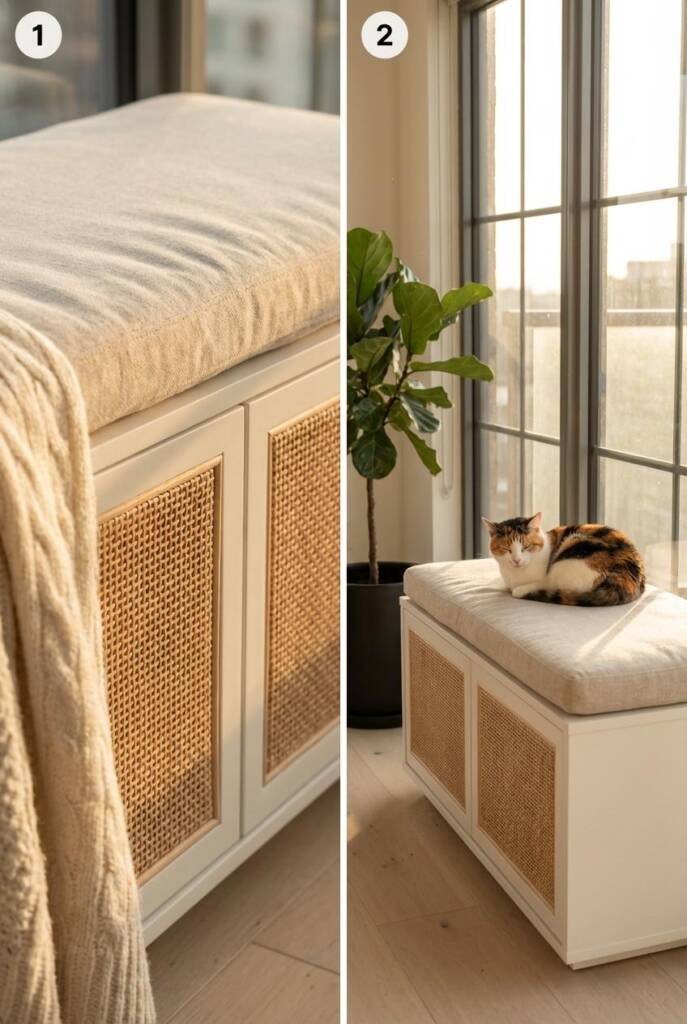
Every cat in your apartment wants the window — this hack gives it to all of them without sacrificing a single square foot of storage.
A low storage bench tucked under your sunniest window instantly becomes the most coveted seat in the house — and your cats will agree. Top it with a thick cushion in a washable fabric, and you’ve got a spot that looks intentionally designed while secretly solving two problems at once: prime sunbathing real estate and hidden storage for the mountain of cat toys, blankets, and harnesses you’re currently stuffing into a closet.
For multi-cat homes, this hack is gold because the bench surface is wide enough for two or three cats to share without a territorial meltdown. The key is choosing a bench with a flip-top lid rather than drawers — cats sprawled on top won’t block access. A washable faux-fur bench cushion (you can find these on Amazon for ~$25) keeps things cozy and easy to de-hair. If your cats tend to jostle for the center spot, add a bolster pillow as a subtle divider so everyone gets their own sunbeam.
How to Build a Window Perch With Storage for a Multi-Cat Home
- Choose the right bench: Grab a flip-top storage bench around 35–40 inches wide — plenty of room for multiple cats. These run roughly $50–$70 on Amazon.
- Add a washable cushion: Top it with a machine-washable bench cushion cut to size. A faux-fur or sherpa option on Amazon for around $25 gives cats the soft texture they gravitate toward.
- Secure it to the wall: Use a furniture anti-tip strap (available on Amazon for under $10) to anchor the bench, especially if your cats launch themselves onto it at full speed.
- Position under the window: Center the bench directly below the sill so cats get an unobstructed view. If the sill is narrow, add a small shelf extension so they can rest their chin while bird-watching.
- Budget move: The full setup runs under $90 with everything sourced from Amazon — a storage bench for ~$60 and a washable cushion for around $25.
6. The Curtain Trick That Cat-Proofs Your Closet and Saves Square Footage
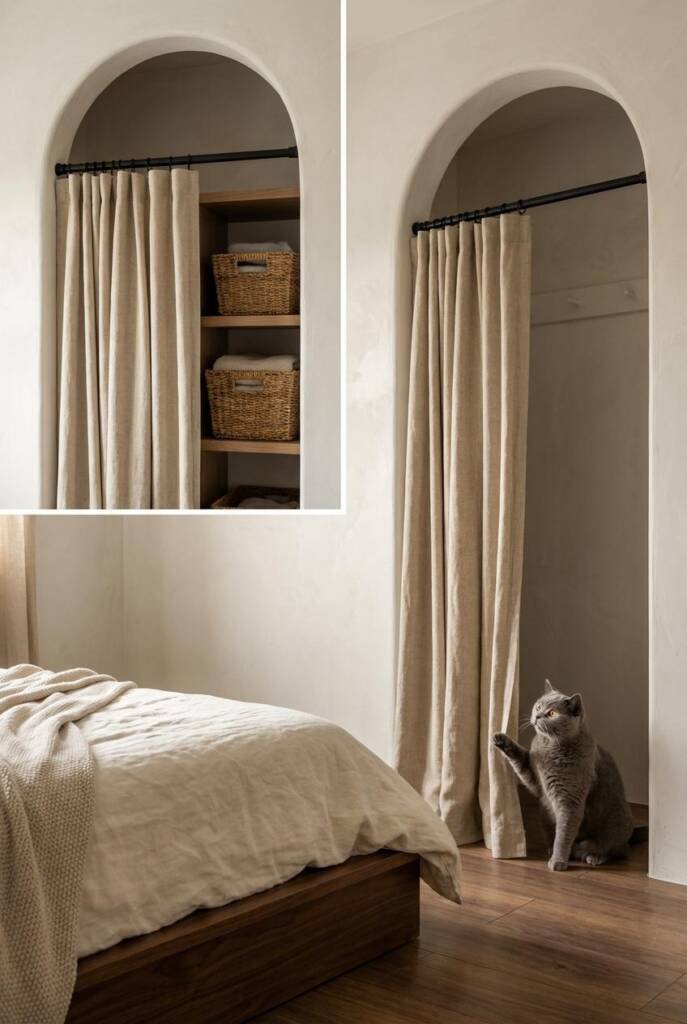
Your closet doors are stealing square footage and giving your cats a noisy toy — fix both problems with one curtain.
Closet doors in small apartments are space thieves — they swing into the room, block furniture placement, and bifold versions are just ugly. Replace yours with a heavyweight linen curtain on a tension rod and suddenly your closet feels like a built-in alcove. The draping fabric adds texture and softness to the room, making the whole space feel more intentional and designed rather than builder-grade bland.
Here’s the cat angle: traditional closet doors become cat toys. Bifolds develop that maddening rattle at 3 AM, and sliding doors leave just enough gap for a determined paw to wedge open. A heavy linen curtain, on the other hand, absorbs the swat without drama. Cats lose interest fast when there’s no satisfying clatter.
Look for a heavyweight linen or linen-blend curtain panel with a rod pocket — you can find panels in neutral tones on Amazon for around $25–$40 each. The weight matters: anything under 200 GSM fabric will look flimsy and invite more batting. Go heavy, go long, and let it puddle slightly at the floor for that effortlessly chic look.
How to Replace a Closet Door With a Cat-Proof Linen Curtain
- Measure and Install the Tension Rod: Measure the inside width of your closet frame and grab an adjustable tension rod rated for at least 20 lbs — available on Amazon for roughly $12–$18. Install it at the top of the frame, about half an inch inside so it’s hidden behind the curtain header.
- Choose the Right Curtain: Pick a heavyweight linen or linen-blend panel (200+ GSM) in a color that matches your walls for a seamless look. A quick Amazon search turns up solid options for $25–$40 per panel.
- Hang and Adjust the Length: Thread the curtain onto the rod and let it hang about half an inch off the floor — just enough clearance that cats can’t bunch it up underneath. If it’s too long, fold and iron a hem with fabric tape instead of cutting.
- Secure Against Curious Cats: Attach two small adhesive hooks inside the closet frame at hip height and loop the curtain edges behind them when you want it held open — this keeps cats from turning the fabric into a swing.
- Budget move: The entire setup runs under $55 on Amazon — a tension rod for ~$15 and a heavyweight linen panel for around $35.
7. Pegboard Command Center That Keeps Cat Supplies Off the Counter
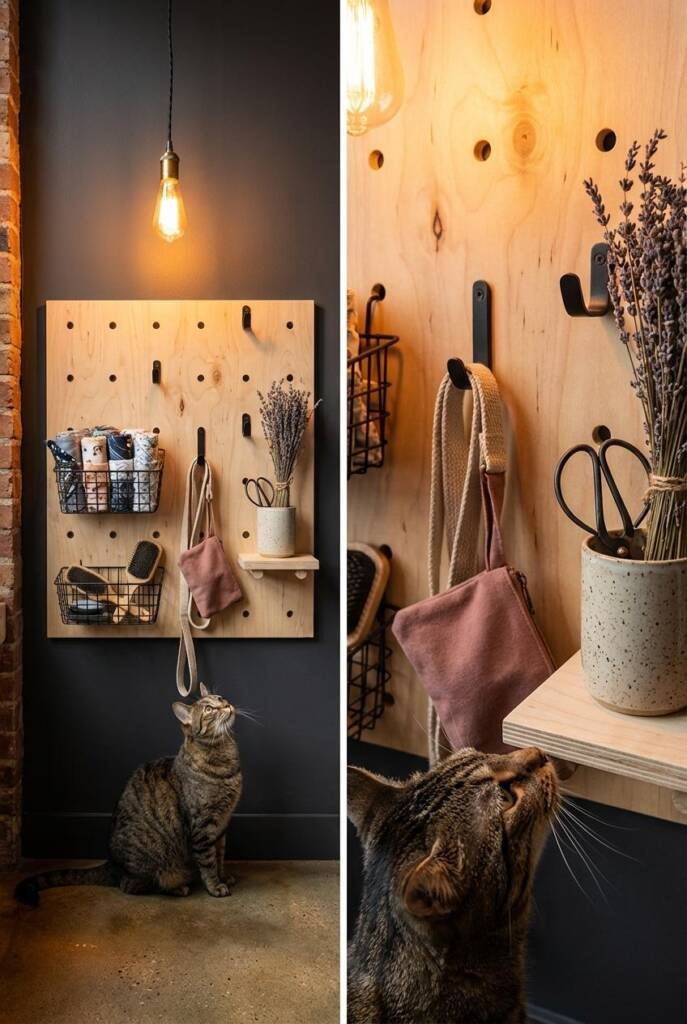
Your countertop is not a cat pharmacy — let’s move all that chaos to the wall.
A pegboard mounted in your entryway or laundry nook instantly transforms a cluttered countertop into a clean, visual command center. Hooks hold leashes and grooming tools, small baskets corral medication bottles and nail clippers, and mini shelves display treat jars — all arranged in a grid that actually looks intentional. Paint the pegboard a matte black or sage green, and it reads more like wall art than storage.
With multiple cats, supply management spirals fast — flea treatments for three, separate brushes, different dietary supplements. A pegboard keeps everything visible and grab-ready so nothing gets missed or doubled up. The vertical layout also means curious cats can’t bat your stuff off the counter at 3 a.m. You can find a large metal pegboard panel (around 24″ × 36″) on Amazon for roughly $25–$40, and a set of assorted pegboard hooks and baskets runs about $15–$20.
How to Create a Wall-Mounted Cat Supply Organizer With Pegboard
- Mount the pegboard panel: Secure a 24″ × 36″ pegboard to wall studs using appropriate anchors — metal panels work best for durability and hold more weight than hardboard.
- Map your zones: Divide the board into sections: daily items (leashes, treats) at eye level, grooming tools in the middle, and medications or less-used supplies up top.
- Add hooks, baskets, and mini shelves: Grab an assorted pegboard accessory kit on Amazon for under $20 — it’ll include hooks, bins, and shelf clips that snap right into the panel.
- Label and maintain: Stick small chalkboard labels (available on Amazon for ~$8) beneath each zone so everyone in the household knows where things go back.
- Budget move: The entire command center comes together for under $65 on Amazon — a metal pegboard panel for ~$35, an accessory kit for ~$18, and labels for around $8.
8. Stackable Storage Cubes That Double as a Cat Condo
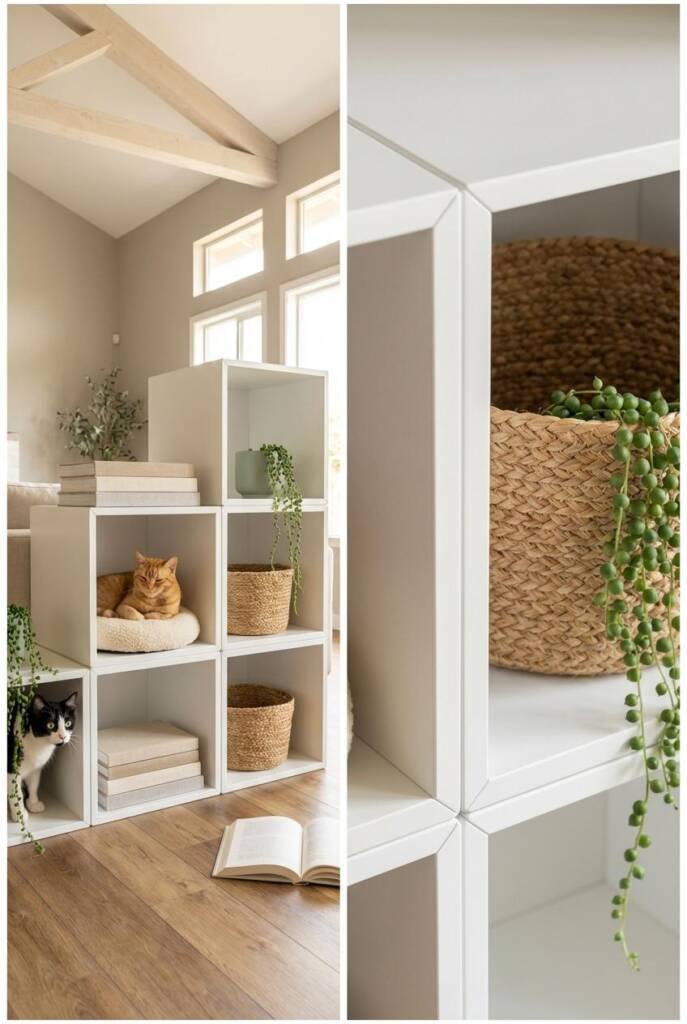
Your storage unit is one rearrangement away from becoming the cat condo your apartment actually deserves.
Modular open storage cubes arranged in a staircase or L-shape pattern give you a legit multi-level cat condo that still functions as a bookshelf, plant display, or media console. The stepped configuration creates visual interest that looks intentional and architectural — not like you just shoved pet furniture in the corner. Style a few cubbies with books and decor, and leave the rest open for your cats to claim.
Cats love this setup because each cubby becomes a semi-enclosed hideaway with sight lines in multiple directions — exactly the kind of secure-but-aware positioning they crave. With multiple cubbies at different heights, you eliminate territorial tension since each cat gets their own level. Line a few cubbies with washable fleece cube inserts (you can find these on Amazon for ~$10 each) to make them irresistibly cozy. The top of the staircase becomes prime perching real estate, which your most confident cat will absolutely commandeer within hours.
How to Arrange Storage Cubes Into a Stylish Cat Condo
- Choose Your Configuration: Grab a set of stackable open storage cubes — a 6-cube or 9-cube unit runs about $40–$60 on Amazon. Plan an L-shape for corners or a staircase pattern against a flat wall.
- Secure and Stack: Anchor cubes together with heavy-duty furniture straps and bolt the structure to the wall with an anti-tip kit (around $8 on Amazon). This is non-negotiable with cats launching themselves on and off.
- Designate Cat vs. Storage Cubes: Alternate purpose — one cubby gets books, the next gets a fleece liner for cats. Place cat cubbies at varied heights so each cat has a distinct level to own.
- Add Entry Enhancements: Attach a small sisal scratching pad (roughly $7 on Amazon) to the side of a lower cube to create a runway entrance and save your furniture in the process.
- Budget move: The full build runs under $75 on Amazon — a 6-cube unit for ~$45, a pair of fleece inserts for $20, and a wall anchor kit for about $8.
9. Washable Slipcover Sofa Hack That Survives Multiple Cats
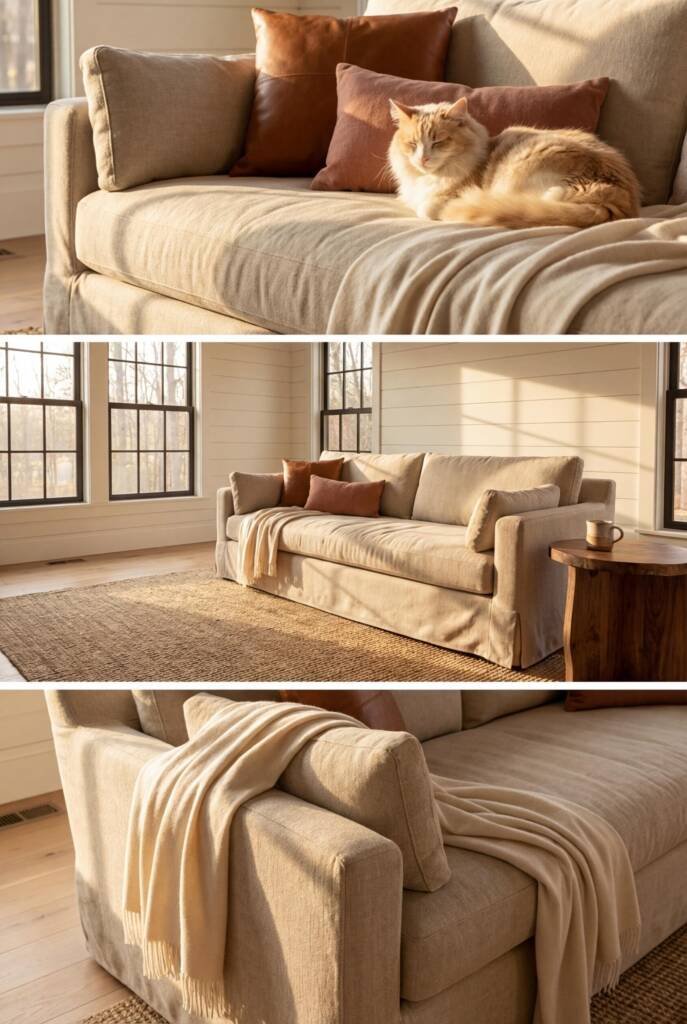
Your sofa doesn’t need to be cat-proof if its armor is machine-washable.
A basic slipcovered sofa in a rich, muted tone — think charcoal, olive, or warm taupe — reads as intentional and designer-level. The secret is choosing a heavyweight performance-fabric slipcover that drapes cleanly, hiding whatever budget frame lives underneath. Toss on a couple of textured throw pillows and nobody guesses your sofa is essentially a washing machine regular.
This is the only sane approach for a multi-cat home. Cat hair, drool spots, the occasional stress-pee incident — none of it matters when you can strip the cover and wash it on hot every single week. Look for a stretchy performance-fabric sofa slipcover with a tight weave that resists snagging from claws; you can find solid options on Amazon for roughly $35–$60 depending on sofa size. The tight weave also means hair sits on top instead of embedding, so a quick lint roller pass between washes keeps things presentable.
How to Choose and Style a Washable Slipcover Sofa for a Cat Household
- Pick Your Sofa Base: Any simple straight-arm sofa works — even a secondhand one. Measure the full width (most slipcovers fit sofas from 72″ to 92″) before you buy a cover.
- Choose a Heavyweight Washable Slipcover: Go for a stretchy performance-fabric slipcover in a dark, forgiving color. A quick Amazon search turns up options for $35–$60 that resist pilling and claw snags.
- Add Claw-Friendly Texture on Top: Layer a chunky knit or waffle-weave throw blanket (~$20 on Amazon) over the seat cushions — cats prefer scratching this instead of the slipcover itself.
- Wash Weekly, No Exceptions: Strip the cover every week and wash on warm with an enzyme-based detergent. Keep a second slipcover on hand so the sofa is never bare during laundry day.
- Budget move: You can pull this entire hack together for under $80 on Amazon — a performance slipcover for ~$50 and a textured throw blanket for around $20.
10. Under-Bed Storage Drawers That Keep Cat Toys From Taking Over
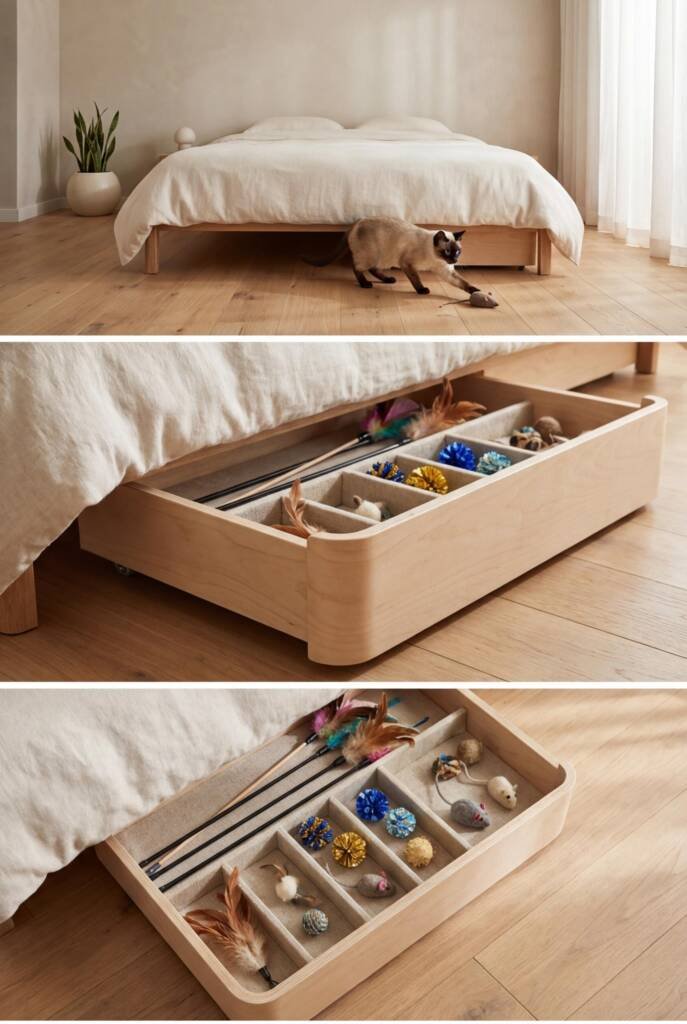
Your cats have more toys than a daycare and half of them are under the couch right now — let’s fix that.
Low-profile rolling storage drawers tucked under your bed turn dead space into a cat-toy command center — and nobody sees the chaos unless they go looking for it. The clean-line look keeps your small apartment feeling open and intentional, not like a pet store exploded in the hallway. When everything has a home, your floor stays clear and your cats still get variety at playtime.
This hack works beautifully for multi-cat households because you can assign one drawer per cat or organize by toy type — feather wands in one, crinkle balls in another, catnip mice in the third. Cats are naturally drawn to low, enclosed spaces, so don’t be surprised if they start nosing the drawers open themselves. A set of under-bed rolling storage drawers with dividers runs about $25–$40 on Amazon, and the wheels mean you can slide them out one-handed while your other hand fends off an impatient tabby.
How to Use Under-Bed Drawers to Organize Cat Toys in a Small Space
- Measure your clearance: Check the gap between your bed frame and the floor — most under-bed drawers need 6–8 inches of clearance. If you’re short on space, a set of bed risers (around $15 on Amazon) buys you an extra 3–5 inches.
- Choose drawers with dividers: Grab a set of low-profile rolling storage drawers with built-in compartments — you can find these on Amazon for roughly $25–$40. Dividers prevent everything from becoming one giant toy pile.
- Sort and purge: Toss anything shredded beyond recognition, then group the survivors by type. Rotate toys weekly so your cats stay interested without you buying new ones constantly.
- Label if you’re feeling fancy: Stick a small adhesive label on each drawer front so everyone in the household knows where things go back — a pack of chalkboard labels runs about $6 on Amazon.
- Budget move: The full setup lands under $50 on Amazon — rolling drawers for ~$30, bed risers for ~$15 if needed, and labels for around $6.
11. Side Table With a Built-In Cat Bed That Saves Serious Space
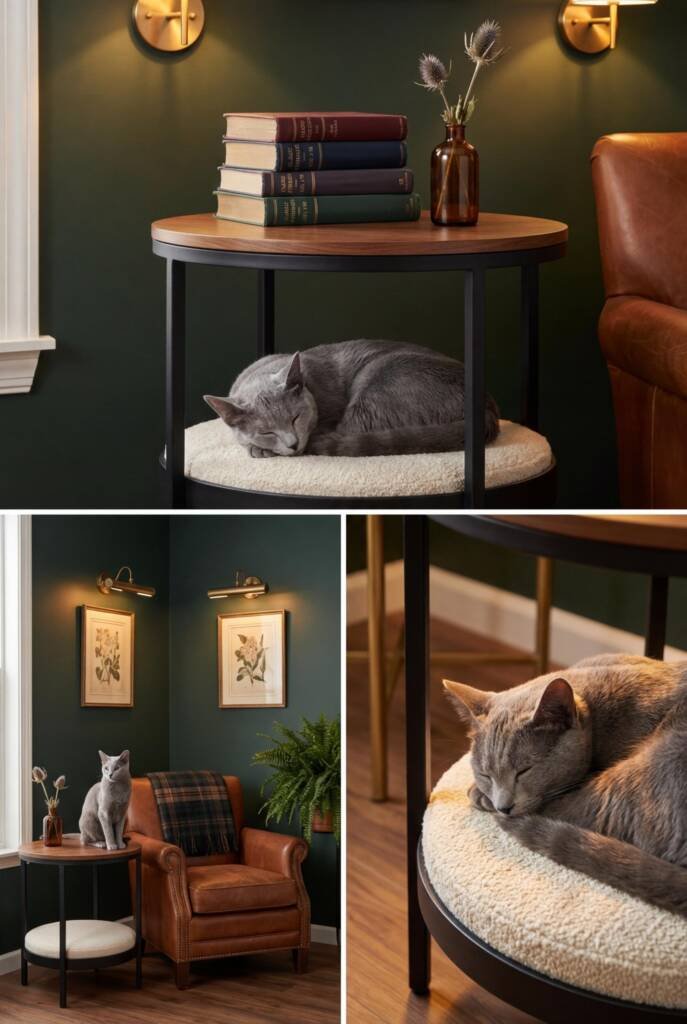
Your side table is already taking up floor space — make it pull double duty as a cat bed.
A round side table with an open lower shelf is already doing half the work — all you need is a cushion to transform that dead space into a cat bed that earns its keep. The look is clean and intentional, like you planned it from day one. Guests see a stylish end table with a book and a candle on top; your cat sees the coziest napping spot in the apartment.
Cats love enclosed, slightly tucked-away sleeping spots, which is exactly what that lower shelf creates — a semi-sheltered nook that feels safe without being closed off. Toss in a round plush pet cushion (you can find these on Amazon for ~$15) sized to fit the shelf diameter, and you’ve got dual-purpose furniture that takes up zero additional floor space. For multi-cat homes, flank your sofa with two of these — instant symmetry, two dedicated beds, no cat tree hogging your living room.
How to Turn a Side Table Into a Cozy Cat Bed Nook
- Measure the Lower Shelf: Grab a tape measure and note the shelf diameter and the clearance height between the shelf and the floor. Most round side tables have a 16–18″ shelf, so you’ll need a cushion that fits within that footprint.
- Add a Fitted Cushion: Pick up a round pet cushion or bolster bed sized to your measurement — a quick Amazon search turns up options for $12–$20. Choose one with a removable, washable cover.
- Secure It in Place: Use a strip of double-sided adhesive tape (roughly $8 on Amazon) underneath the cushion to keep it from sliding when your cat jumps in and out.
- Style the Top Surface: Keep the tabletop functional with a lamp, small plant, or stack of books — the point is making this look like furniture first, cat bed second.
- Budget move: The whole setup runs under $30 with a pet cushion and adhesive strips sourced from Amazon.
IKEA Hacks, Small Apartment Hacks That Welcome Pets
When you stack these IKEA hacks and small apartment hacks together, something clicks — your space stops feeling like a compromise between your style and your cats’ needs. A bookcase becomes a climbing wall, a side table hides a cat bed, and a slim rolling cart turns into a feeding station that tucks away in seconds. Every piece works harder, your cats get more vertical territory and enrichment, and your apartment actually looks better than it did before you started hacking.
That’s the whole point of designing with cats in mind: it doesn’t have to be a sacrifice. The best multi-cat spaces are the ones where smart design and pet-friendly function are the same thing — where guests notice the style first and the cat furniture second, if they notice it at all.
Here at Sweet Purrfections, we create content at the intersection of cool home decor and real life with pets. Because we believe your home should look like it belongs in a design magazine AND work for the furry family members who actually run it.
Leave a Reply