
If you’ve ever spent twenty minutes researching staircase ideas only to realize that every single gorgeous design falls apart the moment you factor in a curious cat or a boundary-challenged dog, welcome — you’re in the right place. The truth is, most staircase content completely ignores the reality that millions of us share our homes with pets who view an open stairway as either a personal highway or a launch pad. And the pet gate options at big box stores? Let’s just say “ugly beige plastic” isn’t exactly the aesthetic we’re going for.
That’s exactly why we pulled together these 11 staircase ideas that build pet gates directly into the design — not as an afterthought, but as a genuine style feature. We’re talking acrylic panels that vanish into your railing, barn door gates with industrial edge, and even a secret bookshelf door that swings open (yes, really). Each one proves you don’t have to sacrifice your home’s look to keep your pets safe and contained.
Whether you’re renovating a full staircase or just need a weekend upgrade that looks intentional, every idea on this list includes a practical DIY breakdown so you can actually make it happen — no contractor required for most of them. We’ve covered materials, approximate costs, difficulty level, and pet-specific considerations like slat spacing and latch security.
Let’s get into it.
1. The Invisible Acrylic Gate That Disappears Into Your Railing
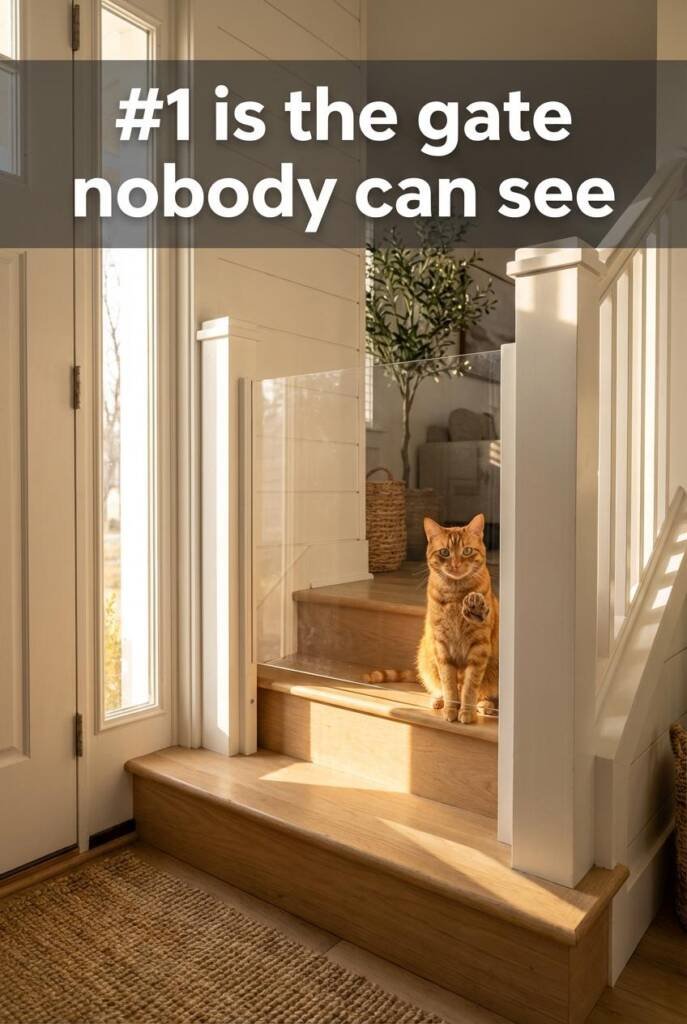
What if the best-looking pet gate on your staircase was one nobody could actually see?
Most pet gates announce themselves the second you walk into a room — chunky frames, metal hardware, that unmistakable “we have animals” energy. A frameless acrylic panel does the opposite. Mounted flush between your newel posts, a 3/8-inch-thick clear acrylic sheet gives you full pet containment while preserving every bit of light and sightline your open staircase was designed for. From more than a few feet away, it genuinely looks like there’s nothing there.
This works especially well for cats because they can’t squeeze through solid material the way they can with slatted or tension-rod gates — no bar spacing to exploit. The Qdos Crystal Designer Gate (around $85) is a popular ready-made option with a clean magnetic latch, but for a truly seamless look, a custom-cut acrylic panel from a local plastics supplier (typically $40–$70 for a 36″ × 30″ piece) mounted with discreet barrel hinges will blend right into your railing like it was always part of the design.
One thing to know: acrylic shows fingerprints and nose prints like nobody’s business. A quick daily wipe with a microfiber cloth keeps it invisible — which is, after all, the entire point.
How to Install a Frameless Acrylic Stair Gate That Looks Like Glass
- Measure your opening: Measure the exact width between newel posts and the height from stair tread to handrail. Subtract 1/4 inch from width for swing clearance.
- Order your panel: Get 3/8-inch cast acrylic cut to size from a local plastics shop like TAP Plastics — expect to pay $40–$70 depending on dimensions.
- Mount with barrel hinges: Attach two or three stainless steel barrel hinges ($8–$12 per pair) to one newel post using pre-drilled pilot holes to avoid splitting the wood.
- Add a magnetic latch: Install a low-profile magnetic cabinet latch on the opposite newel post so the gate closes silently and stays shut against curious paws.
- Budget move: Skip branded pet gates entirely — a custom-cut acrylic panel with hardware from your local plastics supplier runs under $80 total, roughly half the cost of the Qdos Crystal gate.
2. A Mid-Century Slatted Wood Gate That Doubles as Wall Art
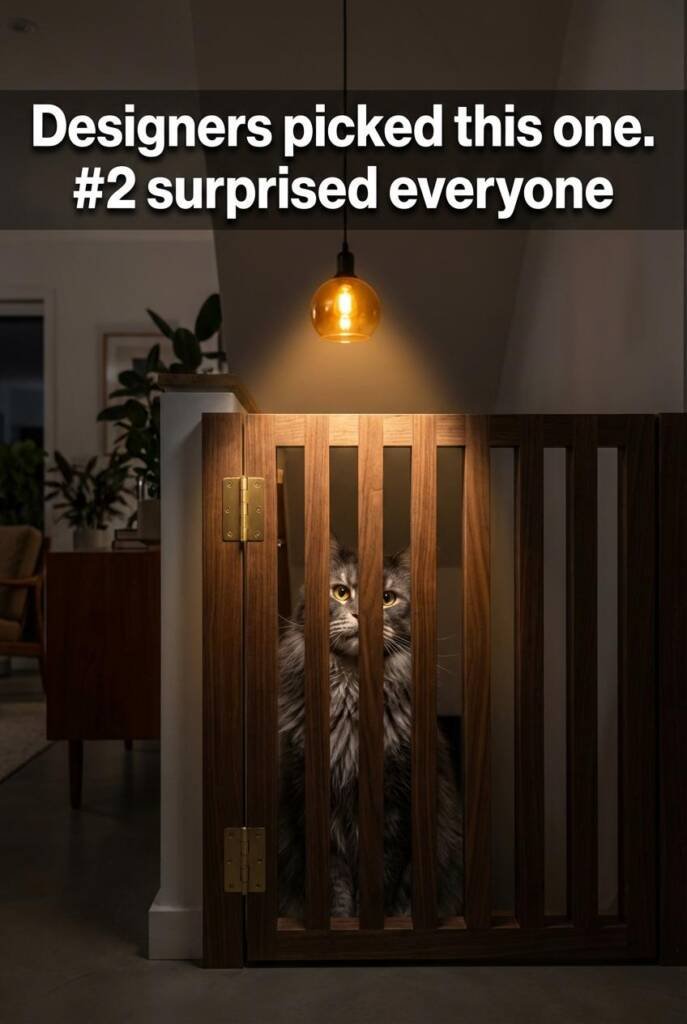
Most pet gates try to disappear — this one deserves a spotlight.
Vertical walnut slats spaced 1.25 inches apart, set inside a slim hardwood frame, and mounted on brass hinges — this gate looks like a piece of museum-quality room sculpture that happens to keep your cat off the stairs. The tight slat spacing blocks even the most determined kitten while the warm wood grain and clean lines channel pure mid-century credibility. Pair it with a tapered-leg console table nearby and the whole entryway feels intentional, not baby-proofed.
For cats specifically, slatted gates beat solid panels because your pet can still see through them, which reduces the anxiety that makes some cats yowl or claw at barriers. If you’d rather buy than build, the Richell Wooden One-Touch Pet Gate in brown ($65–$80 on Chewy) has a similar vibe, though upgrading to real walnut slats takes the look from “nice enough” to “where did you get that.” A magnetic latch at the top keeps operation one-handed — critical when you’re carrying a laundry basket or a squirmy cat.
The best part: when guests come over, nobody clocks it as a pet gate first. They see a design detail. That’s the whole point of this list.
How to Build a Mid-Century Slatted Gate for Your Staircase
- Mill and sand the slats: Rip 3/4-inch walnut boards into 1.5-inch-wide slats on a table saw, then sand to 220 grit. You’ll need about 18–22 slats for a standard 30-inch-wide opening.
- Build the frame: Construct a rectangular frame from 1×3 walnut using pocket screws and wood glue, then attach slats at 1.25-inch intervals with brad nails and glue.
- Mount the hinges and latch: Use two 3-inch brass butt hinges ($8–$12 at Hardware Resources) on the wall side and install a rare-earth magnetic latch at the top for quiet, one-handed operation.
- Finish and seal: Apply two coats of Osmo Polyx-Oil in a satin finish to protect the walnut while keeping the grain visible and natural-looking.
- Budget move: Skip walnut and use poplar slats stained with Minwax Special Walnut (#224) for a convincing lookalike that drops your lumber cost from ~$90 to under $25.
3. Matte Black Steel Barn Door Gate — Industrial Chic Meets Cat-Proof
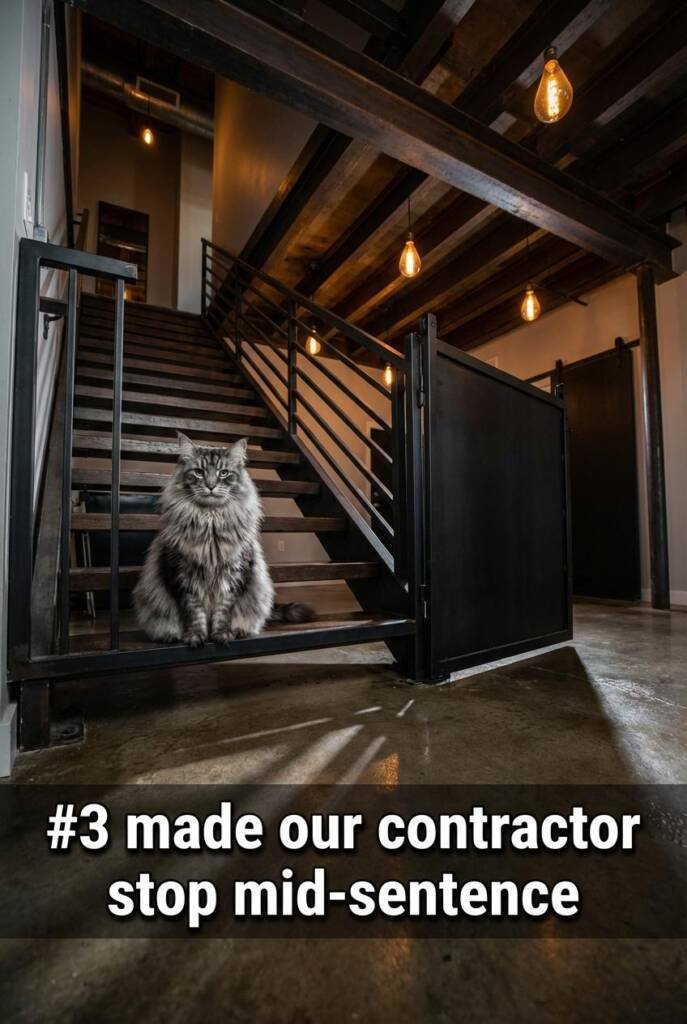
Your staircase doesn’t need to choose between looking like a SoHo loft and keeping your cats off the bedroom floor.
A sliding barn door gate mounted on a matte black steel track turns your staircase into something that looks ripped straight from a Brooklyn loft — except this one actually keeps your cats from treating the second floor like a parkour course. The industrial hardware becomes a design feature instead of an eyesore, and the gate tucks flat against the wall when you don’t need it. Pair it with exposed brick or concrete floors and you’ve got a staircase that belongs in an architecture magazine.
Cats are climbers, so the key here is choosing a gate with vertical steel bars spaced no more than 1.5 inches apart — wide enough to look airy, tight enough that even a determined kitten can’t squeeze through. The Rustica Hardware barn door track system ($149–$299 depending on length) gives you the smoothest glide and holds up to 200 lbs, so even a heavy steel-framed gate won’t sag over time. Mount it at 36 inches high minimum; most cats won’t attempt a jump over something at that height when there’s no shelf to land on.
One thing that makes this option stand out: it’s the only gate style on this list that uses zero floor space when open. The gate slides parallel to the wall, so you never have a swinging door blocking the hallway or creating a trip hazard on the landing.
How to Install a Sliding Barn Door Pet Gate on Your Staircase
- Mount the Track: Install a flat steel barn door track 2–3 inches above your desired gate height using lag bolts into wall studs. Rustica’s flat track kits start at $149 and include all mounting hardware.
- Build or Buy the Gate Panel: Use 1-inch square steel tubing welded into a frame with vertical bars spaced 1.5 inches apart, or order a custom panel from a local metal shop for $200–$400.
- Hang and Align the Gate: Attach roller hangers to the top of the gate panel, hook them onto the track, and adjust the stoppers so the gate locks flush with the newel post on both sides.
- Add a Latch: Install a self-closing cane bolt or a hook-and-eye latch at 42 inches high — out of paw reach but easy for you to flip one-handed while carrying laundry.
- Budget move: Skip the custom metalwork and weld your own gate frame using 1-inch square tubing from a steel supplier — raw materials run about $60–$80 versus $300+ for a fabricated panel.
4. The Retractable Mesh Gate You’ll Forget Is Even There
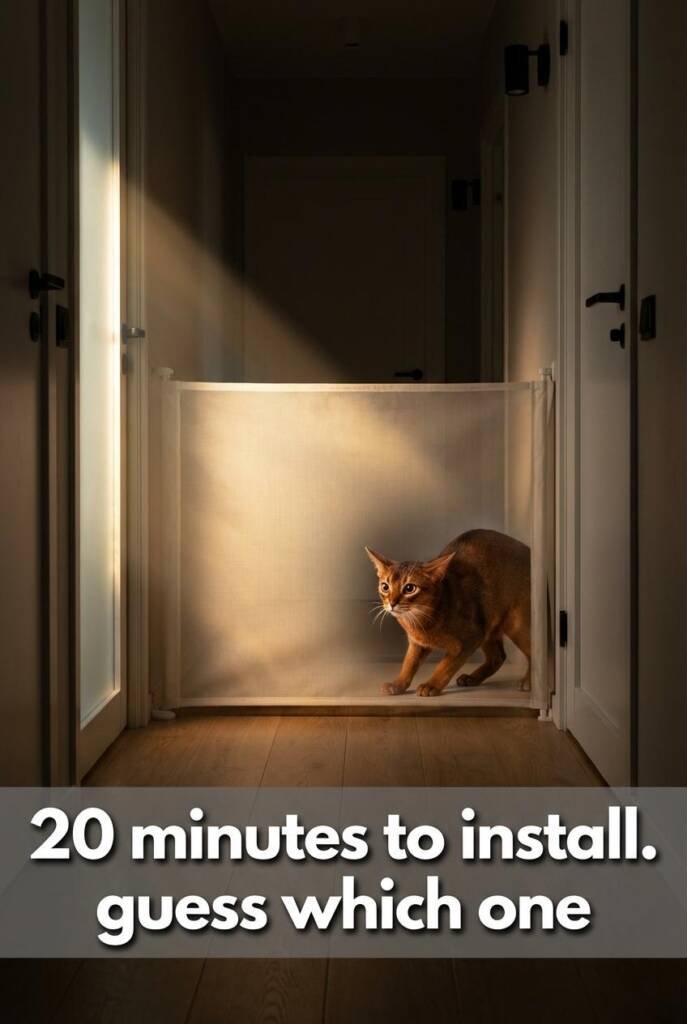
The best pet gate is the one nobody knows is there.
Most pet gates announce themselves the second you walk into a room. A retractable mesh gate does the opposite — when you release the latch, the mesh retracts into a housing no wider than a deck of cards mounted flush against your newel post. What’s left is a slim aluminum casing that reads more like door hardware than pet containment. Visitors genuinely won’t notice it.
The Retract-A-Gate ($50–$70) is the gold standard here, extending up to 72 inches wide with a mesh height of 34 inches — tall enough to block most dogs, though determined cats can leap it. For cats, this gate works best as a deterrent for kittens or older cats who aren’t big jumpers. The mesh is scratch-resistant but not scratch-proof, so if your cat treats barriers as a personal challenge, consider pairing it with a citrus-scent deterrent spray on the mesh itself. The one-handed unlatch mechanism means you can open it while carrying laundry, a toddler, or a very opinionated cat who wants dinner five minutes ago.
How to Mount a Retractable Mesh Gate That Hides When Open
- Mark your mounting points: Hold the retractable housing against the newel post at 34 inches from the stair tread and mark your screw holes. The receiving latch mounts on the opposite wall or post at the same height.
- Pre-drill and reinforce: Use a 7/64″ bit to pre-drill into the newel post, and add wall anchors rated for 50+ lbs on the latch side if you’re going into drywall instead of a stud.
- Install the housing and latch: Secure the retractable housing with the included screws, then mount the magnetic latch receiver on the opposite side. Most Retract-A-Gate installs take under 15 minutes.
- Test the tension and retraction: Pull the mesh across slowly and lock it into the latch — it should sit taut without sagging. Adjust the internal tension dial if the mesh doesn’t retract smoothly when released.
- Budget move: The Perma Child Safety retractable gate runs around $35 on Amazon and uses the same disappearing-mesh concept with a slightly narrower 55-inch max span.
5. Arched Garden-Style Gate for Cottagecore Staircases
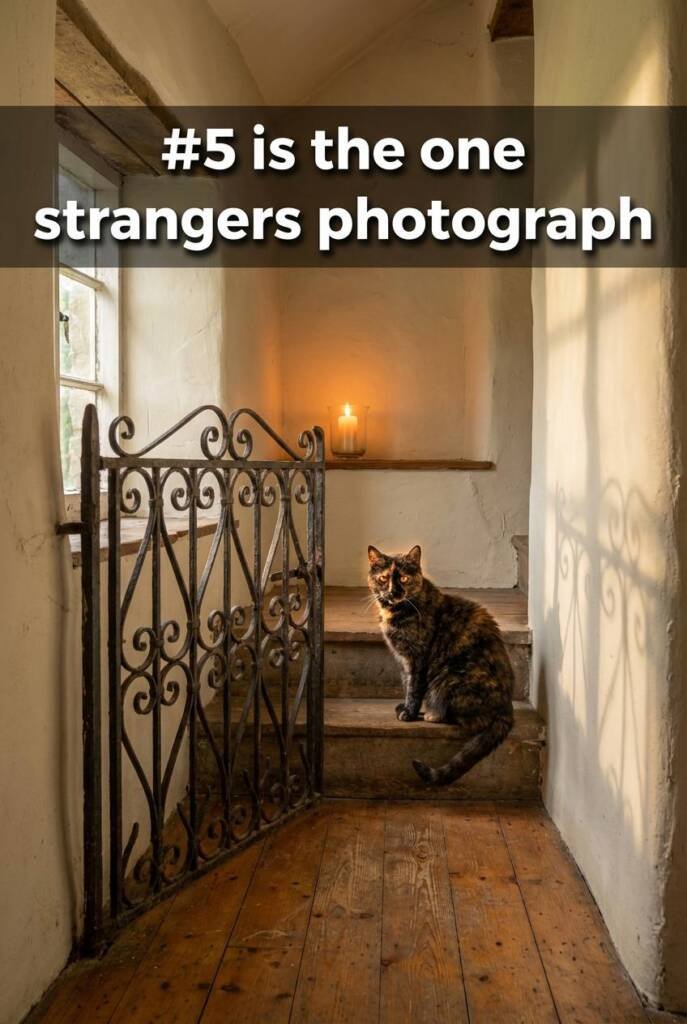
Your cottagecore staircase deserves a gate that looks like it guards an English garden, not a toddler.
A custom arched wrought iron gate at the base of your staircase turns a functional cat barrier into the kind of detail people photograph. Think scrollwork finials, a gentle arch that mirrors a garden trellis, and a matte black or antique bronze finish that pairs perfectly with whitewashed risers, reclaimed wood treads, and floral runners. It’s the cottagecore staircase moment that makes guests ask “where did you find that?” instead of “is that a pet gate?”
For cats specifically, wrought iron works because the vertical pickets can be spaced at 2.5 inches or less — tight enough to block even a determined kitten without looking like a cage. The weight of real iron (typically 25–40 lbs for a gate this size) also means your cat can’t shove it open the way they can with lightweight pressure-mounted gates. If full custom isn’t in your budget, Etsy shop IronCraftUSA offers semi-custom arched iron gates starting around $350 that can be sized to your stair opening up to 38 inches wide.
The arch is what sells this idea. A flat-top gate reads as safety equipment; an arched gate reads as architecture. Lean into it with climbing pothos draped along the newel post and you’ve got a staircase that belongs in a storybook.
How to Source a Custom Arched Iron Gate for a Cottage Staircase
- Measure your opening precisely: Measure the width between newel post and wall (or post to post) at both the base and 30 inches up, since older cottage staircases are rarely perfectly plumb.
- Choose your source: For true custom work, contact a local ornamental ironworker — expect $500–$900 for a single arched gate with scrollwork. For semi-custom, IronCraftUSA on Etsy starts at $350.
- Specify cat-safe picket spacing: Request vertical picket spacing of 2.5 inches or less on center, and confirm the gate swings open in the direction that works for your foot traffic.
- Install with lag bolts: Mount hinges directly into the newel post or wall stud using 3-inch lag bolts — wrought iron is heavy, so toggle bolts or drywall anchors won’t cut it.
- Budget move: Skip full custom and repurpose a vintage wrought iron garden gate from Facebook Marketplace — they regularly go for $40–$80 and just need a hinge adapter to fit your stair opening.
6. Half-Wall with Built-In Cat Pass-Through — Cats Go, Dogs Stay
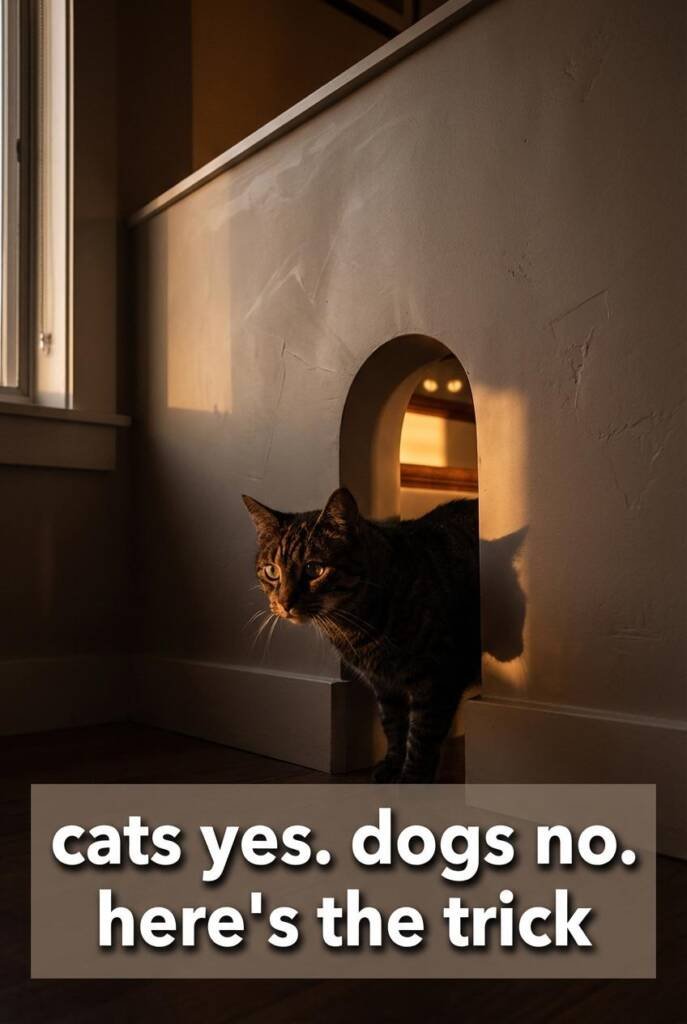
What if your staircase gate had no gate at all — just a wall your cat treats like a VIP entrance?
A half-wall stair barrier with a small arched cut-out at the base is the ultimate multi-pet household hack — it looks like intentional architecture while secretly functioning as a species-specific gate. The half-wall (typically 36–42 inches tall) replaces your standard railing or banister on one side, giving the staircase a clean, modern-craftsman look. The arch at floor level — usually 6–8 inches wide and about 7 inches tall — is just big enough for cats to slip through but too small for most dogs or toddlers to follow.
This works because cats are liquid. A healthy adult cat can squeeze through any opening wider than about 5.5 inches. Meanwhile, even small dog breeds like French Bulldogs have chest depths that won’t clear a 7-inch arch. If you want a ready-made option before committing to construction, the Cat Door Alternatives Interior Pet Door by Cathole ($28 on Amazon) lets you test the pass-through concept in a temporary plywood panel first. For the permanent build, have your carpenter frame the arch with a matching trim profile so it reads as a design detail, not an afterthought.
The beauty here is zero moving parts — no latches, no hinges, nothing to break or leave open. Your cat gets full run of the house while the staircase actually looks more substantial and custom than a standard railing ever could.
How to Design a Half-Wall Stair Gate With a Cat Pass-Through
- Build the half-wall frame: Frame a 2×4 stud wall on the open side of your staircase, 38–42 inches tall, anchored to the stair stringers and the floor/ceiling structure above.
- Cut the cat arch: At the base of the wall, frame an arched opening 6–8 inches wide by 7 inches tall — use a jigsaw for the curve and sand smooth so it won’t snag fur.
- Finish to match your home: Drywall, tape, and paint the half-wall, then add a trim profile around the arch. A bullnose or craftsman-style casing ($1.50–$3/linear foot at Home Depot) makes it look built-in.
- Top it off with a cap: Install a flat or beveled wall cap in stained hardwood or painted MDF — this turns the half-wall into a visual feature and gives you a spot to set your coffee on the way upstairs.
- Budget move: A carpenter can frame, drywall, and finish a half-wall with cat arch for $400–$600 — roughly the same price as a high-end custom baby gate you’d eventually remove anyway.
7. Tension-Mount Fabric Gate That Matches Your Runner
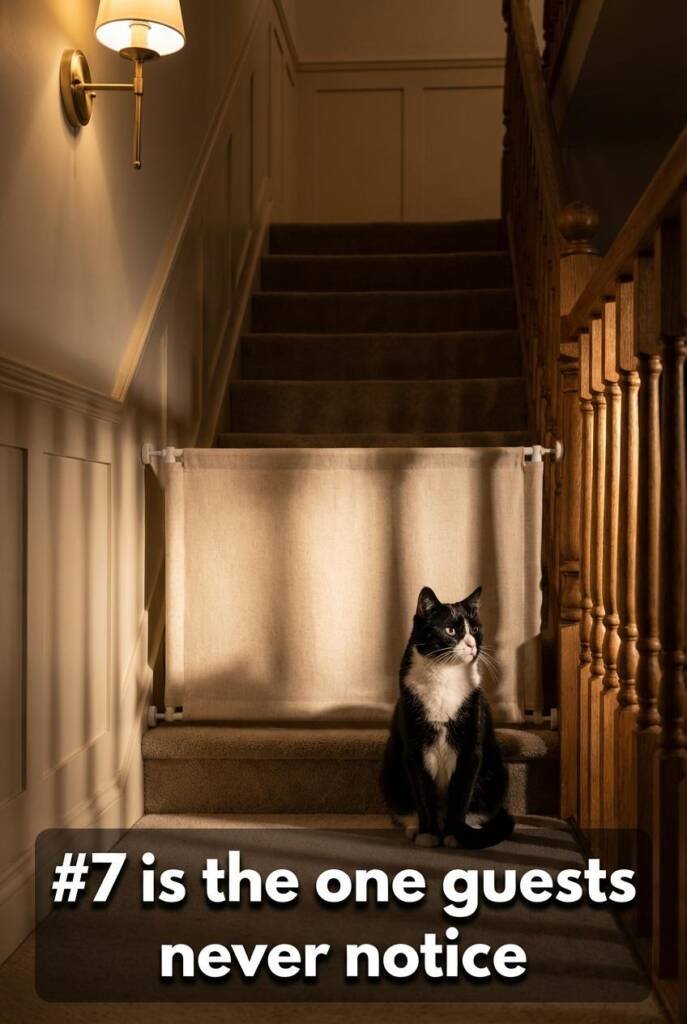
A pet gate that looks like part of your stair runner? Yeah, that exists.
Most tension-mount gates scream “we have pets” with their industrial mesh and plastic hardware. The Stair Barrier flips that script entirely — it’s a fabric panel that stretches between your banisters like a taut Roman shade, available in dozens of patterns from neutral linens to bold geometrics. When you match it to your stair runner or hallway textiles, guests genuinely don’t register it as a pet gate.
For cats specifically, the taut fabric surface works brilliantly because there’s nothing to climb — no bars, no mesh grid, no footholds. The standard size fits openings 36″–42″ wide and stands 32″ tall, which is enough to deter most cats from attempting a leap (though determined climbers may still try). At $90–$130 from The Stair Barrier’s direct site, it’s one of the most affordable options on this list, and installation is truly tool-free — you’re just twisting two tension rods into place.
The real design win here is versatility. Swap the fabric panel seasonally, keep a spare in a coordinating print, or order custom fabric through their made-to-order program for about $20 more. It rolls up and stashes in a drawer when company comes, though honestly, you won’t need to hide this one.
How to Choose a Fabric Stair Gate That Coordinates With Your Decor
- Measure your opening: Measure the distance between your two banisters at both the top and bottom — The Stair Barrier fits openings from 36″ to 42″ in the standard size, with a wide version available up to 52″.
- Match your textiles: Pull a swatch from your stair runner, wall color, or hallway curtains and compare it against The Stair Barrier’s pattern library — their “Wall to Banister” and “Banister to Banister” models each come in 25+ fabrics.
- Install the tension rods: Twist the two included tension rods snugly against each banister post — no drilling, no hardware, and removal takes about 10 seconds.
- Test the tension daily for the first week: Give the fabric a firm push each morning to make sure the rods haven’t shifted; retighten a quarter-turn if there’s any give.
- Budget move: Skip the custom fabric option and choose from in-stock patterns at $90–$110 — they ship faster and save you up to $40.
8. Japandi Rope Barrier — Organic Texture Meets Function
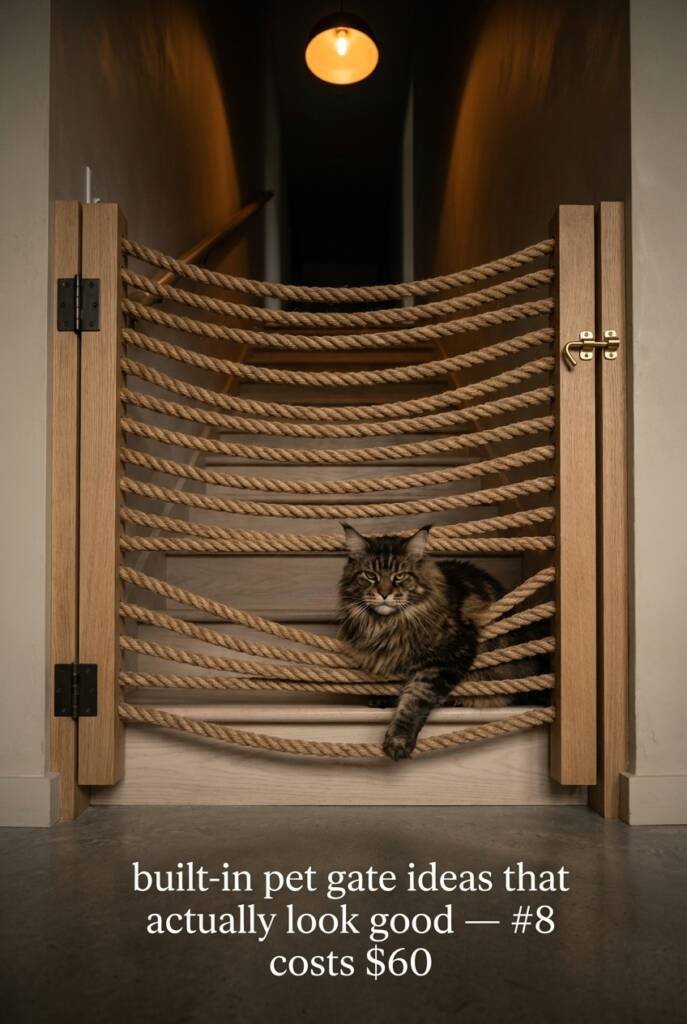
This is the pet gate that doesn’t look like a pet gate — it looks like something from a Tokyo design studio.
Thick jute rope threaded horizontally between minimal wooden posts gives your staircase that quiet, intentional Japandi energy — the kind that makes people stop and ask where you hired your designer. The trick is spacing: ropes placed 2.5 to 3 inches apart create a dense enough barrier to block cats and small dogs while maintaining that open, airy feel Japandi design demands. The natural fiber texture against light oak or ash posts is genuinely beautiful, and it softens the hard lines of a staircase in a way metal or acrylic never could.
For cats specifically, the rough jute surface is a double win — most cats don’t love gripping coarse rope to climb, so it acts as a natural deterrent beyond just the physical barrier. Use 1-inch or 1.5-inch diameter three-strand jute rope from Knot & Rope Supply (around $0.80–$1.50 per foot depending on thickness) for that chunky, artisanal look. If your cat is a determined climber, go tighter on spacing and add a vertical rope accent every few horizontal runs to break up any “ladder” effect.
The best part? This setup is completely removable. Drill your post holes, but use threaded inserts so the whole system can come out cleanly if you sell the house or your pets mellow out with age.
How to Create a Jute Rope Stair Barrier in Japandi Style
- Install the anchor posts: Secure 2×2-inch hardwood posts (white oak or ash work beautifully) to the top and bottom of your stair opening using heavy-duty structural screws into the framing. Keep posts flush and plumb — they’re the whole visual anchor.
- Drill rope channels: Mark and drill 1.5-inch holes every 2.75 inches along each post using a Forstner bit. Sand the inside of each hole smooth so the rope threads through without fraying.
- Thread and tension the jute rope: Feed 1.5-inch three-strand jute rope through each hole, pulling taut. On the backside of each post, tie a figure-eight stopper knot to lock each rope in place — no hardware visible from the front.
- Seal and finish: Apply Osmo Polyx-Oil ($45 for 750ml) to the posts for a matte, natural finish. Leave the jute untreated — sealants darken it and kill the organic texture you’re going for.
- Budget move: Skip pre-made Japandi rope panels ($200+) and DIY this entire setup for around $60–$85 in rope and lumber from your local hardwood supplier.
9. Dutch Door Gate — Close the Bottom, Open the Top
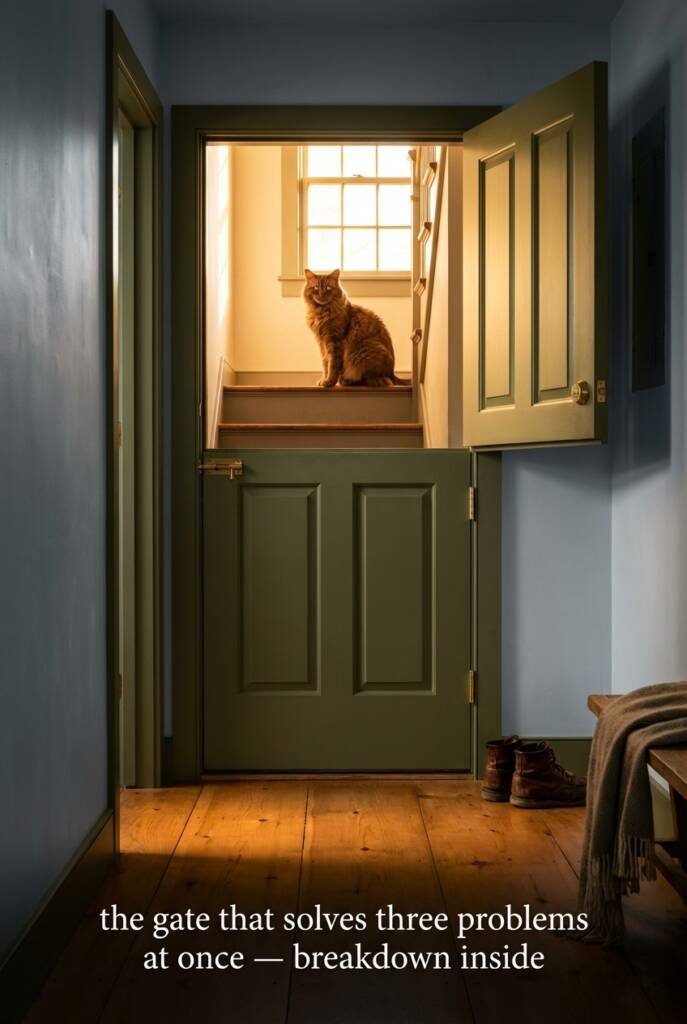
A Dutch door at the top or bottom of your staircase is one of the most charming staircase ideas you’ll ever steal from farmhouse design. The split-door concept lets you latch the lower half to block your cat while swinging the upper portion open — so you still get natural light, conversation flow, and zero claustrophobic hallway vibes. Painted in a contrasting trim color or left in natural wood, it reads as an intentional architectural detail, not a pet barrier.
This works especially well for cats who aren’t climbers, since the lower half typically stands 30–36 inches tall. For determined jumpers, you can always latch both halves closed when you’re not around. Simpson Door Company makes solid wood Dutch doors starting around $500 that you can trim to fit a standard 32–36 inch stair opening, and their unfinished options let you match your existing woodwork exactly.
The real magic here is versatility. Hosting a dinner party? Close both halves and it’s just a beautiful door. Regular Tuesday? Bottom latched, top open, cat contained, airflow maintained. It’s one of the few farmhouse staircase solutions that genuinely pulls double duty without looking like it’s trying.
How to Install a Dutch Door as a Stylish Staircase Pet Gate
- Measure your stair opening: Get the exact width and height of your stairway entrance — most are 32–36 inches wide. Order your Dutch door to fit or plan to add trim pieces to close any gaps.
- Install a standard door frame: Frame the opening with a prehung door jamb kit (around $50 at Home Depot) shimmed plumb and level, just like any interior door installation.
- Hang the Dutch door on heavy-duty hinges: Use three 4-inch ball-bearing hinges per half — six total — to handle the weight of independent operation. Simpson and Jeld-Wen both include hardware specs with their doors.
- Add a latch between the two halves: Install a flush bolt or barrel bolt where the upper and lower halves meet so you can lock them together as a single door or separate them with one flick.
- Budget move: Score vintage Dutch doors at architectural salvage shops for $75–$200 — they just need a fresh coat of paint and new hinges to look intentional.
10. Glass Panel Gate in a Brushed Brass Frame — Quiet Luxury Energy

Your staircase gate shouldn’t look like it came from the baby aisle — this one looks like it came from an architect’s portfolio.
A tempered glass panel set inside a slim brushed brass frame looks less like a pet gate and more like an architectural detail you’d see in a Parisian apartment. The transparency keeps your sightline unbroken — stairs feel open, light passes through, and the warm brass catches it beautifully. This is the gate for people who want zero visual compromise.
For cats specifically, glass is ideal because there are no bars to squeeze through and no mesh to claw apart. The smooth surface is also dead simple to clean. If you want a ready-made option, Cristal Gate by Impag offers a tempered glass panel gate starting around $180, though it comes in chrome rather than brass. For a true brushed brass frame, you’re looking at a custom metalworker — expect $400–$800 depending on your opening width. The investment is worth it when the result reads as intentional millwork rather than a baby product bolted to your bannister.
One thing to watch: tempered glass shows fingerprints and nose prints like nobody’s business. Keep a microfiber cloth nearby, or embrace the lived-in look.
How to Source a Brass-Framed Glass Stair Gate for a Luxury Look
- Measure and template your opening: Measure the width between your stair posts or walls at both the top and bottom — openings are rarely perfectly square. Create a cardboard template so your fabricator gets an exact fit.
- Choose your glass specification: Go with 10mm tempered safety glass for any opening up to 36 inches wide. For wider spans, ask your glazier about 12mm to prevent flex.
- Find a brass fabricator: Search for local custom metal shops or try CustomMade.com, where brass-frame commissions typically run $400–$800. Specify brushed (not polished) finish for that quiet-luxury matte look.
- Install with concealed hardware: Use flush-mount pivot hinges rated for the gate’s weight — glass panels are heavier than you’d expect at roughly 15–20 lbs. Concealed hinges keep the frame lines clean.
- Budget move: Skip custom brass and buy a $180 chrome-frame glass gate, then spray the frame with Rust-Oleum Metallic Brass for a convincing match at a fraction of the cost.
11. Built-In Bookshelf Gate That Swings Open Like a Secret Door
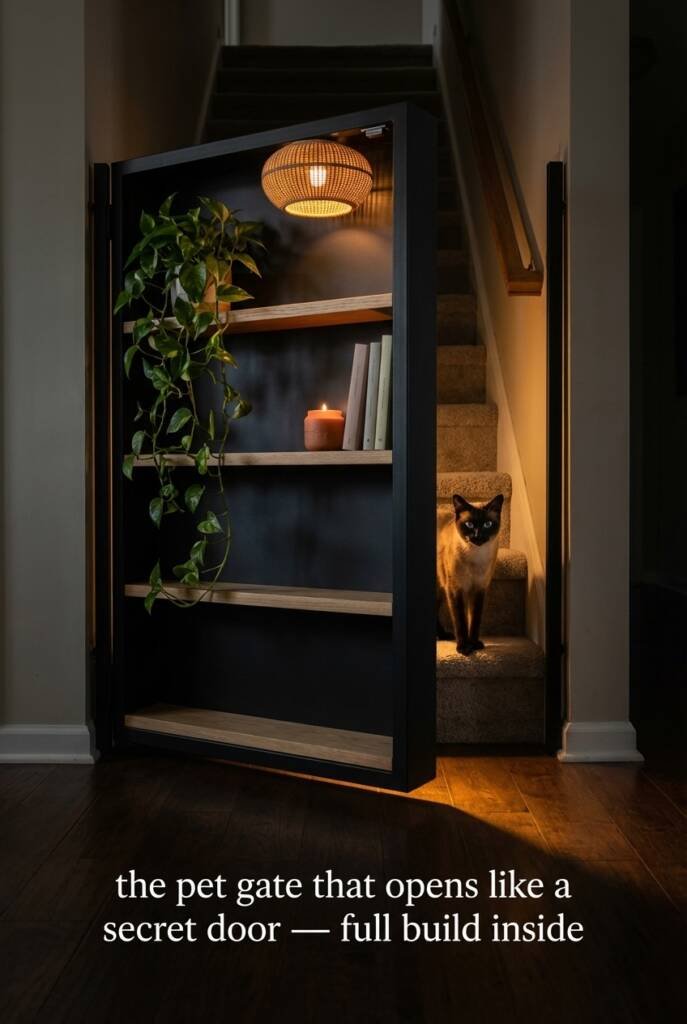
Every home deserves at least one secret door — yours just happens to keep the cat off the stairs.
A shallow bookshelf — just 4–6 inches deep — built into a hinged wooden frame creates a gate that looks like built-in cabinetry when closed and swings open like a secret passageway when you need through. Stack it with small plants, candles, or actual books, and guests won’t even register it as a pet barrier. It’s the kind of detail that makes people ask who your designer is.
For cats specifically, this works because the solid panel construction eliminates climbable bars entirely. The visual weight of a filled bookshelf also tends to discourage jumping attempts more than an open gate does — cats read it as a wall, not a challenge. Use a heavy-duty concealed hinge like the SOSS 218 Invisible Hinge ($38/pair) rated for doors up to 70 lbs, so the swing action stays smooth even with books loaded on the shelves. Add a magnetic push-latch at the top so it clicks shut hands-free.
The best part? This is the one gate on our list that actually adds storage to your home instead of just blocking a staircase. Even a 4-inch-deep shelf holds paperbacks, small frames, and succulents — functional square footage you didn’t have before.
How to Build a Bookshelf Gate for Your Staircase Entrance
- Build the frame: Construct a rectangular frame from 2×4 lumber sized to your stair opening, then attach ¾-inch plywood as the back panel. Leave ¼ inch clearance on the hinge side and ⅛ inch on the latch side for smooth operation.
- Add shelves and trim: Install 4-inch-deep shelves every 8–10 inches using dado joints or shelf pins, then wrap the face in trim molding that matches your existing stair woodwork.
- Mount with concealed hinges: Attach two SOSS 218 Invisible Hinges ($38/pair) to a fixed jamb frame anchored into the wall studs — these sit completely flush when the gate is closed, selling the built-in illusion.
- Install the latch and stop: Add a magnetic push-to-open latch at the top (out of paw reach) and screw a rubber door stop to the floor so the gate can’t swing over the stair edge.
- Budget move: Use a pre-made IKEA BILLY bookcase ($49) cut down to your opening width as the gate panel instead of building shelves from scratch.
Staircase Ideas That Welcome Pets
From invisible acrylic panels to secret bookshelf doors, every one of these staircase ideas proves the same point: pet gates don’t have to be the thing that ruins your home’s aesthetic. They can actually elevate it. The trick is treating the gate as part of the design from the start — matching materials, leaning into your existing style, and thinking about function and form as one single decision instead of two competing ones.
Whether you went all-in on the cottagecore arch or bookmarked that brushed brass glass panel for your future dream renovation, the best staircase ideas are the ones that do double duty — looking stunning for you while keeping your pets exactly where they need to be. Style and pet-proofing aren’t opposites. They never were.
Here at Sweet Purrfections, we create content at the intersection of cool home decor and real life with pets. Because we believe your home should look like it belongs in a design magazine AND work for the furry family members who actually run it.