
If you’ve ever scrolled through a beautifully curated living room on Pinterest and thought, “Yeah, but where’s the cat tree?” — japandi cat furniture is about to become your new obsession. This design style blends Japanese minimalism with Scandinavian warmth, and it turns out that combination is basically tailor-made for people who live with cats. We’re talking clean lines, natural materials, neutral palettes, and a philosophy that says every object in your home should be both beautiful and functional. Sound familiar? That’s literally the requirement for anything a cat owner brings into their space.
What makes Japandi such a perfect fit for pet-friendly homes is that it already embraces imperfection — the Japanese concept of wabi-sabi celebrates the beauty of wear, age, and natural textures. So when your cat scratches that wooden post down to raw grain or naps in a linen-covered basket until it molds to their shape, that’s not damage. That’s aesthetic. The Scandinavian side brings cozy functionality, organic materials like oak, birch, and rattan, and a “less but better” approach that means fewer things for your cat to knock off surfaces.
We pulled together 12 japandi cat furniture ideas that genuinely look stunning in a real home — not a sterile showroom with no evidence of animal life. Each idea includes a breakdown of how to DIY or source it yourself, what materials work best, and the little details that make it both design-worthy and cat-approved. Whether you’re furnishing a whole apartment or just replacing that eyesore of a cat tree in the corner, there’s something here for every budget and skill level. Let’s get into it.
1. The Floating Oak Cat Shelf That Doubles as a Gallery Ledge
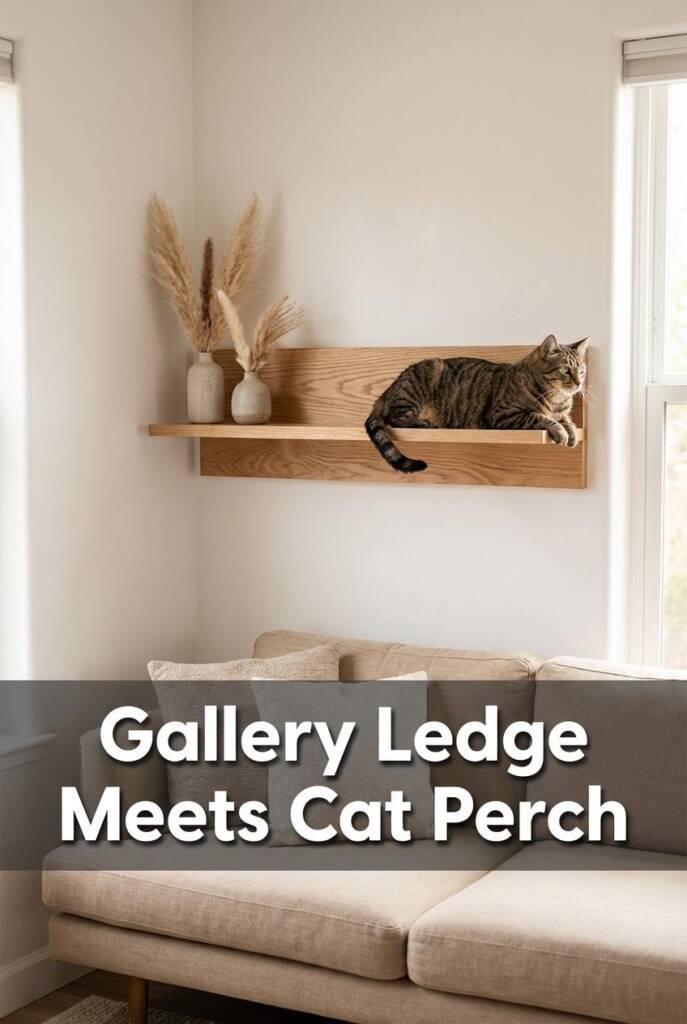
Your cat already thinks they own the highest point in every room—so why not make it the most beautiful thing on the wall?
Here’s the secret most Japandi enthusiasts figure out too late: the best cat furniture doesn’t look like cat furniture at all. A solid white oak floating shelf—like the MADE.com Jenson Picture Ledge (~$89) or the similar IKEA ÖSTNÄS oak ledge (~$35 for 45 cm)—gives your cat exactly what they want (height, a vantage point, a warm perch near the ceiling) while giving you that clean horizontal line that defines Japandi interiors. The shallow lip along the front edge, originally designed to keep picture frames from sliding off, does double duty by giving your cat’s paws something to grip when they leap up or settle in for a nap.
Visually, this works because Japandi design thrives on what the Japanese call “ma”—the intentional use of negative space. A single oak shelf mounted at around 150 cm (roughly 5 feet) off the floor creates a focal point without cluttering the wall. Lean two or three muted-tone prints against the back lip, leave a generous gap of empty shelf, and your cat will naturally claim that open stretch. The warm honey grain of white oak sits perfectly in the Japandi palette alongside matte white walls, warm concrete, and linen textiles. It reads as architecture, not as a pet accessory.
But let’s talk about the engineering, because a 5 kg cat launching itself onto a shelf is a very different load scenario than a few picture frames sitting still. You need a shelf rated for at least 15 kg (33 lbs) to account for the dynamic force of a cat jumping. The MADE.com Jenson is built from solid oak with a steel bracket mounting system rated to 20 kg, which gives you a comfortable safety margin even for larger breeds. Mount it into wall studs—not just drywall anchors—using 70 mm (roughly 2.75-inch) wood screws. If your studs don’t line up where you want the shelf, use toggle bolts rated for at least 25 kg each, and use a minimum of three attachment points across the shelf’s length.
One detail that elevates this from functional to genuinely beautiful: add a strip of natural wool felt (3 mm thick, cut to size) along the shelf surface where your cat sits. It gives them traction and warmth, it dampens the sound of them landing, and the oatmeal or charcoal tones of undyed wool felt look completely intentional next to the oak grain. A 30 cm × 100 cm piece of premium wool felt from a craft supplier runs about $8–$12, and you can secure it with double-sided carpet tape so it’s removable for washing.
How to Install a Dual-Purpose Floating Cat Shelf That Actually Holds Weight
- Find Your Studs and Mark Your Height: Use a stud finder to locate wall studs and mark them with painter’s tape. For most cats, mount the shelf between 140–160 cm (55–63 inches) from the floor. Make sure there’s a logical “stepping stone” route—a nearby bookcase, side table, or second shelf—so your cat can reach the perch without a dangerous leap from the ground.
- Choose the Right Shelf and Verify Its Weight Rating: Look for a solid hardwood shelf (white oak, ash, or birch) with a front lip of at least 2 cm. Verify the manufacturer’s weight rating is 15 kg or above. The MADE.com Jenson (~$89) and IKEA ÖSTNÄS (~$35) both qualify. Avoid MDF or particleboard—they can sag under repeated impact loads over time.
- Mount with Structural Fasteners: Drill pilot holes into the wall studs using a 3 mm bit, then secure the shelf brackets with 70 mm wood screws. If you’re mounting into concrete or brick, use 8 mm masonry anchors and corresponding screws. Always use a spirit level—even a 2-degree tilt will cause frames to slide and make your cat’s perch uncomfortable. Aim for a minimum of three fixing points across the shelf span.
- Add a Wool Felt Liner for Grip and Comfort: Cut a strip of 3 mm natural wool felt to fit the open section of the shelf where your cat will sit. Secure it with removable double-sided carpet tape (3M Command Strips work well) so you can pull it off for washing every few weeks. Stick with undyed or muted tones—oatmeal, slate gray, or soft camel—to keep the Japandi aesthetic intact.
- Style the Non-Cat Zone: On the remaining shelf space, lean two to three prints or postcards in thin black or natural wood frames. Keep them clustered to one side so there’s a clear visual boundary between the “gallery” section and your cat’s lounging area. This deliberate asymmetry is pure Japandi—balanced without being symmetrical.
- Test Before Your Cat Does: Press down firmly on the shelf with about 10–15 kg of force (stack some books on it overnight) to confirm the mount holds. Check for any wobble or wall cracking. Once you’re confident, encourage your cat up with a treat or a bit of catnip on the felt liner. Most cats will claim the spot within 48 hours.
- Budget move: Skip the MADE.com shelf and grab the IKEA MOSSLANDA picture ledge in birch veneer for just $14.99 (115 cm length). It’s rated for lighter loads, so reinforce it by adding a third L-bracket ($3 at any hardware store) in the center and mounting all three brackets directly into studs. Total cost with felt liner and fasteners: under $30 for a shelf that looks nearly identical to options costing three times as much.
2. A Wabi-Sabi Ceramic Water Fountain Your Cat Will Actually Use

Your cat already thinks the kitchen faucet is a water fountain — so give them one that actually belongs on your countertop.
Most cat water fountains look like they belong in a veterinarian’s waiting room — all glossy white plastic with visible cords and cartridge indicators blinking at you. They work fine, but they clash with everything in a carefully curated Japandi space. That’s where handmade ceramic cat fountains change the game entirely. Artisans on Etsy, like MeowModern and PotteryForPaws, are crafting stoneware fountains in the $65–$95 range that look like they wandered off a shelf at Muji and decided to hydrate your cat.
The wabi-sabi philosophy — finding beauty in imperfection and transience — is central to Japandi design, and these fountains embody it perfectly. Think slightly asymmetrical rims, surfaces with visible kiln marks, and matte glazes in oatmeal, charcoal, sage, or raw terracotta tones. Each piece is genuinely one-of-a-kind because of the handmade process, which means the subtle variations in color and texture aren’t flaws. They’re the whole point. Placed on a kitchen counter or a low wooden shelf, a ceramic fountain reads as a beautiful piece of pottery first and cat gear second.
But here’s why it actually works for your cat, not just your Instagram grid. Cats are instinctively drawn to running water because still water in the wild can signal contamination. A ceramic fountain with a gentle bubbling stream or a smooth dome design encourages cats to drink significantly more — veterinary studies suggest up to 30% more daily water intake compared to a standard bowl. The ceramic material itself stays cooler than plastic, which cats tend to prefer, and it doesn’t leach chemicals or develop that slimy biofilm nearly as fast. Most handmade ceramic fountains use food-safe, lead-free glazes fired at cone 6 or higher (around 2,230°F), making them dishwasher safe and incredibly durable.
The practical concern most people have is the pump. Nearly all ceramic cat fountains use a small submersible pump — usually a standard 5V USB or 12V DC unit that draws about 2–3 watts of power. The ceramic walls naturally muffle the motor hum far better than plastic shells, so what you hear is mostly the soft trickle of water. Many Etsy sellers include the pump and a charcoal filter in the purchase price, though replacement filters typically run about $8–$12 for a three-pack. The cord situation is the one thing you’ll need to manage — we recommend running it behind your backsplash or through a simple cord cover in a matching wood tone to keep the Japandi look seamless.
How to Choose a Ceramic Cat Fountain That Matches Your Japandi Aesthetic
- Match the Glaze to Your Palette: Before browsing, identify the dominant neutral in your space. If your room leans warm (oak, linen, cream walls), choose a fountain in oatmeal, warm gray, or raw clay. For cooler Japandi spaces with walnut or ash tones, look for charcoal, slate blue, or matte white stoneware. Ask the Etsy seller for a photo in natural light — studio shots often shift colors.
- Check the Interior Glaze: The outside can be beautifully rough and unglazed, but the interior water basin should have a smooth, sealed glaze for easy cleaning and to prevent mineral buildup. Look for listings that specify ‘food-safe interior glaze’ or ‘fully glazed basin.’ An unglazed interior will absorb water over time and can harbor bacteria.
- Size It for Your Cat and Your Counter: Most ceramic cat fountains hold between 20 and 40 ounces of water. For a single cat, 20–25 ounces works perfectly and keeps the footprint small — roughly 6 to 7 inches in diameter. Multi-cat households should aim for 35+ ounces. Measure your intended spot first; you need at least 2 inches of clearance behind the fountain for the cord and airflow around the pump.
- Choose the Right Flow Style: Ceramic fountains generally come in two styles: a bubbling dome where water flows over a raised center, or a spout design where water streams from a small opening. Bubbling domes are quieter and better for skittish cats. Spout designs create more visible water movement, which can attract stubborn non-drinkers. If your cat currently paws at dripping faucets, go with the spout.
- Plan Your Pump Maintenance Schedule: Set a reminder to clean the pump every two to three weeks. Unplug it, pull the pump housing apart (most snap open without tools), and use a cotton swab or the tiny brush many sellers include to clear mineral deposits from the impeller. Replace charcoal filters every 3–4 weeks. This 5-minute routine keeps the fountain whisper-quiet and your cat’s water fresh.
- Secure the Cord for a Clean Look: Use a 3M adhesive-backed cord clip in oak or walnut finish (about $6 for a 10-pack on Amazon) to route the pump cord along the wall or cabinet edge. Alternatively, drill a small grommet hole in the back of a shelf if you’re placing the fountain on furniture. The goal is zero visible cord from the front — that’s what separates japandi cat furniture from regular pet gear.
- Budget move: If $65–$95 feels steep, search Etsy for ‘ceramic cat bowl fountain’ — smaller single-piece designs without a pump start around $25–$35 and still deliver that wabi-sabi look. Pair one with a separate $15 pet water pump kit from Amazon (the Catit replacement pump fits most bowls with a 4-inch depth) and you’ve built your own ceramic fountain for under $50.
3. The Rattan Cat House That Looks Like a $400 Accent Piece
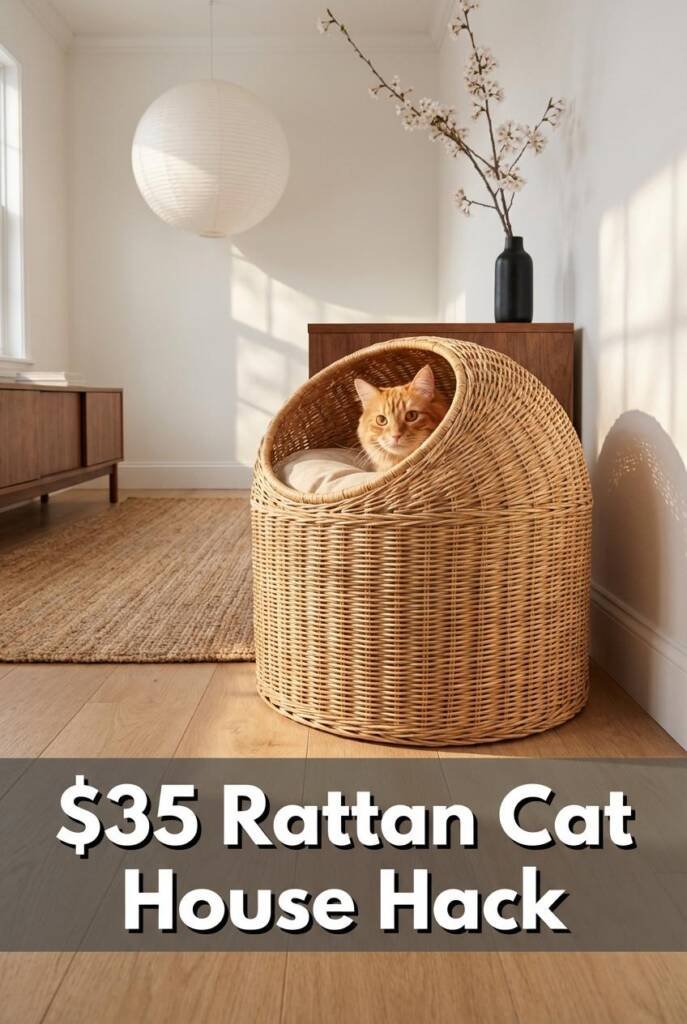
Your cat doesn’t care that designer rattan cat houses cost $400 — and after this $35 IKEA-and-H&M hack, neither will you.
Here’s the truth about rattan cat houses: the designer versions from boutique pet brands like Meyou Paris or MiaCara run anywhere from $200 to $450. They’re gorgeous, sure, but you can achieve a nearly identical Japandi look for about $35 by combining two mass-market pieces that were practically made for each other.
The hack starts with IKEA’s LURVIG cat house ($12.99), a simple plywood-framed box with clean Scandinavian lines and a circular entrance hole. On its own, it’s a bit plain — functional but forgettable. That’s where H&M Home’s natural seagrass or rattan baskets come in. Their round woven baskets ($19.99–$24.99) in natural tan tones fit almost perfectly over or around the LURVIG frame, transforming it from flat-pack basic to something that looks like it belongs on a curated design shelf. The combination of the warm honey-colored rattan weave against the pale birch plywood frame is peak Japandi — that effortless marriage of Japanese wabi-sabi texture with Scandinavian minimalism.
What makes this pairing work beyond aesthetics is the layered comfort factor. Rattan naturally breathes, so your cat won’t overheat inside an enclosed space the way they might in a fully upholstered pod. The woven texture also gives the house just enough surface interest that cats love rubbing against it — think of it as a subtle chin-scratcher built right into their bed. Drop a natural linen cushion inside (IKEA sells LURVIG cushions for $6.99, or cut a piece of a cream sherpa blanket to fit), and you’ve created a den that appeals to your cat’s instinct for enclosed, secure sleeping spots.
The visual trick that makes guests do a double-take is placement. Don’t shove this on the floor next to the litter box. Set it on a low wooden bench or a simple oak plant stand — something 8 to 12 inches off the ground — beside a trailing pothos or a stack of coffee table books. At that height and in that context, it reads as an intentional accent piece rather than pet furniture. The rattan texture ties into other natural elements in a Japandi room — think jute rugs, wooden side tables, ceramic vases — so it disappears into your decor while giving your cat exactly the cozy cave they crave.
Durability-wise, rattan holds up surprisingly well to cat claws. Unlike fabric-covered cat beds that pill and snag within weeks, woven rattan and seagrass actually get better with age, developing a slightly darker patina that only adds to the organic, lived-in Japandi aesthetic. If your cat is an aggressive chewer, lightly mist the basket with a bitter apple spray — one coat usually does the trick without affecting the look.
How to DIY a Rattan Japandi Cat House for Under $40
- Choose Your Basket: Visit H&M Home (in-store or online) and grab a round natural seagrass or rattan basket in the 14–16 inch diameter range. You want one with a relatively rigid structure — avoid the floppy collapsible storage kind. The ‘Seagrass Storage Basket’ in natural ($19.99) or the round rattan version ($24.99) both work perfectly. Hold it upside down and make sure it keeps its dome shape.
- Prep the LURVIG Base: Pick up the IKEA LURVIG cat house ($12.99) and assemble the flat-pack base according to the instructions — it takes about 5 minutes with the included wooden dowels. Sand any rough edges on the entrance hole with 150-grit sandpaper so there’s nothing to snag fur. If you want a warmer tone that matches the rattan, wipe the birch plywood with a single coat of Danish oil and let it dry for 2 hours.
- Combine the Two Pieces: Flip the rattan basket upside down and nestle it over the LURVIG frame so the basket creates a domed canopy above the wooden base. If the basket is slightly larger than the frame, use three small adhesive felt pads (about $3 at any hardware store) on the inside rim to snug the fit. The basket should sit securely without wobbling. For a permanent bond, apply a thin line of E6000 craft adhesive where the basket meets the wood frame.
- Add a Cushion Insert: Place the LURVIG cushion ($6.99) or a cut-to-fit piece of natural cream-colored sherpa or linen fabric inside the base. The cushion should be thick enough — at least 1.5 inches — that your cat sinks in slightly. Wash it on gentle cycle every two weeks to keep things fresh and fur-free.
- Elevate and Style: Set the finished cat house on a low wooden bench, a simple oak plant stand, or even a stack of two thick hardcover books to raise it 8–12 inches off the floor. Position it in a living room corner near a window where your cat already likes to nap. Add a trailing plant nearby and keep the surrounding area minimal — the rattan texture should be the star.
- Maintain the Look: Vacuum the rattan weave monthly with a brush attachment to prevent dust buildup. If your cat scratches at the basket, that’s actually fine — seagrass and rattan develop a beautiful worn patina over time. For cats who chew, one light misting of Grannick’s Bitter Apple Spray ($8.99 on Amazon) on the exterior weave deters nibbling without staining.
- Budget move: Skip H&M entirely and check Facebook Marketplace or Goodwill for natural rattan baskets — they show up constantly in the $3–$8 range because people cycle through home decor trends fast. Paired with the $12.99 LURVIG base, you’re looking at a total build cost of under $20 for a cat house that genuinely looks like it costs 20 times that.
4. Japandi Cat Tree Made from Real Birch Branches (Yes, It Exists)
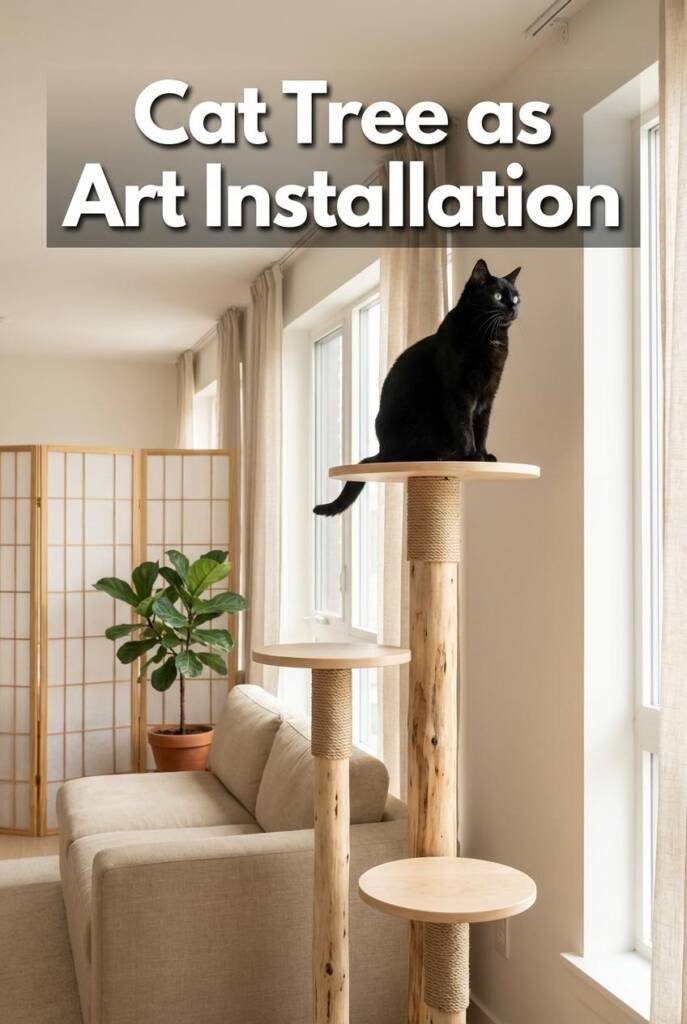
Forget everything you think a cat tree has to look like — this one belongs in a design gallery.
Most cat trees look like they were designed by someone who has never seen the inside of a design magazine. They’re carpet-covered monstrosities in beige or brown, bulky enough to dominate a room and ugly enough to make you wince every time you glance at them. The Mau Lifestyle Cento cat tree is the antidote to all of that, and it’s the closest thing to a genuine Japandi cat tree you’ll find without commissioning a custom piece.
The Cento uses real birch wood poles — not printed laminate, not painted dowels, but actual birch with visible grain variation and the subtle pale tone that defines Scandinavian-Japanese aesthetics. The platforms are minimal rectangular shelves wrapped in tight, natural-colored sisal, giving your cat a satisfying scratch surface that doesn’t scream “pet product” from across the room. Standing roughly 60 inches tall with staggered platforms, the whole structure reads like a sculptural art installation. Think Noguchi meets cat playground. At around $299, it’s priced in line with mid-range conventional cat trees that offer none of the visual refinement.
Why does this work so well in Japandi spaces? It comes down to three principles that define the style: natural materials over synthetic ones, vertical lines that draw the eye upward without consuming floor space, and a restrained color palette that stays within the warm whites, tans, and light wood tones of a curated room. The Cento checks every box. The birch poles echo the light oak and ash furniture common in Japandi interiors, while the sisal wrapping introduces organic texture without adding visual clutter. Place it near a window against a white or warm gray wall, and it becomes a focal point rather than an eyesore.
From your cat’s perspective, the staggered platform design actually encourages natural climbing behavior better than those plush carpet towers. Cats prefer to leap between defined surfaces rather than shimmy up a carpeted tube, and the open framework lets them survey the room from multiple vantage points — exactly the kind of elevated territory that makes indoor cats feel secure. The sisal wrapping is dense enough to withstand aggressive scratching without fraying into sad, dangling threads after a month. We’ve seen these hold up well even with multi-cat households, though particularly determined scratchers will eventually need a re-wrap, which Mau sells as replacement parts.
If the Cento’s specific dimensions don’t suit your space, look at Mau’s other models like the Cento Lux or the Alto, which follow the same birch-and-sisal design language in different configurations. The key takeaway is this: a japandi cat tree should look like furniture first and a cat product second.
How to Pick a Natural Wood Cat Tree That Complements Japandi Decor
- Match the wood tone to your existing furniture: Before buying any natural wood cat tree, identify whether your Japandi space leans toward warm birch and oak tones or cooler ash and walnut. Hold a swatch of your largest furniture piece — your dining table or bookshelf — against product photos online. The Mau Cento’s birch runs pale with warm undertones, making it ideal for rooms with IKEA Stockholm, Muji, or Article furniture lines.
- Measure your vertical space, not just your floor space: Japandi design favors height over footprint. Measure from floor to ceiling and aim for a cat tree that fills at least 40-50% of your wall height. The Cento at 60 inches works well in standard 8-foot ceiling rooms, sitting comfortably below eye-level art or shelving without crowding the vertical plane.
- Check that sisal is natural, not dyed: Dyed sisal in grays or blacks will fight a Japandi palette. Look for product descriptions specifying “natural sisal” or “undyed sisal rope.” The color should be a warm tan or straw tone. If the listing photo looks bright white or charcoal, it’s been treated and will look out of place next to raw wood and linen textiles.
- Prioritize open-frame designs over enclosed cubbies: Japandi interiors rely on negative space and clean sightlines. Avoid cat trees with enclosed condos or plush hammocks — they add visual bulk and usually feature synthetic fabrics. Open platforms on visible poles maintain the airy, gallery-like quality that defines the style.
- Position it as a room accent, not hidden in a corner: Place your natural wood cat tree where you’d place a floor lamp or a tall plant — beside a reading chair, flanking a window, or anchoring an empty wall. Treating it as a design element rather than something to hide ensures it earns its place in your layout. A single trailing pothos on a nearby shelf ties the organic materials together beautifully.
- Budget move: If $299 is steep, search for “birch cat tree” on Etsy where smaller makers sell two- or three-platform birch pole designs starting around $120–$160. Alternatively, buy a basic $45 sisal-wrapped cat tree from Amazon (like the Feandrea model) and replace the faux-fur platforms with custom-cut birch plywood rounds from your local lumber yard — a 12-inch birch round runs about $8–$12 each, and four of them plus wood stain totals under $80 for the whole upgrade.
5. Linen Slipcovers That Hide Cat Hair Like Magic
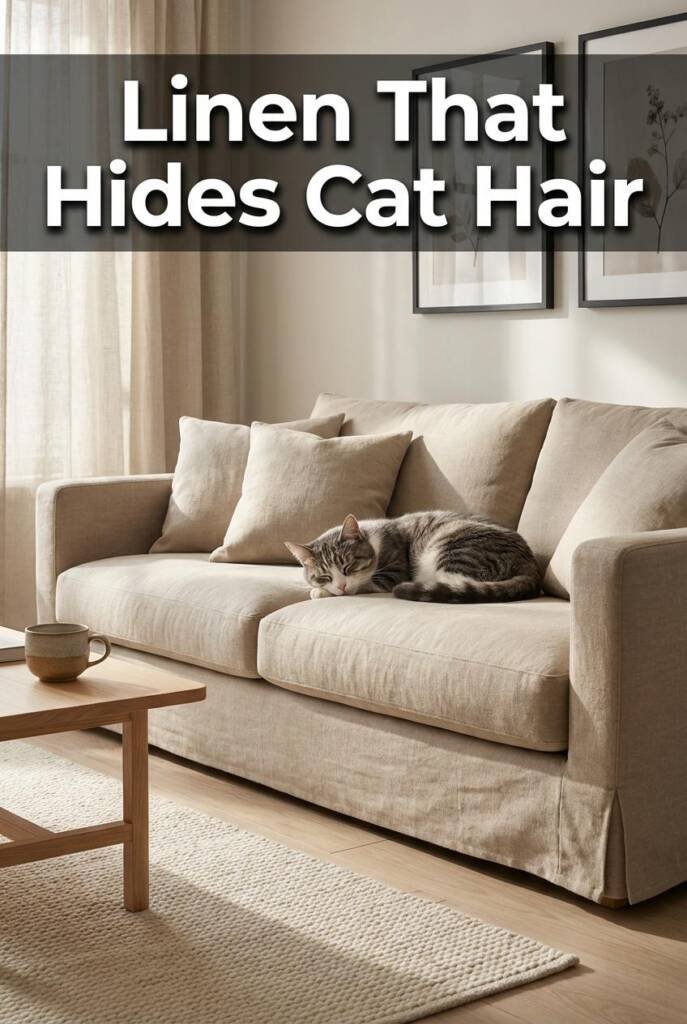
You will never win the cat hair war with a lint roller — but the right slipcover fabric makes the war invisible.
Here’s a dirty little secret about Japandi interiors: they’re not actually pristine. That effortlessly lived-in look you see in magazines? It’s built on textiles that welcome imperfection — and nothing does that better than stonewashed Belgian linen draped over your sofa while three cats compete for the warm spot.
Linen slipcovers are the single smartest textile investment you can make as a cat owner chasing Japandi aesthetics. Bemz makes custom-fit slipcovers for IKEA sofas (like the Ektorp, Söderhamn, and Karlstad lines) in stonewashed linen that starts around $199 for a chair cover and runs up to $349 for a full three-seat sofa. The magic is in the color palette. Their “Oatmeal,” “Sand Beige,” and “Clay” tones sit right in that warm neutral Japandi sweet spot — and they happen to be almost exactly the color of most cat hair. Orange tabby fur on a clay linen sofa? Invisible. Gray and white fluff on oatmeal? You’d need a magnifying glass. The loose weave and matte texture break up any stray hairs visually, unlike tight-weave cotton or velvet that displays every single strand like a forensic evidence board.
What makes linen genuinely cat-proof goes beyond camouflage, though. Linen fibers are naturally smooth and lint-resistant, meaning cat hair doesn’t embed itself the way it does in chenille or microfiber. A quick pass with a rubber-bristled brush (the $8 Lilly Brush is perfect) lifts everything in seconds. And because Bemz slipcovers are machine-washable — they literally instruct you to wash them — you can toss them in on a gentle cold cycle every few weeks without guilt. Each wash actually improves the fabric. Stonewashed linen gets progressively softer, developing that beautiful rumpled drape that makes a sofa look like it belongs in a Kyoto guesthouse rather than a sterile showroom.
The practical beauty here is that minor claw snags don’t spell disaster either. Linen’s natural slub texture means tiny pulls blend into the overall character of the fabric. You’re not babying your furniture — you’re letting it age gracefully alongside your cats. Pair an oatmeal linen sofa with a couple of raw silk or woven jute cushions in muted sage or charcoal, set it against a white oak floor, and you’ve nailed the Japandi living room without sacrificing an ounce of cat-friendliness.
This is the kind of choice that solves two problems simultaneously: you get a room that looks intentionally minimal and warm, and you stop losing the daily battle against cat hair. That’s not compromise — that’s design working the way it should.
How to Choose Cat-Proof Linen Slipcovers in Japandi Colors
- Measure Your Sofa and Confirm Compatibility: Bemz covers are designed for specific IKEA sofa models, so check their website’s compatibility tool first. Measure your sofa’s length, depth, and cushion count to confirm the exact model generation — IKEA has updated frames over the years, and a 2014 Ektorp differs from a 2020 version. If you don’t have an IKEA sofa, Comfort Works offers similar custom linen slipcovers for brands like Pottery Barn and Muji starting around $259.
- Pick Japandi-Aligned Colors That Match Your Cat’s Fur: Choose your linen shade strategically. If you have an orange or cream-colored cat, go with Bemz’s “Clay” or “Sand Beige.” For gray or dark-furred cats, their “Warm Gray” or “Taupe” tones work better. The Japandi rule of thumb is earth tones and desaturated neutrals — avoid pure white (shows everything) and stark black (shows light fur and lint). Oatmeal is the most universally forgiving choice across multiple fur colors.
- Opt for Stonewashed Over Raw Linen: Always choose stonewashed or pre-washed linen. Raw linen is stiff, wrinkles sharply, and can shrink up to 10% on the first wash — which means your perfectly fitted slipcover suddenly won’t zip closed. Stonewashed linen has already gone through that shrinkage process and arrives soft, relaxed, and ready to drape with that characteristic Japandi ease. Bemz labels their washed options clearly; look for the “Washed Linen” fabric category.
- Wash Before First Use and Every 3–4 Weeks After: Run your new slipcover through a cold gentle cycle with a mild detergent like The Laundress Signature Detergent ($19 for 32 washes) before putting it on the sofa. This removes any manufacturing residue and kickstarts the softening process. After that, wash every three to four weeks to remove accumulated dander and fur oils. Tumble dry on low for 10 minutes, then reshape on the sofa while slightly damp for the smoothest fit.
- Add a Linen Throw Layer for High-Traffic Spots: Even with a full slipcover, drape an extra stonewashed linen throw ($35–$55 from H&M Home or MUJI) over the seat cushion your cat favors most. This gives you a quick-swap option between washes — just toss the throw in the laundry and leave the main slipcover in place. Choose a tone one shade darker or lighter than your slipcover for subtle Japandi-style tonal layering.
- Maintain Claw Snags Without Panic: If your cat’s claws pull a small thread, don’t cut it — use a blunt tapestry needle ($3 for a pack at any craft store) to gently push the pulled fiber back through to the wrong side of the fabric. The natural texture of stonewashed linen hides these repairs completely. For extra protection, keep your cat’s claws trimmed every 10–14 days or provide a sisal scratching post within arm’s reach of the sofa.
- Budget move: Skip Bemz entirely and buy 3 yards of stonewashed Belgian linen from Fabric.com or Etsy sellers like LinenByMilan ($18–$24 per yard, so roughly $54–$72 total) and simply drape it as a full sofa throw, tucking it into cushion gaps. It won’t have the tailored fit of a custom slipcover, but the visual effect and cat-hair camouflage are nearly identical — and you’re saving $125–$275.
6. The Muji-Style Wall-Mounted Cat Steps Nobody Notices
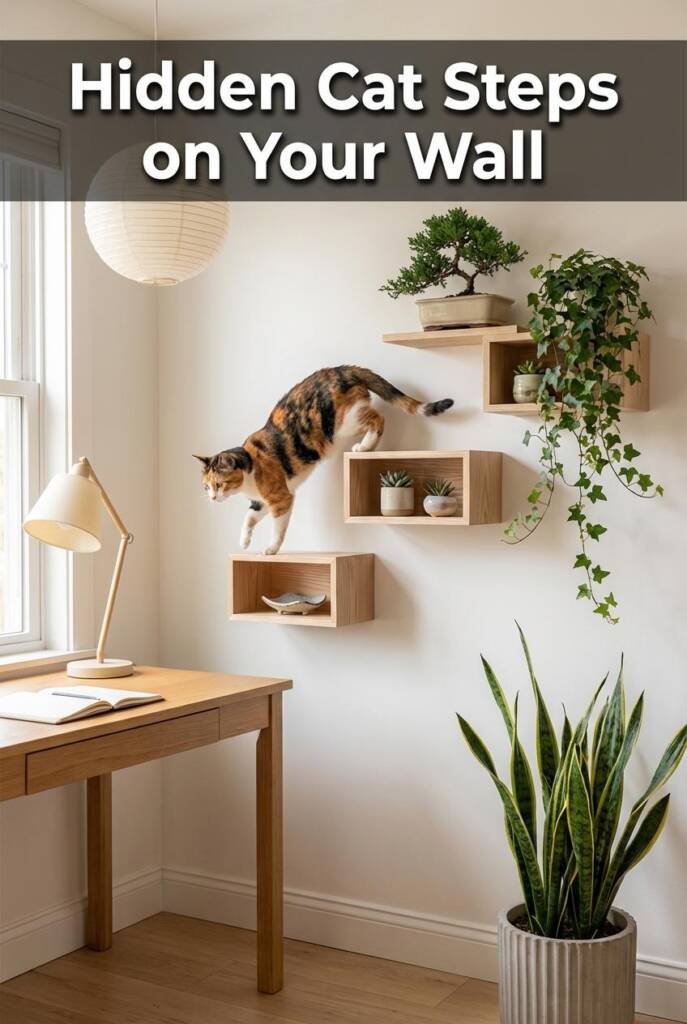
The best cat wall steps are the ones your guests mistake for a gallery wall — and Muji has been accidentally making them for years.
Here’s the secret to japandi cat furniture that truly disappears: it never looks like cat furniture in the first place. Muji’s wall-mounted ash wood box shelves — the ones you’ve probably walked past a hundred times in-store — are essentially pre-made cat steps hiding in plain sight. At roughly $29 each for the 44cm model, these clean-lined open boxes in light natural ash give you that warm Scandinavian wood tone layered with Japanese simplicity. Mount five or six of them in a staggered ascending pattern along your wall, and you’ve got a climbing path your cat will use daily while guests assume you just have impeccable taste in minimalist shelving.
What makes these work so beautifully as cat steps is their proportions. Each box is approximately 44cm wide by 30cm deep by 24cm tall — more than enough surface area for even a 14-pound Maine Coon to land comfortably. The open-box design means your cat can approach from multiple angles, and the 24cm height on the back and sides provides a subtle lip that prevents paws from slipping off the edge. The ash wood is smooth but not slippery, giving just enough grip for confident jumping. And because Muji finishes their wood with a matte lacquer rather than a high-gloss poly, claws won’t leave visible scratch marks the way they would on painted MDF shelving from IKEA.
The visual magic happens in the dual-purpose styling. Place a small succulent or a ceramic vase on two of the shelves, stack a couple of linen-bound books on another, and leave the remaining three open for your cat. The consistent wood tone and identical proportions create a cohesive gallery wall that reads as intentional design rather than pet accommodation. The light ash pairs gorgeously with white or warm gray walls — think Benjamin Moore’s Simply White or Sherwin-Williams Agreeable Gray — and the overall effect is that quiet, uncluttered sophistication that defines the japandi aesthetic.
For durability, these shelves hold up remarkably well. Muji rates them for about 6.6 pounds of static load, but when properly anchored into studs with 3-inch wood screws rather than the included drywall anchors, they’ll easily handle the dynamic force of a cat jumping shelf to shelf. We recommend spacing each step 14 to 16 inches apart vertically and 12 to 18 inches horizontally — close enough for a comfortable hop but far enough apart to look like deliberately asymmetric wall art. The result is a climbing wall that looks like it belongs in a Japanese design magazine, not a pet store catalog.
How to Create Hidden Cat Wall Steps Using Muji Shelving
- Plan Your Layout on Paper First: Measure your wall and sketch a staggered ascending pattern on graph paper. You’ll want 5-6 shelves total, starting about 24 inches from the floor and ending near ceiling height. Space them 14-16 inches apart vertically and offset each one 12-18 inches horizontally. Use painter’s tape on the wall to mock up positions before drilling a single hole.
- Locate Studs and Mark Anchor Points: Use a stud finder to map every stud along your planned path. Each shelf must hit at least one stud for safe cat use. Mark stud locations with light pencil marks. If a shelf falls between studs, shift it 2-3 inches in either direction — the asymmetric look is forgiving and actually benefits from slight irregularity.
- Upgrade the Mounting Hardware: Set aside the included Muji wall anchors. Instead, use 3-inch #10 wood screws driven directly into studs through the shelf’s pre-drilled mounting holes. Add a single toggle bolt on the opposite side if you can’t hit two studs. This upgrade takes the effective load capacity well beyond what you need for a 12-pound cat landing with force.
- Add Non-Slip Grip Pads Inside Each Shelf: Cut pieces of natural wool felt — available at craft stores for about $3 a sheet — to fit the bottom interior of each box shelf. Use double-sided carpet tape to secure them. The felt adds silent landing cushion, prevents your cat from sliding on the smooth ash surface, and matches the warm neutral japandi palette perfectly.
- Style the Shelves for Dual Purpose: Designate 2-3 shelves as display shelves and place small decorative objects like a ceramic cup, a single book, or a dried botanical sprig. Leave the remaining shelves open as active stepping surfaces. This visual mix makes the entire arrangement look like curated wall decor and disguises the cat highway completely.
- Test the Route With Treats: Place high-value treats like Temptations or freeze-dried chicken on each shelf, starting from the lowest. Most cats figure out the path within 24-48 hours. Once your cat is confidently using all the steps, remove the treats and let muscle memory take over.
- Budget move: If $29 per shelf stretches your budget across 5-6 units, check IKEA’s EKET series — the single square cabinet modules run about $15 each in white or light wood tones and offer similar clean-box proportions. You can also find unfinished pine shadow box shelves at Michaels for $8-$12 each during their frequent 50%-off sales, then apply a single coat of Minwax Natural stain ($8 a can) for that light ash look. Total wall of six shelves: under $60 instead of $175.
7. A Japandi Litter Box Cabinet That Actually Ventilates
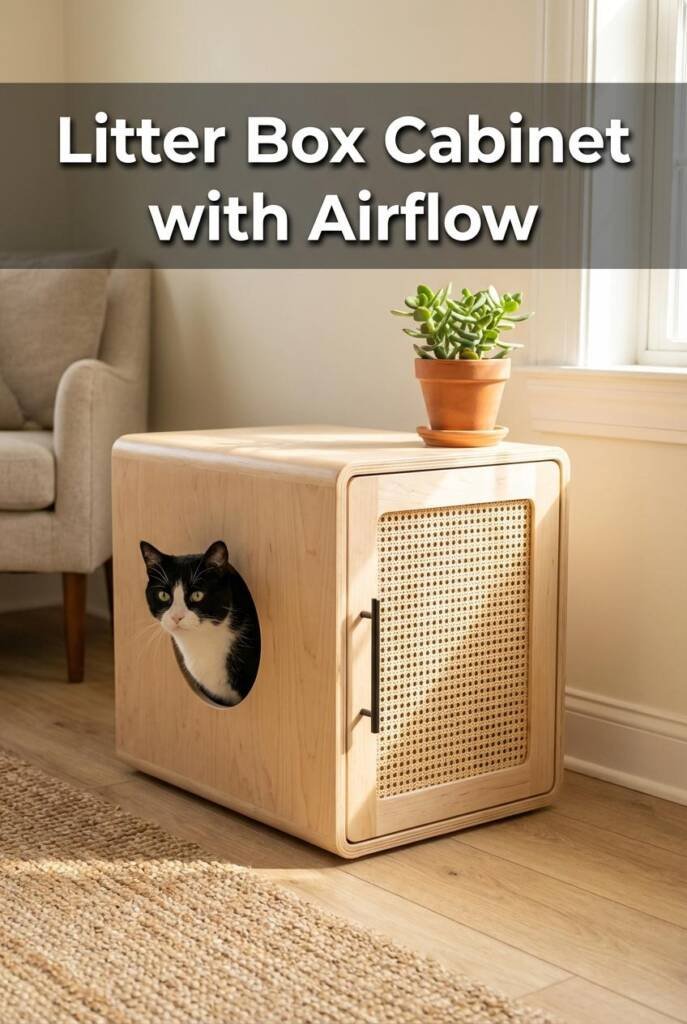
Your litter box doesn’t need to be hidden in shame — it needs to be engineered with airflow and wrapped in materials beautiful enough to earn its place in the room.
Let’s be honest: the litter box is the single biggest design compromise cat owners make. You spend months curating a serene, minimal living space, and then there it sits — a plastic rectangle of chaos in the corner of your bathroom. A Japandi litter box cabinet changes that equation entirely, turning the necessary evil into a piece of furniture you’d actually choose to own.
The Fido Studio from Omlet (starting around $250) is one of the cleanest ready-made options, with its simple box frame and optional wardrobe-style door. But the real Japandi magic happens when you incorporate cane webbing panels — that signature woven rattan material you see on mid-century sideboards and Japanese-inspired screens. Cane webbing isn’t just decorative.
Each tiny hexagonal opening in the weave acts as a micro-vent, letting air circulate continuously through the cabinet so moisture and odor don’t get trapped inside. This is why traditional Japanese shoji screens used woven and semi-permeable materials: airflow was a design principle, not an afterthought. When you apply that same logic to a litter box enclosure, you get a cabinet that genuinely smells better than a standard covered litter box because stale air isn’t pooling around the litter.
Visually, picture a low credenza in birch or white oak plywood, roughly 24 inches wide by 20 inches tall by 22 inches deep — just large enough for a standard open litter pan inside. The front panel features a large rectangle of natural pre-woven cane (the kind sold in 24″ x 24″ sheets from suppliers like Pressed Cane Webbing Co.), framed by slim 1.5-inch solid wood rails. The top is a flat, usable surface — perfect for a small kokedama plant or a ceramic tray. One side has a 7-inch circular cutout for your cat’s entry, with sanded, rounded edges so no fur catches. The whole piece reads as a minimal sideboard, not a pet product.
For durability, line the interior floor with a removable sheet of 1/8-inch white melamine or a silicone litter mat cut to size. This catches tracked litter and wipes clean in seconds. The cane panel should be set into a routed groove in the frame rather than stapled, so you can pop it out and vacuum it or replace it if your cat decides to test its scratch-resistance. Most cats leave cane alone once they have a proper scratching post nearby, but having a replaceable panel means zero stress either way.
How to Build or Buy a Ventilated Japandi Litter Box Cabinet
- Choose Your Cabinet Base: Buy a pre-made plywood cabinet like the IKEA BESTÅ frame (around $40 for the 23⅝” x 15¾” x 15″ size) or build a simple box from ¾-inch birch plywood cut to 24″W x 22″D x 20″H. Sand all surfaces to 220 grit and finish with Rubio Monocoat in Pure or Cotton White for that pale Japandi wood tone ($45 for a small can).
- Add the Cane Webbing Panel: Order a 24″ x 24″ sheet of pre-woven cane webbing ($15–$25 from Amazon or Pressed Cane Webbing Co.). Soak it in warm water for 30 minutes so it becomes pliable. Route a ¼-inch groove around the inside edge of your front frame piece using a router or Dremel, press the damp cane into the groove, and secure it with spline (the thin reed that locks it in place). As it dries, it tightens drum-flat.
- Cut the Cat Entry: On one side panel, trace a 7-inch circle using a dinner plate as a template, positioned about 3 inches from the bottom edge. Cut it out with a jigsaw, then round the edges with 120-grit sandpaper followed by 220-grit. For a polished look, glue a thin strip of iron-on birch edge banding around the cutout.
- Waterproof the Interior: Line the bottom with a cut-to-fit piece of ⅛-inch white melamine board or apply two coats of waterproof polyurethane to the interior plywood. Place a silicone litter-catching mat (like the PetFusion ToughGrip, about $15) on top. This double layer protects the wood from urine accidents and makes cleanup a 30-second task.
- Install Ventilation-Boosting Hardware: Mount two small adhesive rubber bumper feet on the underside of the top panel so it rests slightly raised (about ⅛ inch) when closed — this creates a passive chimney effect, pulling stale air up and out through the cane front panel. If odor is still a concern, attach a USB-powered 40mm fan ($8 on Amazon) inside the back panel with a small exhaust hole to create active airflow.
- Style the Top Surface: Keep the top minimal and functional: a single kokedama moss ball, a small ceramic dish for keys, or a stack of two linen-covered books. Avoid clustering items — the Japandi principle of ma (negative space) means one or two objects look far more intentional than five.
- Budget move: Skip the custom build entirely and convert an IKEA BESTÅ shelf unit ($40) by removing one shelf, adding a cane webbing panel to the door front ($20 for the sheet plus $5 for spline), and cutting a side entry hole. Total cost with a can of Rubio Monocoat sample size ($18): under $85 for a cabinet that looks like a $300 custom piece.
8. Rice Paper Pendant Lights Your Cat Can’t Destroy (We Checked)
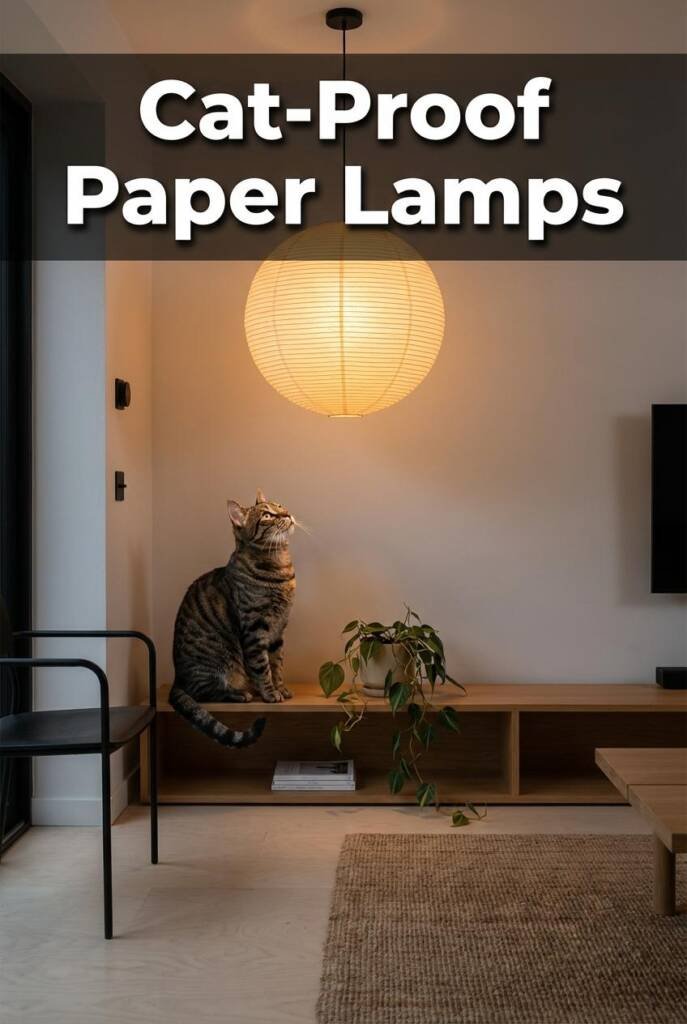
We fully expected three cats to shred a $15 rice paper lamp in under a week — six weeks later, it’s still glowing without a scratch, and it might be the most Japandi thing in our entire apartment.
Here’s the thing about rice paper pendant lights that most cat owners don’t realize: they’re actually more cat-resistant than that expensive glass fixture you’ve been eyeing. The Noguchi-style lanterns that define Japandi interiors — those soft, glowing orbs that look like captured moonlight — work on a principle that accidentally makes them perfect for cat households. When your cat inevitably swats one (and they will), the lightweight rice paper and wire frame simply bounce back into shape. There’s no shattering, no crashing, no dramatic 2 AM destruction. We tested an IKEA SJÖPENNA ($14.99) with three different cats over six weeks, and the worst damage was a single tiny puncture from a particularly determined claw that’s genuinely invisible when the light is on.
The visual impact of these lamps in a Japandi space is hard to overstate. A single rice paper pendant hung over a reading nook or dining area creates that warm, diffused glow that’s the polar opposite of harsh overhead lighting. The paper softens everything beneath it — your furniture looks warmer, your cat’s fur looks more luminous, and those inevitable scratches on your wood surfaces practically disappear in the forgiving light. This is exactly why Japanese interiors have used washi paper lighting for centuries: it transforms a room’s entire mood with zero effort. Pair a round pendant with the clean horizontal lines of a low-profile cat shelf, and you’ve nailed the Japandi balance of organic and minimal.
For the budget-conscious, the IKEA REGOLIT ($5.99) and SJÖPENNA ($14.99–$29.99) lines deliver 80% of the Noguchi aesthetic at roughly 5% of the price of an authentic Akari light sculpture (which starts around $300). If you want to invest more, HAY’s Rice Paper Shades ($85–$195) come in beautiful oblong and elliptical shapes that read as genuine design pieces. The key difference is paper thickness and frame quality, but from across a living room, even a trained eye struggles to tell them apart.
The only real concern is heat. Modern LED bulbs solve this completely — a 9-watt LED puts out the same light as a 60-watt incandescent while barely getting warm to the touch, which means even if your cat somehow climbs inside the shade (stranger things have happened), the burn risk is essentially zero. Stick with bulbs rated 2700K for that warm amber glow that makes Japandi spaces feel like a sanctuary rather than a showroom.
How to Hang Rice Paper Pendant Lights in a Cat-Safe Way
- Choose the right size and shape: For rooms under 150 square feet, stick with pendants 15–19 inches in diameter. Larger rooms can handle 22–30 inch shades. Round shapes are the most cat-resistant because there are no corners or edges for claws to catch. The IKEA SJÖPENNA in the 14-inch round version is the sweet spot for most spaces.
- Hang at a cat-proof height: Mount your pendant so the bottom of the shade sits at least 7 feet from the floor — high enough that even an ambitious vertical leap won’t reach it. If you have tall cat trees nearby, add the height of the tree plus 3 feet to your minimum. Use a ceiling hook rated for at least 10 pounds even though the shade weighs almost nothing; this prevents the whole fixture from coming down during an earthquake or aggressive play session.
- Install LED bulbs only: Replace any incandescent bulb with an LED rated at 2700K color temperature and no higher than 10 watts. Brands like Philips Warm Glow ($7 for a 4-pack) dim beautifully and produce virtually no heat. Never use halogen bulbs inside rice paper — they’re a genuine fire risk regardless of whether you have cats.
- Secure the cord against climbing: Run the pendant cord through adhesive cord clips (Command brand, $3.49 for a pack of 8) pressed flat against the ceiling and wall. Cats are attracted to dangling cords, so eliminate any visible slack. If your cord hangs freely from a ceiling mount, wrap the excess around the canopy housing and secure with a small zip tie tucked out of sight.
- Add a dimmer switch for full Japandi ambiance: Install a simple plug-in or hardwired dimmer ($12–$18 at any hardware store, the Lutron Diva is our go-to). Dimming your rice paper pendant to about 40% creates that signature Japandi twilight glow while also reducing the already minimal heat output. This is the single easiest upgrade that makes a $15 lamp look like a $300 design piece.
- Budget move: The IKEA REGOLIT shade costs just $5.99 and has been a design-world secret for years — pair it with a $7 HEMMA cord set and a $7 Philips LED bulb, and you have a complete Noguchi-inspired Japandi pendant for under $20 total. Buy two for symmetrical hanging over a dining area, and you’re still under $40 for a look that rivals fixtures costing ten times more.
9. A Window Perch Wrapped in Bouclé That Screams Quiet Luxury
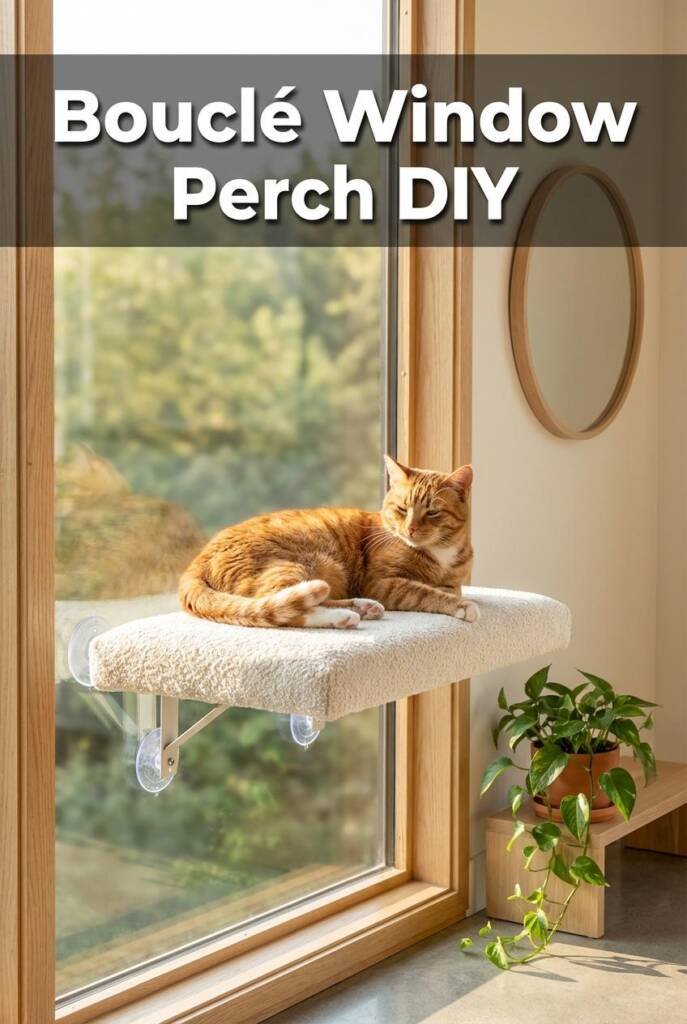
Your cat is going to claim the sunniest window in the house whether you like it or not—you might as well make their throne look intentional.
There’s something deeply Japandi about a cat stretched out in a sunbeam—that effortless calm, that total commitment to doing absolutely nothing with grace. A window perch is already the most popular seat in any cat household, but the standard versions look like exactly what they are: a piece of nylon strapped to two suction cups. The Oster Sunny Seat (~$20 on Amazon or Chewy) is one of the sturdiest budget perches out there, rated for cats up to 30 pounds, but that black hammock fabric does zero favors for your carefully curated Japandi living room. The fix? Wrap it in bouclé and suddenly you’ve got a window seat that looks like it belongs in an Architectural Digest feature.
Bouclé is having a massive moment in interior design right now, and for good reason—its loopy, textured weave adds visual warmth without any loud patterns, which is exactly the quiet luxury Japandi spaces thrive on. Pick up a yard of bouclé fabric from Joann in cream, oatmeal, or warm taupe (their house brand runs about $15/yard, and you’ll only need about half a yard for this project). The texture does double duty here: it looks intentionally designer while also hiding cat hair between those soft loops. White and cream cat hair practically disappears into ivory bouclé, and even darker fur brushes off easily because the loops don’t grip the way flat-weave fabrics do.
What makes this perch feel genuinely Japandi rather than just “DIY cute” is the contrast between the minimal metal frame and that one moment of tactile indulgence. Japandi design isn’t about being austere—it’s about choosing a single luxurious element and letting it breathe. The perch mounted to a clean window frame, wrapped in creamy bouclé with no extra embellishments, achieves exactly that. Your cat gets the warm spot they’d kill for, and you get a window detail that guests will assume cost ten times what it did.
For added durability, consider slipping a thin layer of quilt batting (Pellon makes a great one for about $4/yard at Joann) between the original nylon surface and your bouclé cover. This gives the perch a slightly cushier feel that cats absolutely melt into, and it helps the bouclé maintain that plump, upholstered look rather than pulling taut and flat over the frame. The whole assembly tucks neatly under the bouclé wrap, so from the outside all anyone sees is a perfectly plush little cloud floating in your window.
How to DIY a Bouclé Cat Window Perch for Under $40
- Assemble and test the perch first: Set up the Oster Sunny Seat according to its instructions and let it hang on your window for 24 hours before modifying it. This confirms the suction cups hold on your specific glass and lets you identify the exact dimensions you need to cover—typically about 24″ x 12″ for the seat surface.
- Cut your bouclé and batting: Cut a piece of bouclé fabric roughly 28″ x 16″—that gives you 2 inches of overhang on every side for wrapping. Cut a matching piece of Pellon quilt batting at the same size. Use sharp fabric scissors and cut from the back side of the bouclé to minimize fraying on those looped fibers.
- Layer and wrap the seat: Remove the fabric seat from the perch frame. Lay the batting on top of the original nylon surface, then lay the bouclé face-down on your work surface with the batting-covered seat centered on top. Fold the bouclé edges over the seat like you’re wrapping a gift, pulling gently so the front stays smooth but not drum-tight.
- Secure with fabric glue and safety pins: Use Beacon Fabri-Tac (~$6 at Joann) to glue the folded edges to the underside of the original nylon—this stuff dries flexible and holds through washing. While the glue sets, place safety pins every 3 inches along the edges as temporary clamps. Remove the pins after 2 hours once the glue has fully cured.
- Reattach and style: Slide the wrapped seat back onto the perch’s wire frame and mount it to your window. Position it where afternoon light hits for maximum cat appeal. For a finishing Japandi touch, place a single small potted plant—like a cat-safe ponytail palm—on the windowsill beside it.
- Budget move: Wait for Joann’s regular 50%-off-one-cut-of-fabric coupons (they run almost every other week) and your bouclé drops from $15 to about $7.50. Combined with the $20 Oster perch and $4 batting, your total lands around $32—less than a third of what brands like Tuft + Paw charge for their minimalist window perches ($100+).
10. Shoji-Inspired Room Divider That Creates a Secret Cat Zone
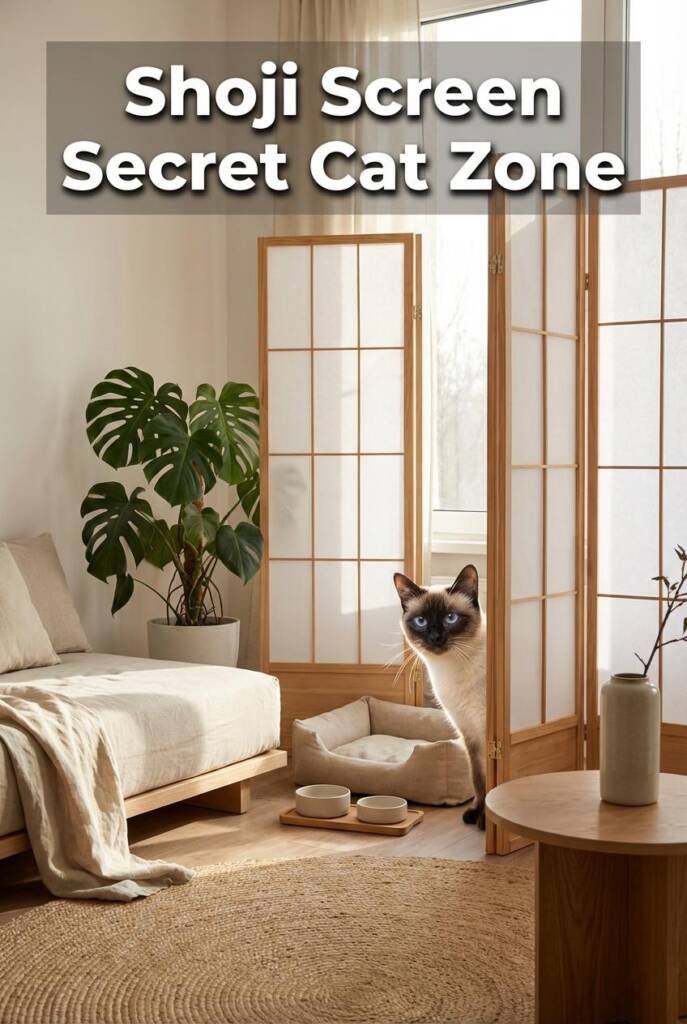
Your cat deserves a private dining room — and a $150 shoji screen gives them one without sacrificing a single square foot of your carefully curated Japandi aesthetic.
Open-plan living is gorgeous until you realize your cat’s food bowls, water fountain, and litter station are on full display during dinner parties. A shoji-inspired folding screen solves this with a single elegant gesture — it carves out a dedicated cat zone while adding the kind of authentic Japanese architectural detail that makes a room feel intentionally designed rather than cobbled together.
The translucent rice-paper-style panels (most modern versions use shoji rice paper laminated onto a wooden lattice, or a durable washi-look polyester) diffuse light beautifully, so the space behind the screen never feels like a dark closet. Your cat gets privacy; you get a room that looks like it belongs in a Kyoto ryokan.
Look for a three- or four-panel folding screen on Wayfair in the $120–$180 range — the Oriental Furniture 6 ft. Tall Double Cross Shoji Screen in natural or black lacquer is a popular pick that hits the right Japandi note without veering into overly ornate territory.
The key dimension to watch is panel width: most shoji screens have panels around 17–18 inches wide, so a four-panel version gives you roughly 70 inches of coverage when angled. That’s enough to section off a corner of a living room, dining area, or hallway nook for a feeding station, a cat bed, or even a discreet top-entry litter box like the IRIS USA model (~$25). The lattice framework is typically Spruce or Gemin pine, light enough to reposition but sturdy enough that a casual cat brush-by won’t topple it.
Here’s why this works so well in a Japandi context: shoji screens are literally the defining architectural element of traditional Japanese interiors, and their clean grid lines pair naturally with Scandinavian minimalism. The translucent panels echo the Japandi love of soft, filtered natural light — no heavy curtains, no solid walls, just gentle diffusion.
Place the screen at a slight zigzag angle rather than a straight line, and it becomes a sculptural element that adds depth to a flat wall. Behind it, keep things minimal: a low wooden feeding tray, a wool felt cat bed in cream or charcoal, and maybe a small potted snake plant (non-toxic once leaves are intact, but monitor chewers). The effect is a room that feels layered and thoughtful rather than cluttered.
Pet-proofing is straightforward. If your cat is a climber or scratcher, apply a strip of clear furniture edge protector tape along the bottom rail — a $7 roll from Amazon covers all four panels. For extra stability, use two small adhesive-backed wall hooks (Command Strips, ~$5) connected to the end panel with a short loop of fishing line, anchoring the screen without drilling. The panels themselves are replaceable on most quality screens, so even if a determined cat punctures one, a single replacement sheet of shoji paper costs about $8–$12 and takes ten minutes to glue on.
How to Use a Shoji Screen to Create a Stylish Cat Nook
- Choose Your Screen and Spot: Pick a three- or four-panel shoji screen in natural wood, black, or walnut finish — the Oriental Furniture brand on Wayfair ($120–$180) offers solid options. Measure your corner: you need at least 5 feet of wall length and 3 feet of depth behind the screen to fit a feeding station or cat bed comfortably.
- Angle the Screen for Stability and Style: Position the screen in a gentle zigzag rather than a straight line. This makes it self-supporting and adds visual dimension. The two end panels should touch or nearly touch the wall, creating a semi-enclosed nook. Leave a 14–16 inch gap at one end as your cat’s entrance.
- Anchor It Discreetly: Attach two medium Command Strip hooks to the wall at the height of the screen’s top rail. Loop a short piece of clear fishing line from each hook around the screen’s frame. This prevents tipping without any drill holes and is invisible from the room side.
- Set Up the Cat Zone Behind the Screen: Place a low wooden tray or bamboo placemat for food and water bowls, a cozy bed (try a round wool felt style in a neutral tone, $20–$35 on Etsy), and optionally a top-entry litter box if the nook is large enough. Keep the arrangement minimal — the screen’s beauty is lost if you stuff too much behind it.
- Protect the Bottom Rail: Run a strip of clear furniture edge protector tape along the bottom 6 inches of each panel to guard against scratching or kicking. A $7 roll covers all panels with material to spare. This also helps prevent moisture damage if your cat splashes water.
- Maintain and Replace Panels as Needed: If a panel gets punctured, order replacement shoji paper sheets ($8–$12 each) from Amazon or a specialty shop like Shoji Designs. Peel off the old paper, apply a thin line of wood glue around the lattice frame, press the new sheet on, and trim with a craft knife. The whole repair takes about ten minutes.
- Budget move: Skip the brand-name shoji screen entirely and build a DIY version using three pre-made pine lattice panels from Home Depot ($12–$15 each) connected with small cabinet hinges ($4 for a pack of six). Staple translucent white fabric or $8 shoji paper from Amazon over each frame. Total cost: roughly $45–$55 for a custom three-panel screen you can stain any color to match your Japandi palette.
11. The Japanese Zabuton Cushion Your Cat Will Steal Immediately
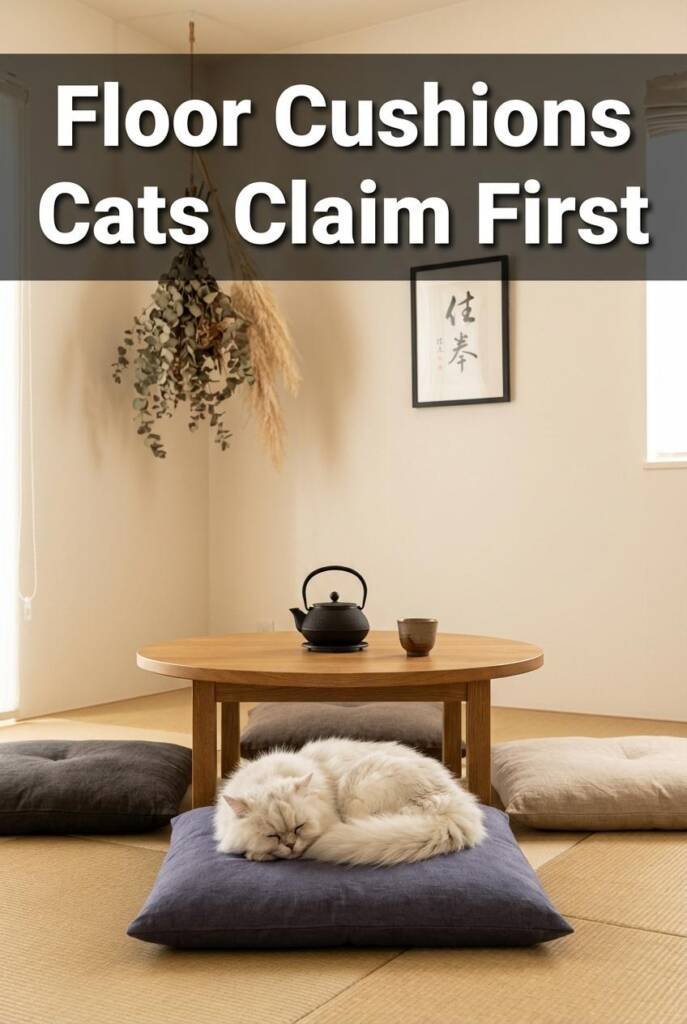
You will not win this battle — every cat who encounters a zabuton floor cushion immediately claims it as their personal meditation throne, and the resulting scene is so effortlessly Japandi that you’ll wonder why you ever bought an actual cat bed.
Here’s the thing about zabuton cushions: you’ll buy them for yourself, arrange them artfully beside your low coffee table, and within approximately forty-five seconds your cat will be curled up dead center on one like they’ve been meditating there for centuries. And honestly? That’s the best possible outcome, because a cat sleeping on a traditional Japanese floor cushion is peak Japandi aesthetic without even trying.
Zabuton are the flat, square cushions used in Japanese homes for floor seating — typically around 21″ x 21″ (the traditional size is about 55cm square), stuffed with cotton batting to a thickness of roughly 2-3 inches. Brands like Takaokaya offer handmade versions in Japan using natural cotton fill and linen or cotton covers, running $40–$55 each. Amazon carries solid options from brands like Waterglide and HIGOGOGO in the $25–$35 range. The key for Japandi styling is sticking to muted, natural tones: deep indigo (the classic Japanese aizome dye color), charcoal linen, undyed cotton, or warm oatmeal. These colors ground a room without competing with your other furniture, and they happen to look absolutely gorgeous against most cat fur — orange tabbies on indigo is basically a Renaissance painting.
What makes zabuton genuinely practical for cat households is their construction. They’re flat enough that cat hair doesn’t sink into deep crevices the way it does with overstuffed cushions. A lint roller or a quick pass with a rubber-bristled brush cleans them in seconds. Most cotton or linen covers can be spot-cleaned or hand-washed, and several Amazon options come with removable zippered covers you can toss in the washing machine on a gentle cycle. The dense cotton fill holds its shape well even under the daily kneading ritual your cat will inevitably perform.
Style-wise, zabuton work beautifully stacked in pairs beside a low walnut or oak table, scattered casually on a jute rug, or placed on a tatami mat section if you’ve committed to a full Japanese-inspired corner. The visual magic is in their simplicity — clean square lines, no tufting, no tassels, no fussy trim. When your cat claims one (and they will), the scene practically photographs itself. It’s functional furniture for you and an irresistible napping spot for them, which is really the entire philosophy of japandi cat furniture distilled into a single cotton square.
How to Style Zabuton Floor Cushions for You and Your Cat
- Choose the right size and fill: Look for zabuton in the traditional 21″ x 21″ square size with cotton batting fill, 2-3 inches thick. Avoid polyester-filled versions that crinkle or compress too quickly. Takaokaya’s handmade options ($45–$55) are the gold standard, but HIGOGOGO cotton zabuton on Amazon ($25–$30) are a solid everyday choice.
- Pick your Japandi palette: Stick to two colors maximum across your cushion set. Classic combinations include deep indigo paired with natural undyed cotton, or charcoal linen with warm oatmeal. Avoid bright patterns or printed fabrics — the beauty of zabuton in a Japandi space comes from solid, muted tones and visible textile texture.
- Arrange with intention and asymmetry: Place two or three zabuton around a low coffee table or floor tray, using the Japanese principle of odd numbers and asymmetrical spacing. Stack two cushions on one side and leave a single one opposite. Leave at least 6-8 inches between cushions so each one reads as a distinct object rather than a pile.
- Layer on natural surfaces: Set your zabuton on a jute or sisal rug, directly on light hardwood floors, or on a tatami mat section. The contrast between the soft cushion and the woven or wood surface underneath creates the textural layering that defines Japandi interiors. Avoid placing them on carpet, which flattens the visual distinction.
- Maintain with a cat-hair routine: Keep a rubber-bristled pet brush (like the ChomChom roller, ~$13) near your seating area. Give each zabuton a quick brush-off every other day. Once a month, take them outside and beat them gently to refresh the cotton fill — exactly the way they’ve been maintained in Japanese homes for centuries.
- Rotate the designated cat cushion: Your cat will choose a favorite. Accept this gracefully. Rotate that specific zabuton to the washing rotation more frequently — every two weeks for the removable cover — and keep the others in your seating arrangement. Having three or four total means you always have a clean one ready while one is being washed.
- Budget move: Skip specialty Japanese imports for your cat’s designated cushion and grab a two-pack of HIGOGOGO cotton zabuton on Amazon for around $28–$32 total. Save the nicer Takaokaya version ($45–$55 each) for your own seating spot. Your cat genuinely cannot tell the difference between a $15 cushion and a $55 one — they care about the flat surface and the warmth, not the provenance.
12. A Wooden Cat Scratching Post That Looks Like Sculptural Art
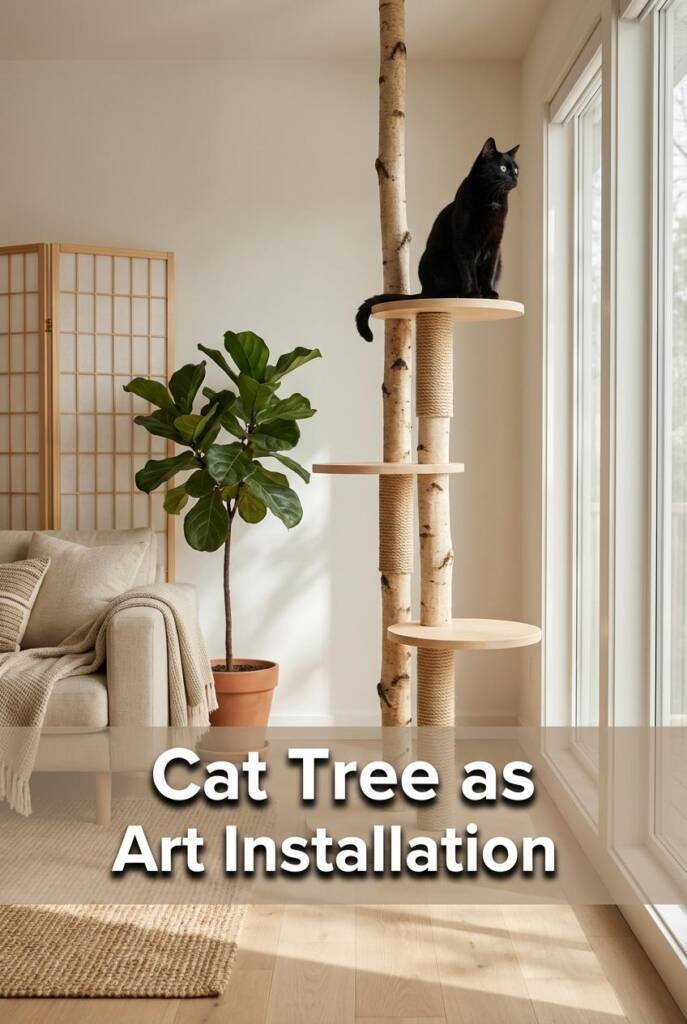
Your cat is going to scratch something in your home every single day—it might as well be a piece that looks like it belongs in a design museum.
Most cat scratching posts look like they belong in a veterinary waiting room—beige carpet wrapped around a wobbly dowel, topped with a dangling pom-pom no self-respecting cat would touch twice. A sculptural Japandi scratcher flips that script entirely. Pieces like the KATRIS Nest modular scratcher ($59–$89 per unit) or the MiaCara Vigo scratching post ($169–$189) use clean geometric forms, premium solid wood, and tightly wound natural sisal to create objects that read as intentional art on your floor. You’d set one next to a ceramics collection or a stack of Kinfolk magazines and nobody would blink.
The reason these pieces work so well in Japandi spaces comes down to the philosophy both traditions share: materials should be honest, forms should be purposeful, and nothing should be added purely for decoration. The MiaCara Vigo, for instance, features a solid oak base with a tapered cylindrical sisal column—no plastic caps, no synthetic carpet, no cartoon colors. The KATRIS system takes a different approach, using compressed corrugated cardboard sculpted into interlocking geometric blocks that can be arranged as a single statement piece or stacked into a modular climbing structure. Both honor the wabi-sabi appreciation for natural textures while maintaining the Scandinavian commitment to functional minimalism.
From your cat’s perspective, these aren’t compromises—they’re upgrades. Sisal rope provides the exact vertical resistance cats crave for a full-body stretch and claw maintenance, while the KATRIS corrugated cardboard offers that satisfying horizontal shredding texture. The MiaCara Vigo’s weighted oak base (roughly 8 pounds) keeps it stable even when your 14-pound Maine Coon throws their full weight into a scratching session, which means no tipping, no wall anchors, and no scratched-up baseboards because the post migrated across the room.
What really elevates these pieces is their restraint. A Japandi interior thrives on negative space, and a sculptural scratcher occupies visual real estate without cluttering it. Place a MiaCara Vigo on a light ash floor near a low credenza, and it looks like a turned-wood sculpture you picked up at a design fair. Arrange three KATRIS blocks in an asymmetric cluster beside a monstera plant, and you’ve created a vignette that happens to keep your sofa intact. That’s the ultimate goal of japandi cat furniture: every object in the room earns its place by being both useful and beautiful, and a well-chosen scratcher is no exception.
How to Choose a Sculptural Cat Scratcher That Elevates Japandi Decor
- Identify your cat’s scratching style: Watch your cat for a few days. If they scratch vertically on door frames and couch corners, choose a tall sisal post like the MiaCara Vigo (23 inches of scratchable height). If they prefer horizontal scratching on rugs or carpet edges, go with a flat corrugated option like the KATRIS Nest blocks. Matching the style ensures they’ll actually use it instead of your furniture.
- Match the wood tone to your existing palette: Japandi rooms typically stick to two or three wood tones at most. If your space features white oak or ash furniture, choose a scratcher with a light natural wood base. For rooms with walnut or darker teak accents, look for options in smoked oak or dark-stained beech. The KATRIS blocks come in kraft brown that pairs well with any light wood; the MiaCara Vigo is available in oak and walnut finishes.
- Scale the scratcher to the room: In a small apartment living room (under 200 square feet), a single KATRIS block or a slim sisal post under 24 inches tall keeps things proportional. In a larger open-plan space, you can go taller—look for sculptural posts in the 30- to 36-inch range, or cluster two to three KATRIS modules for visual weight that matches bigger furniture pieces.
- Position it near a natural anchor point: Place your scratcher within 3 feet of where your cat already likes to stretch—usually near their favorite napping spot or right beside the piece of furniture they’ve been targeting. Cats scratch after waking up, so next to a window-facing bed or beside a low daybed works perfectly. This also keeps it integrated into a furniture grouping rather than floating awkwardly in the middle of the room.
- Plan for maintenance and refills: Sisal rope wears down after 12 to 18 months of regular use. The MiaCara Vigo sells replacement sisal sleeves for around $35, so you’re refreshing the texture without replacing the whole piece. KATRIS blocks can be flipped and rotated to expose fresh cardboard surfaces, roughly doubling their lifespan before you need a $59 replacement unit.
- Anchor the scene with a simple base: Place a natural jute or cotton rug (roughly 3 by 5 feet) underneath and slightly behind the scratcher to catch any sisal fibers or cardboard dust. A neutral rug in cream or oatmeal frames the piece like a pedestal frames a sculpture, reinforcing the Japandi aesthetic while making cleanup a 30-second task.
- Budget move: Build a similar look for under $30 by wrapping a 4×4 cedar fence post (about $9 at Home Depot for a 4-foot length) tightly with 1/4-inch natural sisal rope ($12 for a 100-foot coil). Mount it vertically on a 12×12-inch plywood base stained in a light ash tone ($3–$5 for stain and wood). Sand all edges smooth, leave the cedar grain visible above and below the rope, and you get the same honest-materials Japandi look for a fraction of the designer price.
Japandi Cat Furniture That Welcome Pets
When you step back and look at these 12 ideas together, a theme emerges that goes way beyond aesthetics. Every single piece pulls double duty — it serves your home’s design vision while genuinely improving your cat’s daily life. That rattan cat house isn’t just gorgeous; it gives your cat a cozy hideaway with natural airflow. That sculptural scratching post isn’t just a conversation starter; it saves your couch. Japandi cat furniture works because the philosophy behind it — intentional, functional, beautiful — is exactly what pet owners need from every piece in their home.
The best part is that none of this requires a massive budget or a design degree. With natural materials, clean lines, and a willingness to let your cat’s life blend seamlessly into your decor, you can build a space that feels elevated and lived-in at the same time. That’s the whole point of japandi cat furniture: it doesn’t ask you to choose between a stunning home and a happy cat.
Here at Sweet Purrfections, we create content at the intersection of cool home decor and real life with pets. Because we believe your home should look like it belongs in a design magazine AND work for the furry family members who actually run it.
Leave a Reply