

Yes, You Can Tire Out Your Dog Indoors
You know the look. Your dog is standing at the window, watching the rain pour down, then turning back to stare at you like you personally caused this weather. The pacing starts. Maybe some whining. And if you don’t intervene soon, that pent-up energy is going to find an outlet — probably your couch cushions or that pair of shoes you left by the door.
Bad weather doesn’t care about your dog’s exercise needs. But here’s the good news: you don’t need a yard or a sunny day to wear out your pup. In fact, some of the best ways to tire out a dog happen right in your living room.
The secret? Mental stimulation exhausts dogs just as much as physical exercise — sometimes more. A dog who spends 15 minutes solving a puzzle or learning a new trick will often be more tired than one who ran around the backyard for an hour with nothing to think about.
These 8 indoor activities will keep your dog entertained, engaged, and ready for a long nap — no umbrella required.
1. The “Find It” Nose Work Game

Dogs experience the world through their noses. While we’re busy looking around a room, they’re cataloging every scent — who’s been there, what food is nearby, and whether the neighbor’s cat walked past the door three hours ago. The “find it” game puts that incredible nose to work.
Start simple. Toss a treat a few feet away from your dog and say “find it!” in an upbeat voice. Once they grab it, do it again. After a few rounds, your dog will start to understand the game.
Now make it harder. While your dog waits in another room (or holds a “stay”), hide treats under cushions, behind furniture legs, or around corners. Release them with “find it!” and watch them work.
You can even turn mealtime into a 20-minute activity by scattering their entire portion of kibble around the house instead of dumping it in a bowl. They’ll sniff out every piece, and you’ll have a tired, satisfied dog.
Why does this work so well? Scent work is mentally demanding. Trainers often say that 10 to 15 minutes of nose work can tire a dog out more than a 30-minute walk. Their brain is working overtime to process all that olfactory information.
Pro tip: Always use the same cue word so your dog learns when the game starts — and when it’s over. This prevents them from spending the rest of the day randomly searching your house for hidden snacks.
2. DIY Puzzle Toys Using Household Items
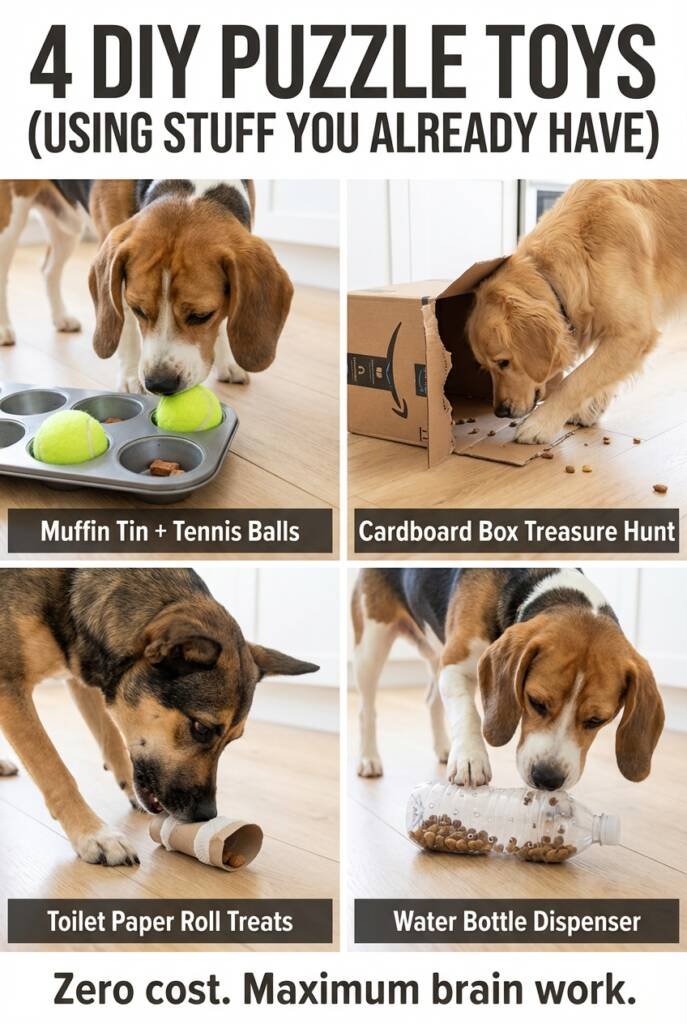
You don’t need to spend money on fancy puzzle feeders. Some of the best brain games for dogs can be made from stuff you already have in your recycling bin.
The idea is simple: make your dog work for their food. In the wild, dogs don’t eat from bowls — they forage, hunt, and problem-solve. Puzzle toys tap into those natural instincts, and the mental effort required to “solve” the puzzle leaves dogs genuinely tired.
Here are a few easy options:
- The muffin tin puzzle is a classic. Drop a treat or a few pieces of kibble into each cup of a muffin tin, then cover every cup with a tennis ball. Your dog has to figure out how to remove the balls to get to the food. Start with only half the cups covered so they can see and smell the exposed treats — this teaches them that good things are hiding under those balls.
- The cardboard box game is perfect for dogs who like to destroy things. Take an old Amazon box, toss in some treats or kibble, and let your dog tear it apart to find the food. You can make it harder by putting treats inside smaller boxes nested within the big one.
- Toilet paper roll treats take about 10 seconds to make. Drop a few treats inside an empty roll, fold or crimp both ends shut, and hand it over. Some dogs will delicately unfold the ends; others will shred the whole thing. Either way, they’re working for their reward.
- The plastic bottle dispenser turns an empty water bottle into a rolling treat toy. Cut a few small holes in the sides — big enough for kibble to fall out, but not so big that it pours out immediately. Fill it up and let your dog bat it around.
Pro tip: Always supervise your dog with DIY toys. Some dogs will try to eat the cardboard or chew through the plastic, which isn’t the goal. Remove the toy once the treats are gone.
3. Indoor Fetch With a Twist

Fetch doesn’t have to be an outdoor-only game. With the right setup and the right toys, you can get your dog moving without breaking any lamps.
The key is using soft, lightweight toys. A plush squeaky toy or a fabric ball won’t damage furniture or ricochet off walls the way a tennis ball might. If you have a long hallway, that’s your new fetch lane. Otherwise, clear some space in your largest room and keep throws low and controlled.
But here’s how you make indoor fetch actually tiring: add commands.
Instead of mindless throwing and retrieving, turn each rep into a mini training session. Ask for a “sit” and “stay” before you throw. Make your dog “wait” until you give the release word. When they bring the toy back, practice “drop it” before you throw again.
Now your dog isn’t just running back and forth — they’re thinking, listening, and exercising impulse control. That mental layer transforms a simple game into a genuine workout.
You can also mix up the toys. Use something that squeaks for one round, something with a different texture for the next. The novelty keeps your dog engaged longer.
Pro tip: Stop the game while your dog still wants more. If you play until they’re bored or exhausted, they’ll be less excited next time. Ending on a high note keeps fetch feeling like a special treat.
4. Staircase Workout
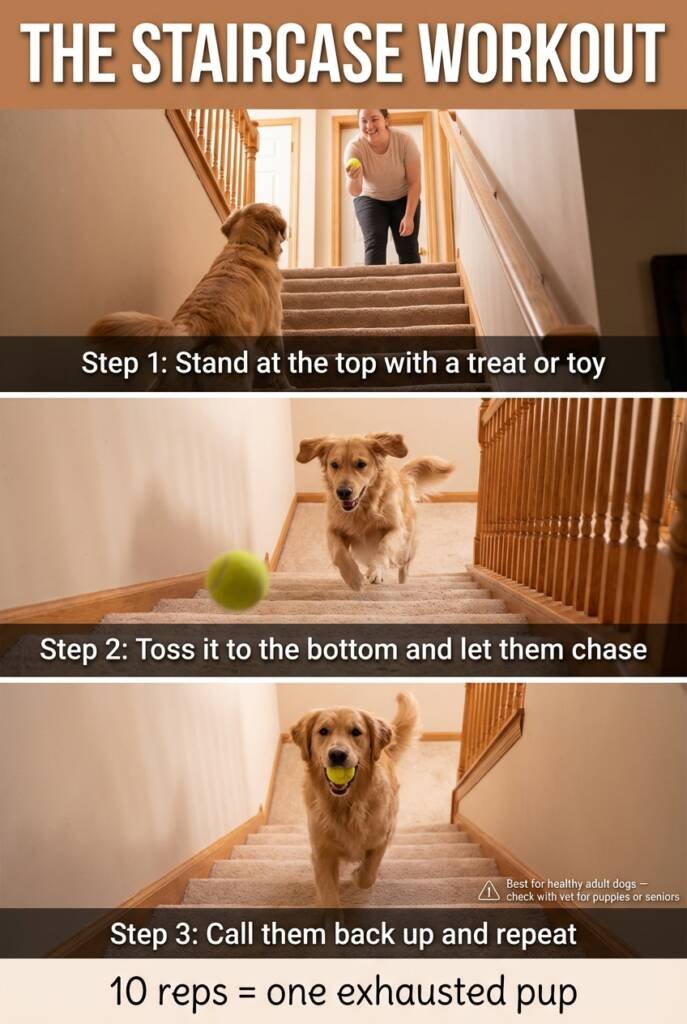
If you have stairs in your home, you have a built-in gym for your dog.
Running up and down stairs is intense. The constant elevation change works your dog’s legs, hips, shoulders, and core muscles in ways that flat-ground movement doesn’t. It’s also cardiovascularly demanding, which means your dog will tire out faster than you might expect.
The easiest way to do this: sit at the top of your stairs with a toy or some treats. Toss one down to the bottom and let your dog chase it. When they grab it (or eat the treat), call them back up to you. Repeat.
Ten to fifteen trips up and down is usually plenty. You’ll notice your dog starting to slow down, maybe panting a bit more. That’s your sign to wrap it up.
A few cautions here. This activity isn’t right for every dog. Puppies whose joints are still developing should avoid repetitive stair work — it can stress their growing bones and ligaments. Senior dogs or dogs with hip dysplasia, arthritis, or knee issues should also skip this one. When in doubt, check with your vet before adding stair workouts to your dog’s routine.
For healthy adult dogs, though, this is one of the fastest ways to burn off energy without leaving the house.
5. Hide and Seek (With You!)
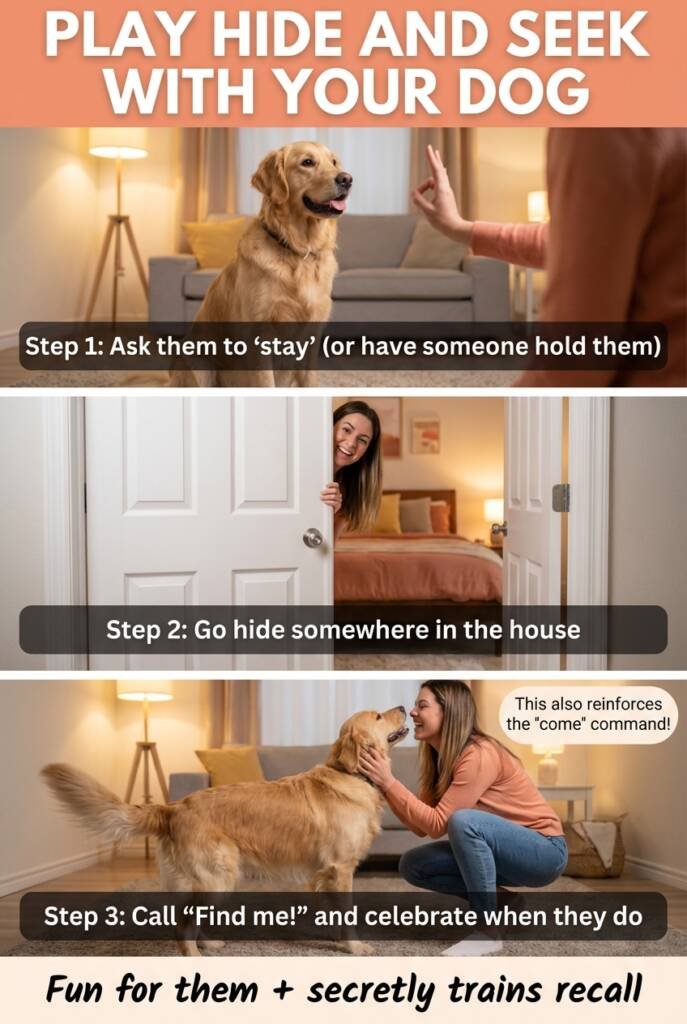
This childhood classic works just as well with dogs, and they absolutely love it.
Hide and seek combines everything that tires a dog out: mental problem-solving, physical movement through the house, and the joy of “finding” their favorite person. It also sneakily reinforces your recall command in a way that feels like play instead of training.
Here’s how to start. Ask your dog to “sit” and “stay” — or have another family member hold them while you hide. In the beginning, pick an easy spot. Stand behind a door that’s slightly open, or duck behind the couch where part of you is still visible. You want your dog to succeed quickly so they understand the game.
Once you’re hidden, call out “come!” or “find me!” in an excited voice. When your dog locates you, make it a big celebration. Treats, praise, excited petting — whatever makes your dog feel like they just won the lottery.
As your dog catches on, choose harder hiding spots. Go into a different room. Hide behind a shower curtain. Squeeze into a closet. Some dogs get surprisingly good at this game and will start checking all your usual spots, which means you’ll need to get creative.
If you have kids, this is a perfect rainy day activity for the whole family. Everyone takes turns hiding while the dog searches. Your dog gets worn out, your kids get entertained, and nobody is staring at a screen.
Pro tip: Hide and seek naturally teaches your dog that coming when called leads to good things. If you’re working on recall training, this game is one of the most effective (and fun) ways to reinforce it.
6. Teach a New Trick

Rainy days are perfect for training sessions. Your dog is stuck inside anyway, you’re probably not rushing off anywhere, and learning something new is one of the most mentally tiring things a dog can do.
Think about how you feel after a day of intense focus at work or studying for an exam. Your body didn’t run a marathon, but your brain is exhausted. Dogs experience the same thing. A 15-minute training session where they’re concentrating hard will leave them ready for a nap.
The trick you teach doesn’t have to be complicated. Here are some crowd-pleasers that most dogs can learn in a few sessions:
- “Spin” is a fun one. Hold a treat near your dog’s nose and slowly lure them in a circle. Once they complete the spin, say “yes!” and give them the treat. After a few repetitions, add the verbal cue “spin” right before you start the lure. Eventually, you can phase out the hand motion entirely.
- “High five” builds on “shake” if your dog already knows that one. Hold your hand up flat like you’re about to receive a high five, and wait. Most dogs will paw at your hand out of curiosity. The moment their paw touches your palm, mark it with “yes!” and reward.
- “Touch” teaches your dog to boop their nose to your hand on command. Hold your flat palm a few inches from your dog’s face. Most dogs will sniff it out of curiosity — when their nose makes contact, say “yes!” and treat. This one is incredibly useful for redirecting your dog’s attention or guiding them into position without pulling on a leash.
- “Put your toys away” is a more advanced trick that pays off big time. Teach your dog to pick up a toy, carry it to a basket, and drop it in. You’ll build this in stages — first rewarding the pickup, then rewarding movement toward the basket, then rewarding the drop. It takes patience, but imagine ending every play session with your dog tidying up after themselves.
The key to effective training sessions is keeping them short and positive. Ten to fifteen minutes is plenty. End while your dog is still engaged and succeeding — you want them to walk away feeling good, not frustrated.
Pro tip: Use high-value treats during training, something your dog doesn’t get every day. Small pieces of cheese, boiled chicken, or commercial training treats work well. The better the reward, the harder they’ll work.
7. Tug-of-War (Done Right)

Tug-of-war gets a bad reputation in some circles. You might have heard that it makes dogs aggressive or teaches them to challenge you. Fortunately, that’s mostly a myth. When played correctly, tug is a fantastic workout and a great bonding activity.
The physical benefits are obvious. Tug engages your dog’s whole body — jaw, neck, shoulders, core, and legs. It’s a full-strength workout in a very small space. Five to ten minutes of enthusiastic tugging will leave most dogs panting.
Here’s how to play it right.
- You start and end the game. Pick up the tug toy and invite your dog to play with an excited “get it!” or whatever cue you want to use. When you’re done, say “drop it” (more on that in a second) and put the toy away. This structure keeps the game feeling like a shared activity rather than a competition.
- Teach “drop it” as part of the game. During a pause in the action, hold a treat near your dog’s nose. Most dogs will release the toy to take the treat. The moment they let go, say “drop it” and reward. After practicing this a bunch, your dog will release on the verbal cue alone. Now you have a built-in off switch for the game.
- Let your dog win sometimes. Letting them “beat” you and parade around with the toy is fun for them and doesn’t undermine your relationship. Tug should feel like cooperative play, not a dominance struggle.
- Take breaks if things get too intense. Some dogs get over-aroused during tug and start getting mouthy or wild. If you notice your dog’s eyes getting hard, their body stiffening, or teeth landing on your hands instead of the toy, calmly end the game. Wait for them to settle down before starting again.
A note of caution: Tug isn’t the right game for every dog. If your dog has a history of resource guarding, aggression, or gets possessive over toys, skip this one. There are plenty of other activities on this list that will tire them out just as effectively.
8. DIY Indoor Obstacle Course
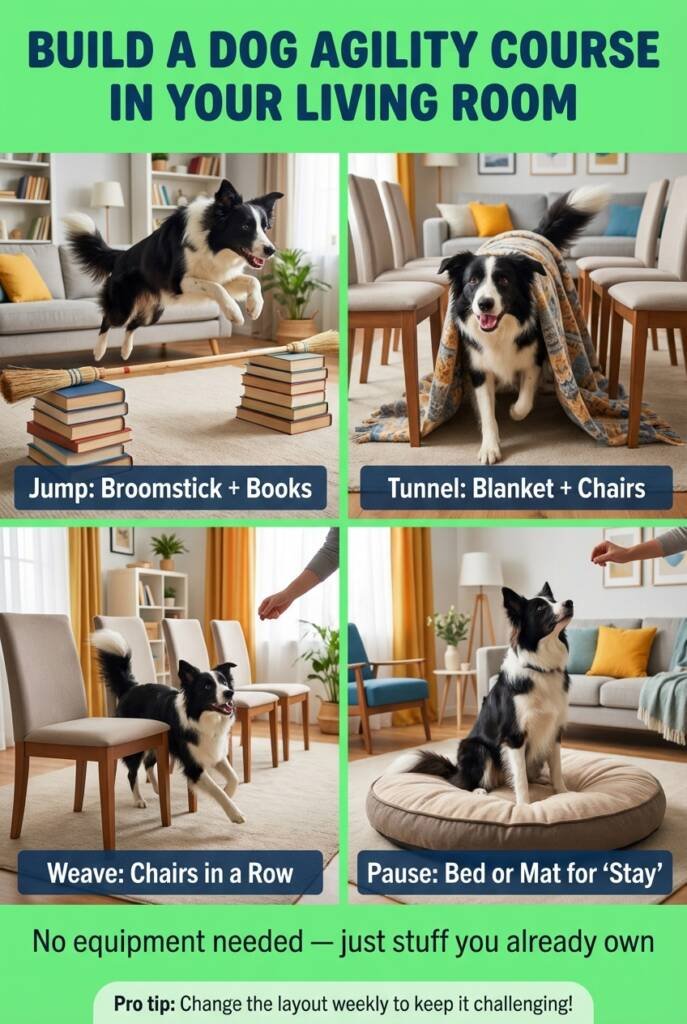
Turn your living room into an agility arena using furniture and household items. This activity combines physical exercise with mental focus as your dog navigates obstacles while following your cues.
You don’t need professional equipment. Here’s how to build a course with stuff you already own:
- Jumps can be as simple as a broomstick or mop handle balanced across two stacks of books or two sturdy chairs. Start with the bar low — just a few inches off the ground — so your dog gets the idea. Raise it gradually as they gain confidence.
- Tunnels are easy to improvise. Drape a blanket over a row of dining chairs to create a fabric tunnel your dog can run through. If you have a large cardboard box, cut the bottom out to make an instant tube. Some dogs take to tunnels immediately; others need a little coaxing with treats.
- Weave poles can be a line of dining chairs, tall books standing upright, or even plastic cones if you have them. Guide your dog through with a treat in your hand, weaving left and right between the obstacles.
- A pause station adds a training element. Designate a spot — a dog bed, a towel on the floor, or a yoga mat — where your dog has to stop and “sit” or “down” before continuing. This builds impulse control and gives them a mental challenge alongside the physical one.
Start by walking your dog through the course slowly, rewarding each obstacle they complete. Use a treat to lure them over the jump, through the tunnel, around the weave poles, and onto the pause station. Once they understand the sequence, you can speed things up. For extra fun, time your dog’s runs and try to beat their previous record. Just don’t sacrifice form for speed — you want them completing obstacles correctly, not cutting corners.
Pro tip: Change the course layout every so often. Dogs are smart, and once they memorize a route, it becomes less mentally stimulating. Rearranging the obstacles keeps things fresh.
Your Dog Doesn’t Need Sunshine to Sleep Well Tonight
Rainy days, snowstorms, extreme heat, or those weeks when your schedule just doesn’t allow for long walks — none of it has to mean a bored, destructive, or restless dog.
The activities on this list work because they engage your dog’s brain, not just their legs. Mental stimulation is exhausting in the best way. A dog who spends 20 minutes solving puzzles, learning tricks, or sniffing out hidden treats has genuinely worked for their rest.
You don’t need to do all eight activities in one day. Pick one or two that fit your dog’s personality and your available space. A high-energy herding breed might love the obstacle course and staircase workouts. A scent hound will go crazy for the “find it” game. A dog who loves to shred things will think the cardboard box puzzle is the greatest invention ever.
The goal isn’t to replicate an outdoor adventure. It’s to give your dog something meaningful to do with their energy and their mind. Try one of these today. Your dog — and your furniture — will thank you.
For more tips on keeping your furry friends happy and healthy, Sweet Purrfections is your go-to blog for all things pets.